All species › Passerines › Sunbirds › Oustalet's Sunbird
Oustalet's Sunbird | Cinnyris oustaleti
Angolahoningzuiger | Suimanga de Oustalet
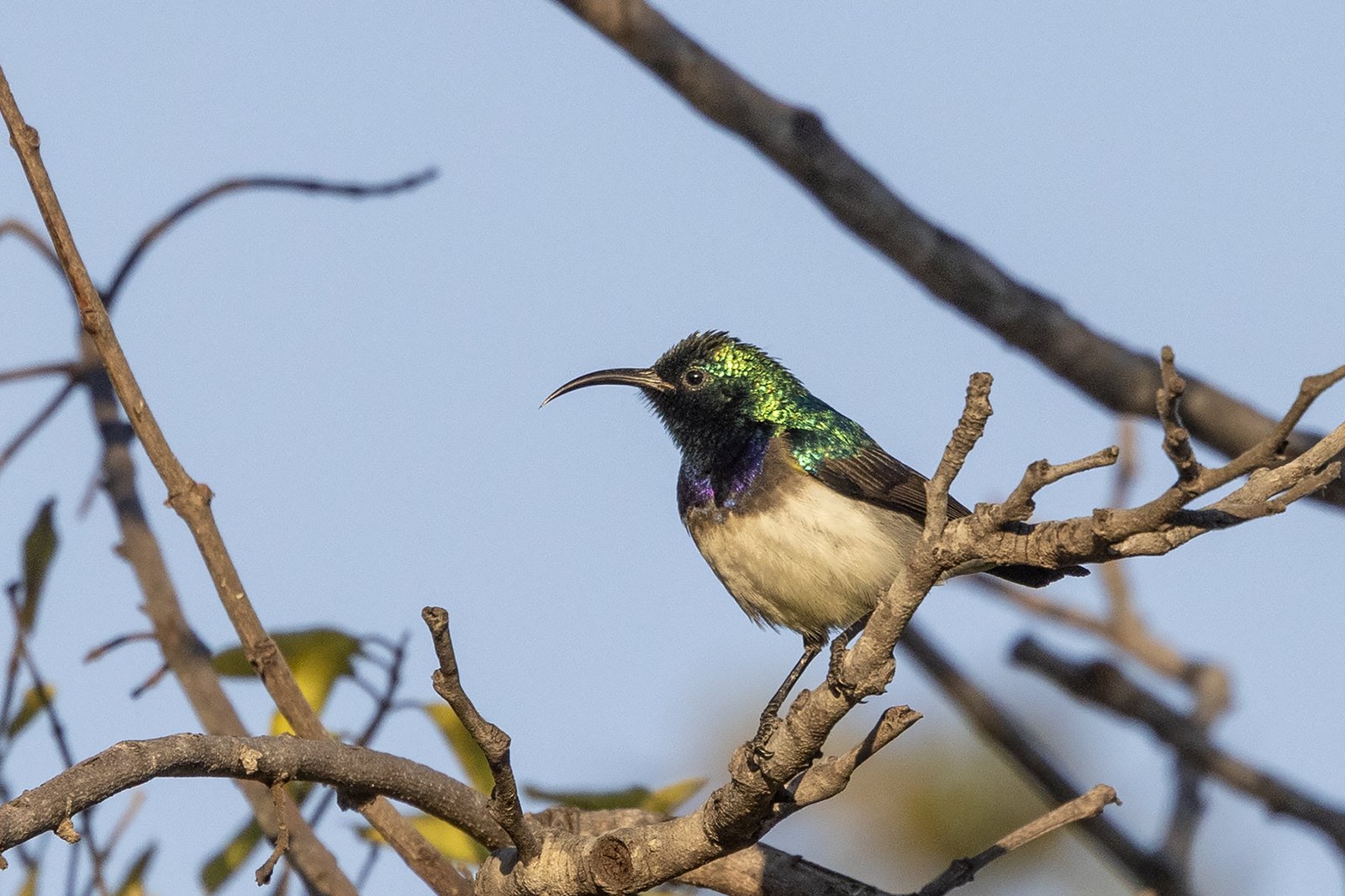
Oustalet's Sunbird is a small white-bellied sunbird with a fragmented range: the highlands of Angola and, as a separate subspecies, north-eastern Zambia and Malawi. The male closely resembles that of White-Bellied Sunbird.
Voice
Poorly described. The call is a high tchip; the song is a rapid, high twittering series, similar to but weaker than that of White-Bellied Sunbird.
Recording: He Wenjin/文进 — CC BY-NC-SA 4.0 · shortened to the first 60 s, mono · xeno-canto
Identification
10 to 11 cm, with a short, decurved bill. The male has a metallic green head, back and throat, a narrow glossy blue-purple breast band and a white belly; the pectoral tufts are orange and yellow. The breast band may merge into a thin, faint brownish fringe. The female is grey-brown above and dirty white to pale yellow below, without streaks. The eastern subspecies rhodesiae has a slightly broader, more purple band.
Confusion species
White-Bellied Sunbird (Cinnyris talatala) is slightly larger, has only yellow pectoral tufts and occurs in southern Angola and most of Zambia and Malawi; where both occur, the orange in the tufts is the only safe feature. Western Miombo Sunbird (Cinnyris gertrudis) and Eastern Miombo Sunbird (Cinnyris manoensis) have a red breast band and a grey belly. Females cannot reliably be told from those of White-Bellied Sunbird in the field.
Habitat
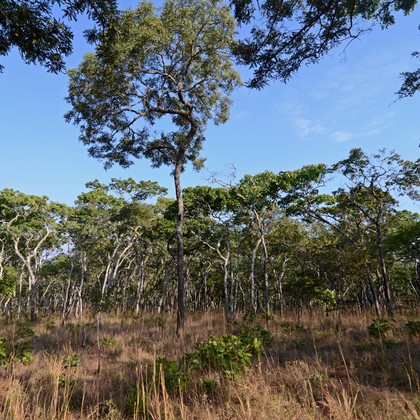
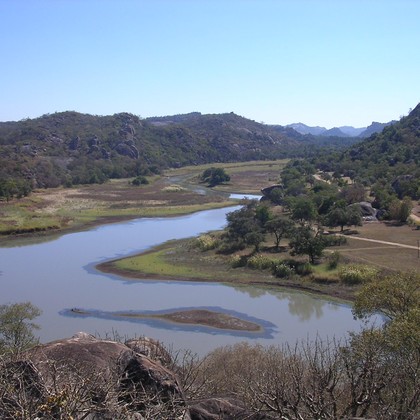
Open miombo and other broadleaved woodland, grassy savanna with scattered trees and bushes, dambo margins and forest edges in highlands, also scrub on slopes. It seeks out flowering shrubs and mistletoe.
Where the bird is most at home, classified by the vegetation units of southern Africa.
Range and movements
Two separate populations. The nominate form lives in the west-central highlands of Angola, from the Benguela escarpment and the Huíla plateau to Huambo and Bié. The subspecies rhodesiae lives in north-eastern Zambia, northern Malawi and extreme south-western Tanzania. Beyond the region possibly in southern DR Congo.
- Resident
- dark = core range, pale = thinly spread
How and when to look
In Angola best searched for on the Huíla plateau and around Huambo; in Zambia around Kasama and Mbala. Check every white-bellied male in these areas carefully and wait until it lifts its wings or displays: only then do the orange pectoral tufts show.
Conservation status
Not threatened. Locally fairly common but little studied; the trend is unknown. Conversion of miombo to cropland is a threat in parts of the range.
Scientific name
Cinnyris oustaleti | (Bocage, 1878)
Bocage described the species in 1878 as Nectarinia oustaleti; because it was later moved to another genus, the author and year stand in brackets. The genus Cinnyris was introduced in 1816 by Cuvier, GLCFD. Cinnyris derives from the Greek kinnuris, the name of a small bird mentioned by the lexicographer Hesychius that cannot be identified further. oustaleti honours the French zoologist Émile Oustalet (1844–1905), ornithologist at the natural history museum in Paris. The specimen the first description was based on came from Caconda, Huíla, Angola.