All species › Passerines › Chats and flycatchers › Kalahari Scrub Robin
Kalahari Scrub Robin | Cercotrichas paena
Kalahariwaaierstaart | Alzacola del Kalahari
The Kalahari Scrub Robin is the pale, sandy scrub robin of dry thornveld. It runs over bare ground between bushes with its tail cocked high and fanned, and is best known by the rufous tail with a black band and white tips.

Voice
The song is a series of clear, whistled phrases interspersed with chattering notes and mimicry, often from the top of a bush and also at dusk. The alarm is a dry, rattling tjrrr; there is also a sharp tchik.
Recording: Yoann Blanchon — CC BY-NC-SA 4.0 · converted to mono · xeno-canto
Identification
A slim, long-legged scrub robin of 17 cm. The upperparts are plain sandy to greyish brown, the rump and tail base warm rufous. The tail has a broad black band before the white tips, which show best when it fans the tail. A white supercilium and a dark eye-stripe mark the head; the underparts are white with buff breast and flanks and no streaking. The wing has only narrow pale fringes and lacks white wing bars. The sexes are alike. The tail is constantly cocked, often over the back, and the wings drooped.
Confusion species
White-Browed Scrub Robin (Cercotrichas leucophrys) is darker, has two white wing bars and, in the south, a clearly streaked breast; it lives in denser scrub and stays closer to cover. Karoo Scrub Robin (Tychaedon coryphoeus) is dark greyish brown with a white throat between dark malar stripes and a dark tail without rufous; the two meet only in the Northern Cape. Familiar Chat (Oenanthe familiaris) also has a rufous tail but lacks the supercilium, has dark central tail feathers and flicks its wings rather than fanning its tail.
Habitat
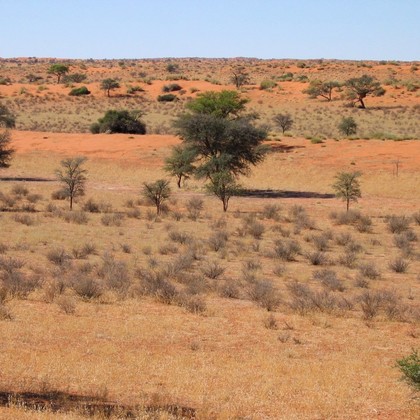
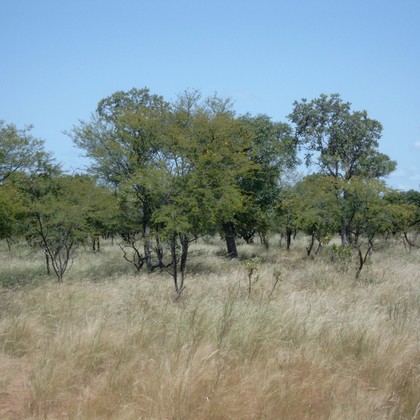
Dry thornveld and open savanna on sand, Kalahari dune veld with scattered Acacia bushes, transitions to Nama Karoo and bare, grazed ground around cattle posts. Forages on the ground for insects and other invertebrates, mostly in the shade of bushes.
Where the bird is most at home, classified by the vegetation units of southern Africa.

Range and movements
Endemic to southern Africa. Widespread in Namibia (except the coastal Namib Desert), central and southern Botswana, in South Africa in the Northern Cape, North West, western Free State and western Limpopo, and further in south-western Zimbabwe and south-western Angola. The species occurs nowhere outside this region.
- Resident
- Summer visitor (c. Oct–Mar)
- Winter visitor (c. Apr–Sep)
- Passage (Mar–Apr, Oct–Nov)
- dark = core range, pale = thinly spread
How and when to look
Search early in the morning along sandy tracks in the Kgalagadi or the Central Kalahari for a pale bird that runs over the ground, stops and fans its tail. The combination of unstreaked breast, no wing bars and the black tail band rules out White-Browed Scrub Robin. In the breeding season, mainly September to February, it sings conspicuously from bush tops.
Conservation status
Not threatened. The species is widespread and common in suitable habitat, and numbers appear stable. Moderate grazing and bush thickening in the thornveld tend to favour rather than harm this ground forager.
Scientific name
Cercotrichas paena | (Smith, 1836)
Smith described the species in 1836 as Erythropygia paena; because it was later moved to another genus, the author and year stand in brackets. The genus Cercotrichas was introduced in 1831 by Boie. Cercotrichas is Greek, from kerkos 'tail' and trikhas 'thrush'. paena comes from Phêna or Phênê, the Tswana name for this species; Andrew Smith (1836) deliberately adopted the local names as specific epithets. The specimen the first description was based on came from north of Kuruman, Northern Cape, South Africa.