All species › Bustards › Bustards and korhaans › Karoo Korhaan
Karoo Korhaan | Heterotetrax vigorsii
Zwartkintrap | Sisón del Karroo
The Karoo Korhaan is the typical small bustard of the Karoo: a greyish-brown, finely marked bird that is barely noticeable among the dwarf shrubs until a pair gives its frog-like duet at dusk. It is almost endemic to South Africa and southern Namibia.

Voice
A deep, croaking, frog-like duet, wrok-wrok-wrak, the partners alternating rapidly; mainly at dawn and dusk and audible far across the plain.
No recording with a suitable Creative Commons licence is available for this species yet.
Identification
Medium-sized, 56–60 cm. The plumage is grey-brown to sandy, finely streaked and vermiculated dark above and plainer grey on neck and breast. Distinctive are a black chin and throat patch edged with white and a dark spot on the nape. The belly is greyish white, the bill and legs yellowish. The sexes are similar; the female is slightly smaller and browner, with less contrast in the throat patch. In flight the primaries are dark without much white.
Confusion species
Rüppell's Korhaan (Heterotetrax rueppelii) of the Namib is paler and sandier, with a narrow black stripe down the centre of the foreneck and more black and white on the face; intermediate birds occur in southern Namibia. The Blue Korhaan (Eupodotis caerulescens) has a blue-grey belly and a white cheek. Ludwig's Bustard (Neotis ludwigii) is much larger, with a rufous hindneck.
Habitat
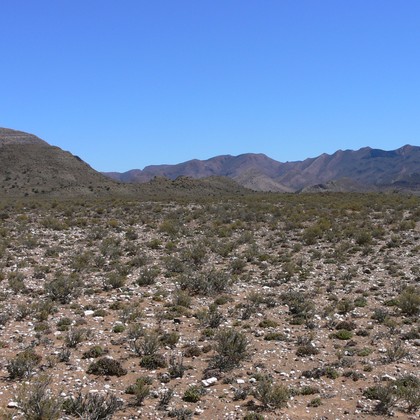
Dwarf-shrub plains of the Nama and Succulent Karoo, renosterveld and fynbos margins, also stony hills and lightly grazed land. It eats insects, especially beetles, termites and grasshoppers, as well as seeds, flowers and leaves of Karoo plants.
Where the bird is most at home, classified by the vegetation units of southern Africa.


Range and movements
Almost endemic to the region: the Karoo and Namaqualand in the Western, Northern and Eastern Cape and the south-western Free State in South Africa, and southern Namibia, where it grades northwards into Rüppell's Korhaan.
- Resident
- Summer visitor (c. Oct–Mar)
- Winter visitor (c. Apr–Sep)
- Passage (Mar–Apr, Oct–Nov)
- dark = core range, pale = thinly spread
How and when to look
Drive the Karoo roads early in the morning, for example in Karoo National Park near Beaufort West or around Calvinia and Sutherland, and listen for the croaking duet. Pairs and small groups walk slowly among the shrubs; stop and scan carefully, as the camouflage is excellent.
Conservation status
Not threatened and still common in the Karoo. Overgrazing causes local disturbance, and this bustard too dies in collisions with wires and fences, but its habitat is largely intact.
Scientific name
Heterotetrax vigorsii | (Smith, 1831)
Smith described the species in 1831 as Otis Vigorsii; because it was later moved to another genus, the author and year stand in brackets. The genus Heterotetrax was introduced in 1894 by Sharpe. Heterotetrax comes from the Greek heteros, 'different', and tetrax, an ancient game bird (now the name of the Little Bustard) — a 'different' small bustard. vigorsii honours the Irish zoologist and politician Nicholas Aylward Vigors (1785–1840), co-founder of the Zoological Society of London. The specimen the first description was based on came from South Africa.