All species › Bustards › Bustards and korhaans › Rüppell's Korhaan
Rüppell's Korhaan | Heterotetrax rueppelii
Rüppells trap | Sisón de Damaraland
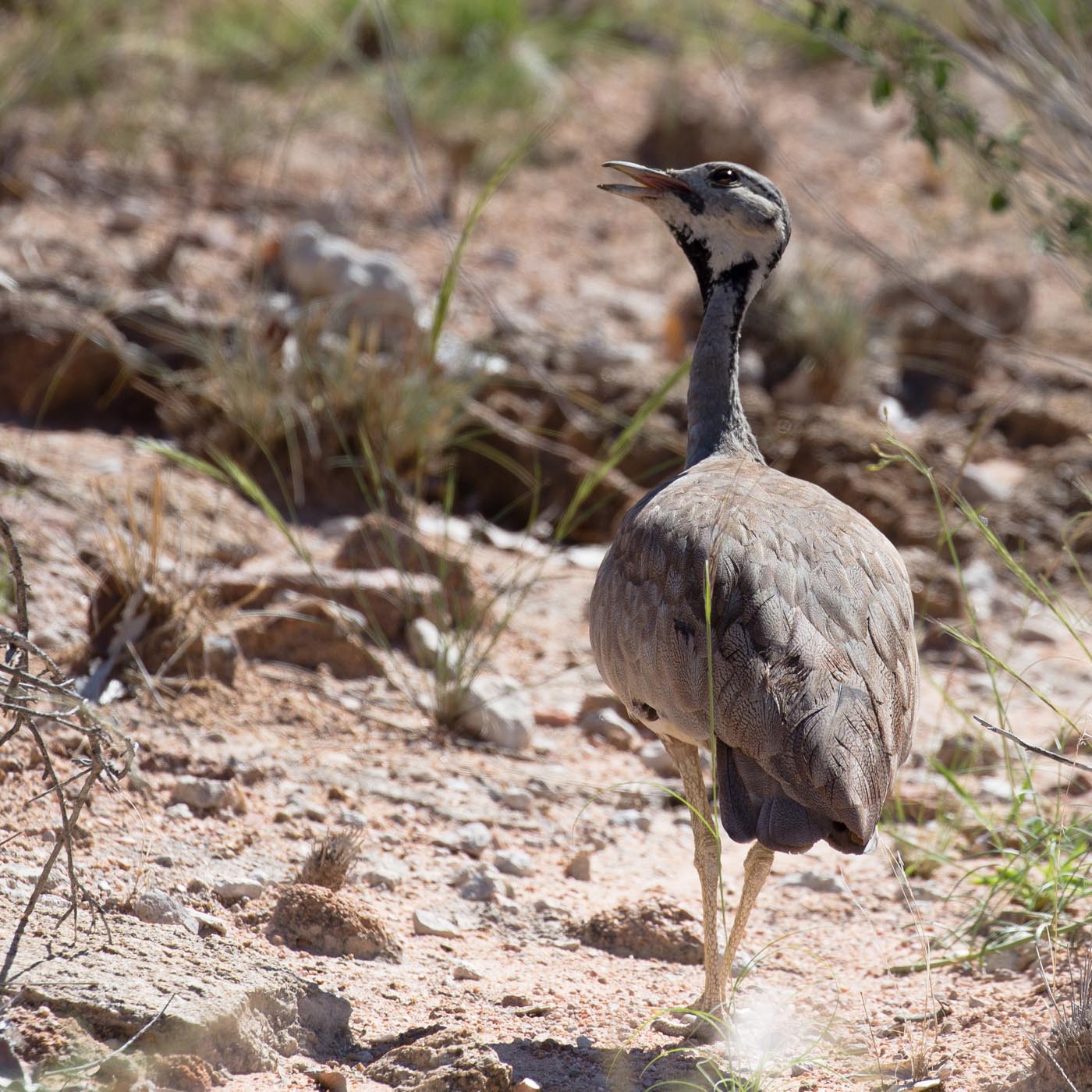
Rüppell's Korhaan is the pale desert bustard of the Namib, almost entirely confined to Namibia and the far south-west of Angola. Pairs walk across bare gravel plains with barely a blade of grass and draw attention there with their loud, rattling duet.
Voice
A loud, rasping, croaking duet, karrak-karrak-karrak, mainly at dawn, the partners alternating rapidly; audible far across the open plain.
No recording with a suitable Creative Commons licence is available for this species yet.
Identification
Medium-sized, 54–60 cm. Pale sandy to greyish beige, the upperparts finely vermiculated and less boldly marked than in the Karoo Korhaan. The neck is pale grey with a narrow black stripe down the centre of the foreneck, joining a black throat patch. The face is grey with black-and-white markings around eye and cheek and a dark line over the crown. The belly is white, the legs yellowish. The female has less black on throat and neck.
Confusion species
The Karoo Korhaan (Heterotetrax vigorsii) is darker and browner, without the narrow black stripe down the foreneck; intermediates between the two occur in southern Namibia. Ludwig's Bustard (Neotis ludwigii) shares the Namib margins but is much larger, with a rufous hindneck.
Habitat
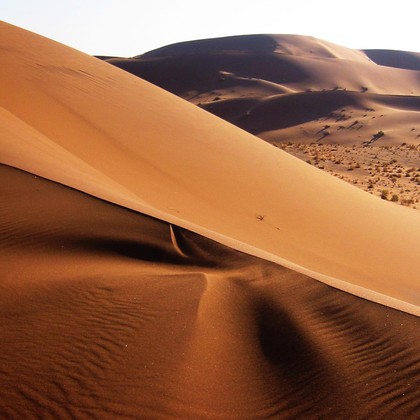
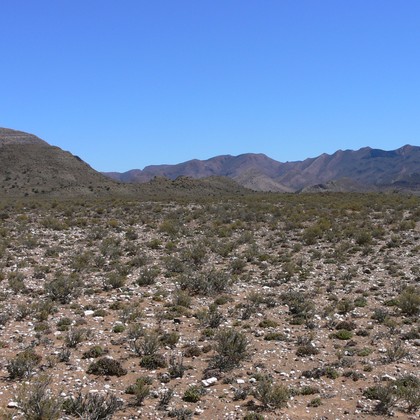
Bare and sparsely vegetated gravel plains, sandy flats with tufted grass and the margins of the Namib Desert and pro-Namib, also dry riverbeds and the low hills of the interior. It eats insects, especially beetles and termites, as well as seeds and greens after rain.
Where the bird is most at home, classified by the vegetation units of southern Africa.
Range and movements
Almost endemic to the region: the Namib and pro-Namib of Namibia, from the south around Aus north through the Kaokoveld into south-western Angola (Namibe). In southern Namibia it grades into the Karoo Korhaan.
- Resident
- Winter visitor (c. Apr–Sep)
- Passage (Mar–Apr, Oct–Nov)
- dark = core range, pale = thinly spread
How and when to look
The gravel plains of Namib-Naukluft Park, for example along the road between Solitaire and Walvis Bay and around Ganab, and the plains east of Swakopmund are reliable. Scan the horizon with a telescope and listen for the duet at dawn.
Conservation status
Not threatened. The desert habitat is little used and lies largely within protected areas. Disturbance from off-road vehicles and mining plays a local role.
Scientific name
Heterotetrax rueppelii | (Wahlberg, 1856)
Wahlberg described the species in 1856 as Otis Rüppelii; because it was later moved to another genus, the author and year stand in brackets. The genus Heterotetrax was introduced in 1894 by Sharpe. Heterotetrax comes from the Greek heteros, 'different', and tetrax, an ancient game bird (now the name of the Little Bustard) — a 'different' small bustard. rueppelii honours the German explorer and naturalist Eduard Rüppell (1794–1884), known for his travels in north-east Africa. The specimen the first description was based on came from Onanis, Damaraland, Namibia.