All species › Bustards › Bustards and korhaans › Blue Korhaan
Blue Korhaan | Eupodotis caerulescens
Blauwe trap | Sisón Azulado
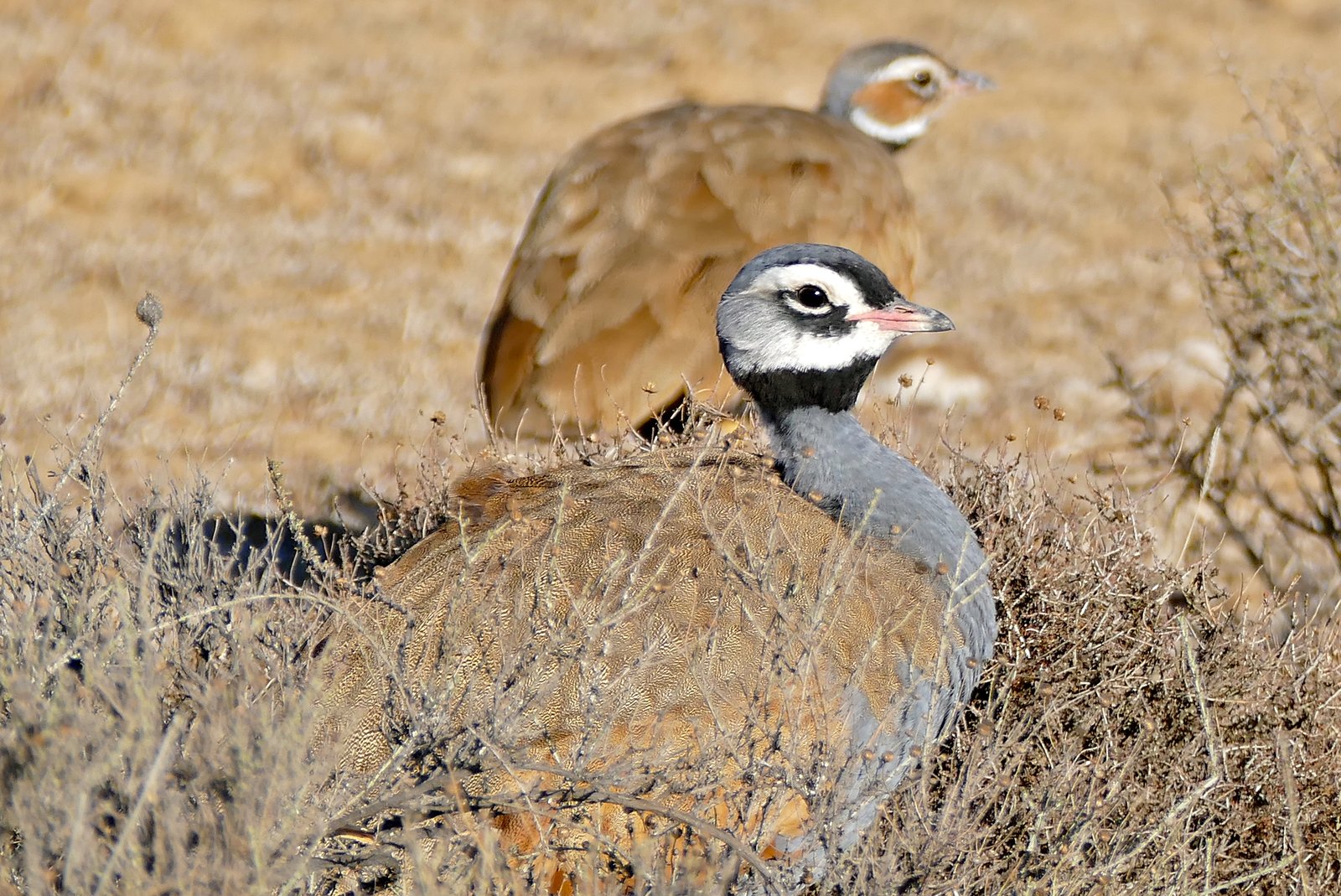
The Blue Korhaan is an endemic small bustard of the highveld of South Africa and Lesotho, the only one with an entirely blue-grey neck and underparts. It lives in small family groups whose loud, rhythmic croaking fills the grassland.
Voice
Very vocal, especially at dawn and dusk: a loud, croaking, rhythmic krok-kaa-krok-kaa-krok, often in duet or by the whole group, carrying far across the grassland.
Recording: Rick Nuttall — CC BY-NC-SA 4.0 · shortened to the first 60 s, mono · xeno-canto
Identification
Medium-sized, 50–58 cm. Neck, breast and belly slate to blue-grey, back and wings warm brown with fine dark markings. The male has a black crown, a white cheek bordered behind by a black line and a black throat; the female has a brown crown and cheek with less contrast. In flight the flight feathers are dark with blue-grey undersides. The legs are yellowish.
Confusion species
The White-Bellied Bustard (Eupodotis senegalensis) has a white belly, a more orange-brown back and, in the male, a black throat patch with a blue foreneck; the two overlap on the eastern highveld. The Karoo Korhaan (Heterotetrax vigorsii) of the Karoo is greyish brown, without a blue belly, and has a black chin patch. No other bustard in the region has wholly blue-grey underparts.
Habitat
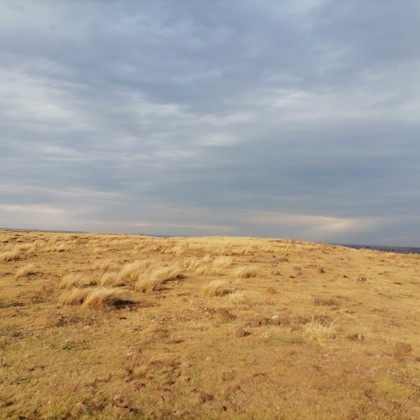
Open, short highveld grassland with few trees, often on gently rolling plains and also in pastures and around fields, at 1200–2100 m. It eats insects, especially termites, beetles and grasshoppers, as well as seeds and greens.
Where the bird is most at home, classified by the vegetation units of southern Africa.

Range and movements
Endemic to the region: the highveld of South Africa in the Free State, Mpumalanga, southern Gauteng, the north-eastern Eastern Cape and western KwaZulu-Natal, and western Lesotho. Found nowhere else in the world.
- Resident
- Summer visitor (c. Oct–Mar)
- dark = core range, pale = thinly spread
How and when to look
Drive through the highveld around Wakkerstroom, Memel or Volksrust early in the morning and listen for the croaking chorus; groups of two to five birds then often walk close to the road. They are tame from a vehicle.
Conservation status
Near Threatened. The highveld is being converted on a large scale to cropland, plantations and mining, fragmenting suitable grassland; the species tolerates pasture but not closed cropland. Collisions with wires also play a part. The world population is estimated at 8000–10,000 mature birds.
Scientific name
Eupodotis caerulescens | (Vieillot, 1820)
Vieillot described the species in 1820 as Otis Caerulesens; because it was later moved to another genus, the author and year stand in brackets. The genus Eupodotis was introduced in 1839 by Lesson. Eupodotis comes from the Greek eu, 'good', pous (podos), 'foot', and ōtis, 'bustard' — for the sturdy, well-developed legs. caerulescens is Latin for 'bluish' — for the blue-grey neck and underparts. The specimen the first description was based on came from Eastern Cape, South Africa.