All species › Bustards › Bustards and korhaans › White-Bellied Bustard
White-Bellied Bustard | Eupodotis senegalensis
Senegaltrap | Sisón Senegalés
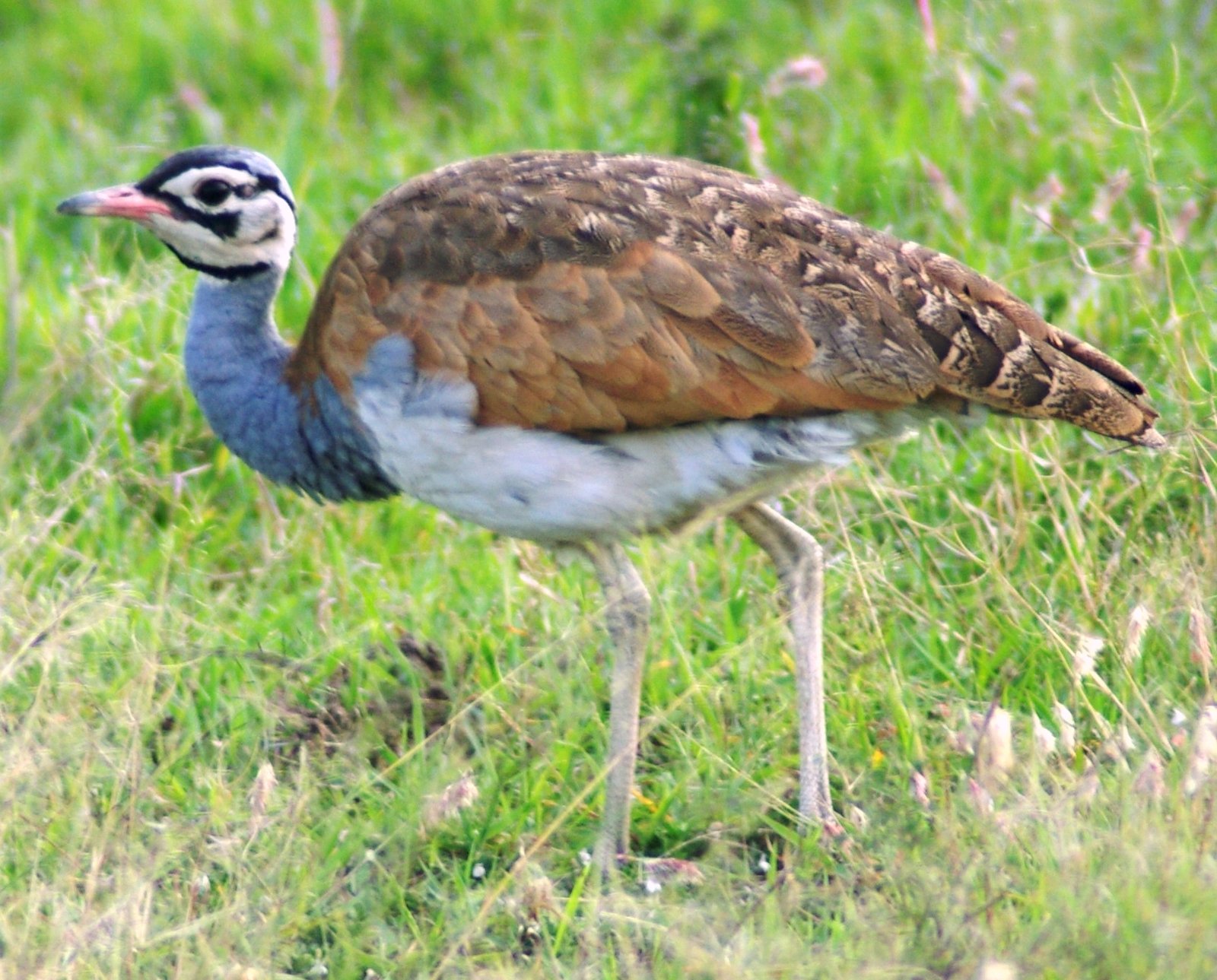
The White-Bellied Bustard is a slim, medium-sized bustard with a white belly and blue-grey neck, widespread across the African savanna belt. Southern Africa holds the subspecies barrowii, often treated as a separate species, Barrow's Korhaan, in tall grassland in the east.
Voice
A loud, croaking, repeated takwarat-takwarat, often in duet at dawn and dusk, carrying far across the grassland.
Recording: isaac kilusu — CC BY-NC-SA 4.0 · converted to mono · xeno-canto
Identification
Medium-sized and slender, 52–61 cm. Back and wings orange-brown to ochre with fine dark vermiculation, belly pure white. The male has a blue-grey foreneck, a black throat patch, a black border around a blue-grey crown and a white cheek; the female has a brown neck without black and less marked head pattern. The bill is pink with a dark tip, the legs yellowish. In flight, dark primaries contrast with a paler wing.
Confusion species
The Blue Korhaan (Eupodotis caerulescens) has wholly blue-grey underparts without a white belly and a darker brown back. The Red-Crested Korhaan (Lophotis ruficrista) and Northern Black Korhaan (Afrotis afraoides) have black bellies. The Black-Bellied Bustard (Lissotis melanogaster) is larger, with a long thin neck and, in the male, a black belly.
Habitat
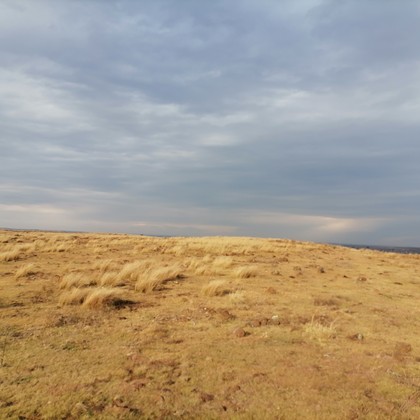
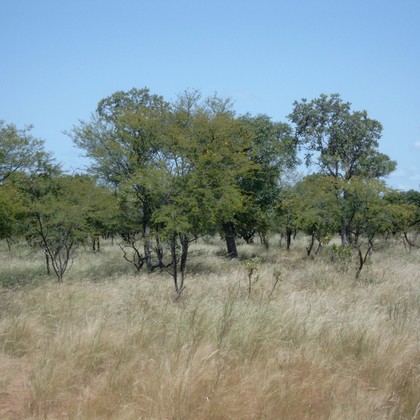
Tall, open grassland and grassy, lightly wooded savanna, typically with longer grass than the Blue Korhaan uses, sometimes near fields and pastures. It eats insects, especially grasshoppers and beetles, as well as seeds, flowers and berries.
Where the bird is most at home, classified by the vegetation units of southern Africa.

Range and movements
Within the region two separate populations: in South Africa in the grasslands of Mpumalanga, eastern Gauteng, the eastern Free State and KwaZulu-Natal into Eswatini, and in Angola on the central and south-western plateau. Beyond the region across the savanna belt from Senegal to Ethiopia and south through East Africa to Tanzania.
- Resident
- Winter visitor (c. Apr–Sep)
- Passage (Mar–Apr, Oct–Nov)
- dark = core range, pale = thinly spread
How and when to look
Search the taller, rougher grasslands of Mpumalanga, for example around Dullstroom, Lydenburg and Wakkerstroom, and northern KwaZulu-Natal. Listen at twilight for the croaking duet; in tall grass the birds are hard to see and are often noticed only when standing close to the road.
Conservation status
Not globally threatened, but the South African population is small and declining through conversion of grassland to crops and plantations, overgrazing and frequent burning. Within South Africa the species is therefore on the regional Red List.
Scientific name
Eupodotis senegalensis | (Vieillot, 1820)
Vieillot described the species in 1820 as Otis Senegalensis; because it was later moved to another genus, the author and year stand in brackets. The genus Eupodotis was introduced in 1839 by Lesson. Eupodotis comes from the Greek eu, 'good', pous (podos), 'foot', and ōtis, 'bustard' — for the sturdy, well-developed legs. senegalensis means 'from Senegal', where the first specimen came from. The specimen the first description was based on came from Senegal.