All species › Passerines › Thrushes › Kurrichane Thrush
Kurrichane Thrush | Turdus libonyana
Kurrichanelijster | Zorzal de Kurrichane
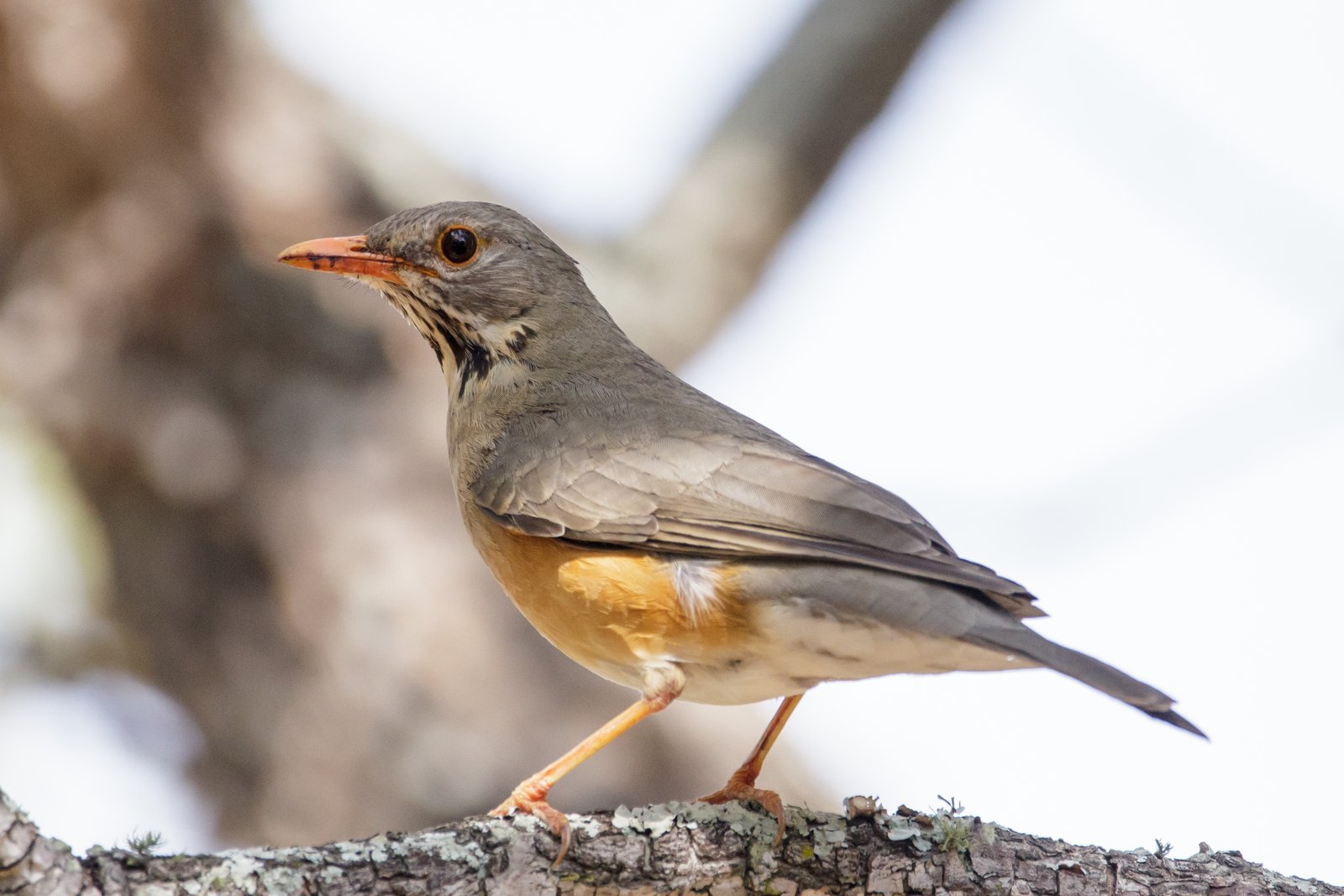
The Kurrichane Thrush is the thrush of the bushveld: a grey-brown bird with a bright orange bill and black moustachial stripes, running over bare ground beneath the trees. Its clear, descending whistle is one of the characteristic sounds of savanna woodland and gardens in the north of the region.
Voice
The call is a loud, clear, descending whistle pee-oo-weet or peet-peeoo, often at dusk, and is highly distinctive. The song is a varied series of melodious whistles and chattering phrases, including mimicry of other birds, mainly in spring and early summer. In alarm a sharp chik-chik.
Recording: Ehren Eksteen — CC BY-NC-SA 4.0 · converted to mono · xeno-canto
Identification
A medium-sized thrush of 21 to 22 cm. The upperparts are plain grey-brown and the white throat has two conspicuous black malar stripes. The breast is pale grey, the flanks orange and the belly white. The bill is bright orange, the legs pale brown, and there is a narrow orange eye-ring. The sexes are alike. Juveniles have pale spots on the upperparts and black spots on the breast and flanks.
Confusion species
Olive Thrush (Turdus olivaceus) is darker olive-brown, lacks the black malar stripes and has an orange belly; it lives mainly in montane forest and gardens of the Highveld and the Cape. African Thrush (Turdus pelios) of northern Angola, Zambia and Malawi is paler, with a yellow bill, pale flanks and at most faint throat streaks. Groundscraper Thrush (Turdus litsitsirupa) is spotted and stands upright on open ground. Karoo Thrush (Turdus smithi) of the dry west is dark grey without malar stripes.
Habitat
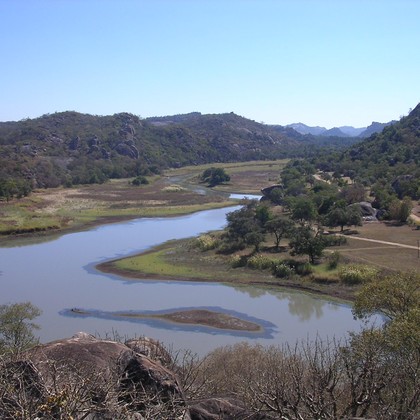
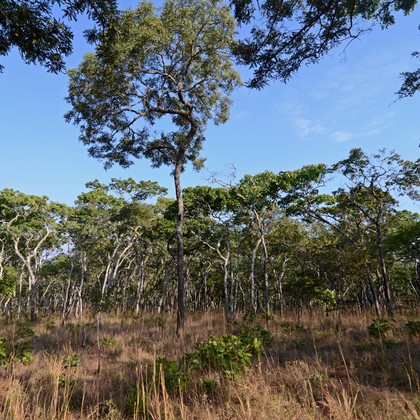
Dry and moist savanna woodland, miombo, mixed bushveld, riverine woodland and, in the south, also gardens, parks and farmyards with large trees. Forages on the ground for insects, worms and snails, often on bare patches under trees, and also eats fruit. The nest is a cup of grass and mud in a tree fork or on a branch.
Where the bird is most at home, classified by the vegetation units of southern Africa.

Range and movements
Widespread in the northern and eastern parts of the region: Angola (except the arid south-west), Zambia, Malawi, Mozambique, Zimbabwe, northern and eastern Botswana, north-eastern Namibia including the Caprivi, and in South Africa in Limpopo, Mpumalanga, North West, Gauteng and northern KwaZulu-Natal, as well as Eswatini. Beyond the region it reaches southern DR Congo and Tanzania.
- Resident
- Summer visitor (c. Oct–Mar)
- Winter visitor (c. Apr–Sep)
- Passage (Mar–Apr, Oct–Nov)
- dark = core range, pale = thinly spread
How and when to look
Listen at dawn and dusk for the descending pee-oo-weet, which gives the bird away long before you see it. Then check bare ground under trees in camps and lodges. In Pretoria and Johannesburg Kurrichane and Olive Thrush overlap: the white belly and black malar stripes make Kurrichane Thrush instantly recognisable.
Conservation status
Not threatened. The species is common and widespread, has spread on the Highveld with the growth of gardens and parks, and the population is stable. It disappears locally where savanna woodland is cleared for charcoal and farming.
Scientific name
Turdus libonyana | (Smith, 1836)
Smith described the species in 1836 as Merula Libonyana; because it was later moved to another genus, the author and year stand in brackets. The genus Turdus was introduced in 1758 by Linnaeus. Turdus is the ordinary Latin word for 'thrush'. libonyana derives from lebonyana, the Tswana name for Red-billed Buffalo Weaver — apparently transferred to this thrush by Andrew Smith. The specimen the first description was based on came from Kaditshwene ('Kurrichane'), near Zeerust, South Africa.