All species › Passerines › Indigobirds and whydahs › Cuckoo-Finch
Cuckoo-Finch | Anomalospiza imberbis
Koekoekswever | Viuda Anómala
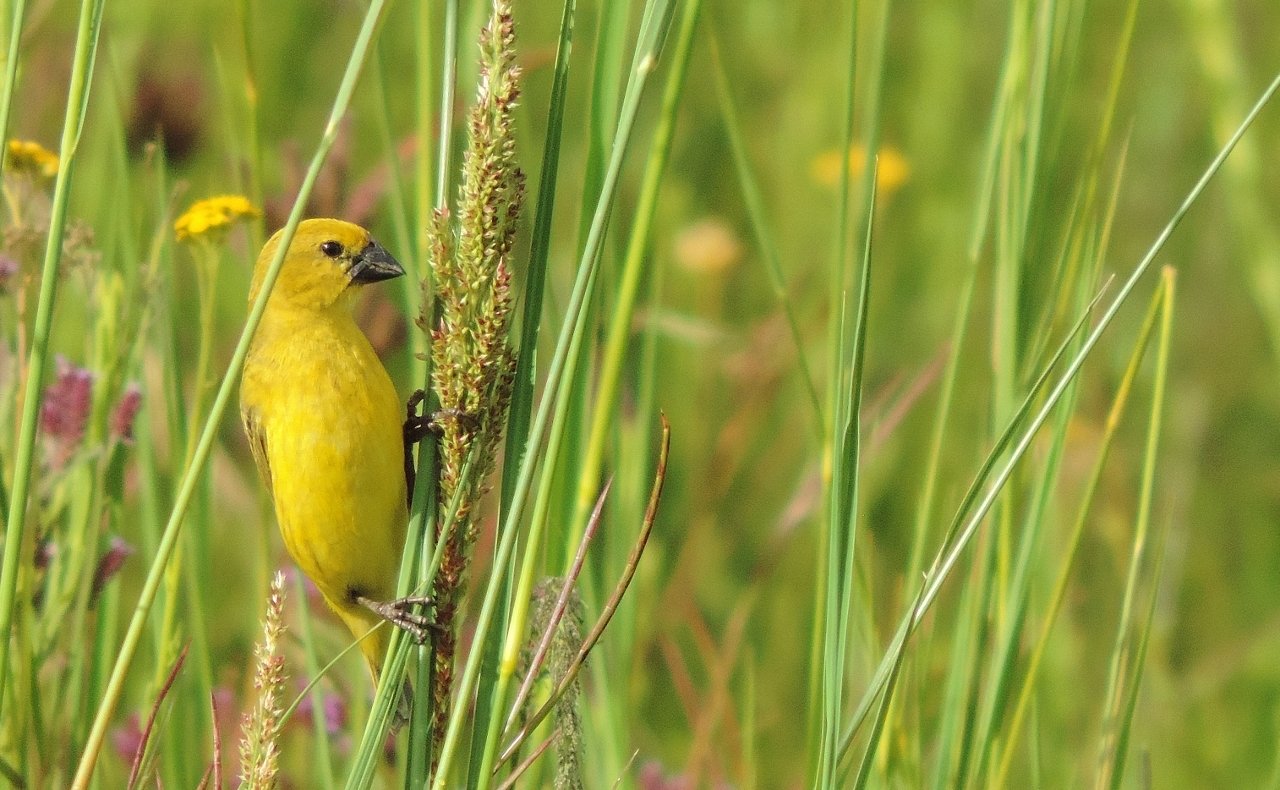
The Cuckoo-Finch is a stocky, thick-billed brood parasite of grasslands and vleis that lays its eggs in the nests of cisticolas and prinias. It was long placed with the weavers, but is the closest relative of the whydahs and indigobirds and the only member of its genus.
Click a thumbnail to switch the photo above.
Voice
The song is a soft, thin twittering of sizzling and squeaky notes, tsi-tsi-tseeuw, delivered from a grass stem or wire. The call is a short, dry chip or dzip, mainly in flight.
Recording: Niall Perrins — CC BY-NC-SA 4.0 · converted to mono · xeno-canto
Identification
12–13 cm, compact with a short tail and a strikingly short, deep, black conical bill with a strongly curved culmen. The breeding male is bright canary-yellow on the head and underparts, with an olive-green, black-streaked mantle and a greenish-yellow streaked crown. The female is brown with dark streaking on crown and back, and pale yellowish-buff below with fine streaks on breast and flanks; her bill is dark horn. The non-breeding male resembles the female but often keeps a yellow wash on face and breast. Juveniles are warmer brown and unstreaked below. It often perches upright on grass stems, fences and wires and moves about in small, sometimes large flocks.
Confusion species
The male may suggest Yellow-Fronted Canary (Crithagra mozambica) or Yellow Canary (Crithagra flaviventris), but these have a finer, pale bill and a different head pattern, and the female Southern Masked Weaver (Ploceus velatus) is longer and more slender-billed. The female closely resembles females of Southern Red Bishop (Euplectes orix) and Yellow-Crowned Bishop (Euplectes afer), but the Cuckoo-Finch has a shorter, deeper bill with a strongly arched culmen and more yellowish ground colour. Even in mixed bishop flocks, the blunt bill is the best clue.
Habitat
Open moist grassland, grassy vleis and dambos, marsh edges, fallow fields and grain crops, also grassy open savanna. It eats seeds, mainly of grasses, on the ground and from the seedheads. It lays one or two eggs per host nest, mainly with Tawny-Flanked Prinia (Prinia subflava) and cisticolas such as Zitting Cisticola (Cisticola juncidis), Desert Cisticola (Cisticola aridulus), Croaking Cisticola (Cisticola natalensis) and Levaillant's Cisticola (Cisticola tinniens). The chicks closely resemble those of the host and are raised alongside the host young.
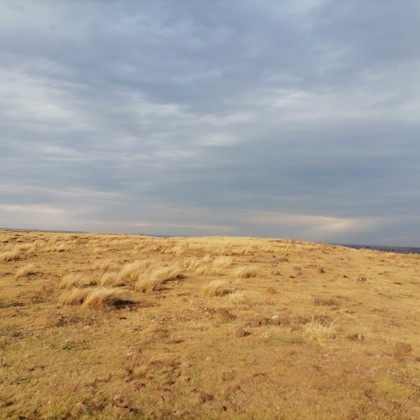
Where the bird is most at home, classified by the vegetation units of southern Africa.


Range and movements
Local and irregular in the east and north of the region: eastern South Africa (Mpumalanga, Gauteng, KwaZulu-Natal, Limpopo), Eswatini, Zimbabwe, Mozambique, Malawi, Zambia and Angola; scarce in northern Botswana and the Zambezi Region of Namibia. It is absent from the arid west. Beyond the region it is scattered and patchy across sub-Saharan Africa, from West Africa to Ethiopia and Kenya.
- Summer visitor (c. Oct–Mar)
- Passage (Mar–Apr, Oct–Nov)
- dark = core range, pale = thinly spread
How and when to look
In late summer, from January to April, check moist grasslands and vleis for flocks of small yellow and brown birds: among bishops and widowbirds the Cuckoo-Finch stands out by its short, thick bill and stocky build. Breeding males sing from tall grass stems and wires. Because the species is highly nomadic, it may be numerous one year and almost absent the next.
Conservation status
Not threatened, but scarce and local in southern Africa. The loss of moist grassland to agriculture, afforestation and drainage reduces its habitat, while grain fields locally provide food.
Scientific name
Anomalospiza imberbis | (Cabanis, 1868)
Cabanis described the species in 1868 as Crithagra imberbis; because it was later moved to another genus, the author and year stand in brackets. The genus Anomalospiza was introduced in 1901 by Shelley. Anomalospiza comes from the Greek anōmalos, 'abnormal, irregular', and spiza, 'finch' — for the unusual features of this brood parasite among finch-like birds. imberbis is Latin for 'beardless' — probably because the bird lacks the moustachial stripe of the canaries with which Cabanis placed it. The specimen the first description was based on came from Mombasa, Kenya.