All species › Passerines › Indigobirds and whydahs › Long-Tailed Paradise Whydah
Long-Tailed Paradise Whydah | Vidua paradisaea
Smalstaartparadijswida | Viuda del Paraíso
The Long-Tailed Paradise Whydah is the paradise whydah of dry thornveld: the breeding male trails a huge, tapering black tail. A brood parasite, it lays its eggs only with the Green-Winged Pytilia, whose song the male also copies.

Voice
The male's song is a mixture of its own high, sizzling notes and accurate imitations of the calls and song of the Green-Winged Pytilia, such as a soft, burbling cheep-cheep-chrrr. The call is a sharp chip.
Recording: Andrew Spencer — CC BY-NC-SA 4.0 · converted to mono · xeno-canto
Identification
15–38 cm; the body measures 15 cm, and the breeding male adds four elongated central tail feathers: a short, broad pair with a thread-like tip and a very long pair of 20–25 cm that is broad at the base and tapers to a point. Head, throat, back and tail are black, the nape golden-yellow to cream, the breast warm chestnut and the belly creamy white. Bill and legs are dark. The female and the non-breeding male are sparrow-like brown with dark streaking on the back, pale buff below and with a bold black-and-white striped head: a pale crown stripe, black lateral crown stripes and a black eye-stripe. Their bill is dark grey. During moult (May–June and November) males with half-grown tails and blotchy heads are seen.
Confusion species
Broad-Tailed Paradise Whydah (Vidua obtusa) has a shorter tail that is broad along its whole length with a blunt tip, and a darker, more chestnut breast with a narrower yellow nape band; it lives mainly in miombo. Long-Tailed Widowbird (Euplectes progne) is much larger and all black with a red and buff shoulder patch. The female resembles that of Pin-Tailed Whydah (Vidua macroura) and Shaft-Tailed Whydah (Vidua regia), but these have a red or pink bill; the female Broad-Tailed Paradise Whydah is practically inseparable in the field.
Habitat
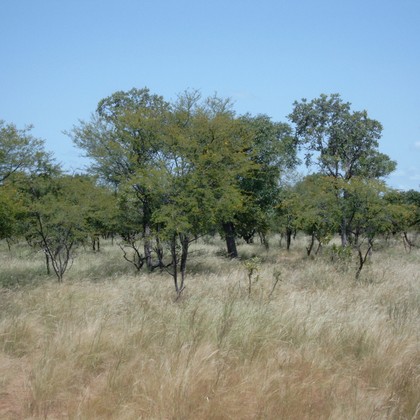
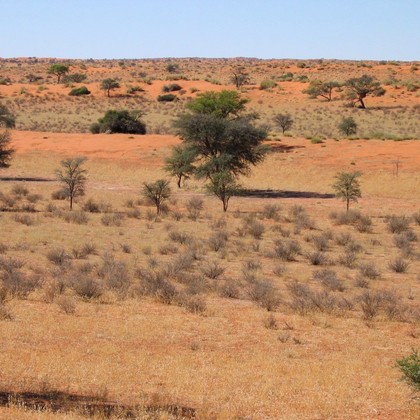
Dry acacia savanna, thornveld, Kalahari thornveld and mopane woodland, often near water and on bare patches among grass. It feeds on seeds from the ground, usually with waxbills and other seedeaters. It lays its eggs in the nests of Green-Winged Pytilia (Pytilia melba); the chicks share the mouth markings of the host young and are raised alongside them.
Where the bird is most at home, classified by the vegetation units of southern Africa.

Range and movements
Widespread in the dry savanna of the north of the region: northern South Africa (Limpopo, North West, Mpumalanga, northern KwaZulu-Natal and the Kalahari in the Northern Cape), Eswatini, Botswana, northern and central Namibia, Zimbabwe, southern and central Mozambique, southern Zambia, Malawi and southern Angola. Beyond the region it ranges through East Africa to South Sudan, Ethiopia and Somalia.
- Resident
- Summer visitor (c. Oct–Mar)
- Winter visitor (c. Apr–Sep)
- Passage (Mar–Apr, Oct–Nov)
- dark = core range, pale = thinly spread
How and when to look
January to April in Kruger, the Waterberg or the Kalahari, when the males carry their full tails. The displaying male flies high and undulating with the tail raised as a stiff plume, or hovers above the female; this makes him recognisable at great distance. Where a Green-Winged Pytilia sings, a paradise whydah is rarely far away.
Conservation status
Not threatened and common in suitable savanna. It is trapped for the cage-bird trade, but this has no noticeable effect on numbers.
Scientific name
Vidua paradisaea | (Linnaeus, 1758)
Linnaeus described the species in 1758 as Emberiza paradisaea; because it was later moved to another genus, the author and year stand in brackets. The genus Vidua was introduced in 1816 by Cuvier, GLCFD. Vidua is the Latin word for 'widow'. paradisaea is Latin for 'of paradise' — for the breeding male's magnificent long tail feathers. The specimen the first description was based on came from Angola.