All species › Birds of prey › Hawks, eagles and kites › Lappet-Faced Vulture
Lappet-Faced Vulture | Torgos tracheliotos
Oorgier | Buitre Orejudo
The Lappet-Faced Vulture is the largest and most powerful vulture in Africa, with a bare red head with hanging skin folds and an enormous, deep bill. At a carcass it dominates the other vultures and tears open tough hide and sinew that the smaller species cannot manage.

Voice
Mostly silent. At carcasses a low growling, hissing and bark-like sounds when displacing other vultures.
No recording with a suitable Creative Commons licence is available for this species yet.
Identification
About 105 cm, wingspan nearly three metres. The head and neck are bare and deep pink to red, with large skin folds ('lappets') on the sides of the head. The bill is very heavy, horn-coloured to yellowish with a dark tip. The body is dark brown with long, lanceolate breast feathers falling over a pale, downy base; the thighs are feathered white. The legs are grey. The sexes are alike; the female is slightly larger. Juveniles are uniformly dark brown with a pinkish-grey head and brown thighs, and acquire the white thighs and red head only after six years or more. In flight note the very broad, rectangular wings, the short wedge-shaped tail and a narrow white line along the leading edge of the underwing, with the white thighs as pale patches under the body.
Confusion species
White-Headed Vulture (Trigonoceps occipitalis) is smaller with a white, triangular head, a red bill and a white belly. White-Backed Vulture (Gyps africanus) and Cape Vulture (Gyps coprotheres) have a long neck with a ruff and a grey or bluish head, and pale underwing coverts contrasting with the dark flight feathers. Young Lappet-Faced Vultures may resemble a dark young White-Backed Vulture, but the massive bill and the broad, rectangular wings settle it.
Habitat
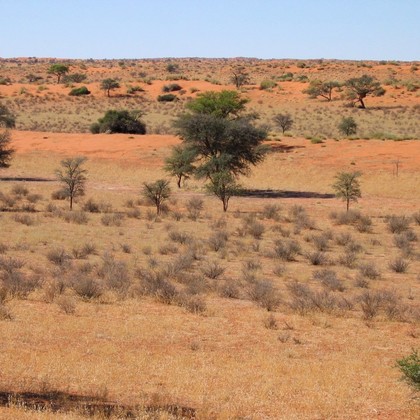
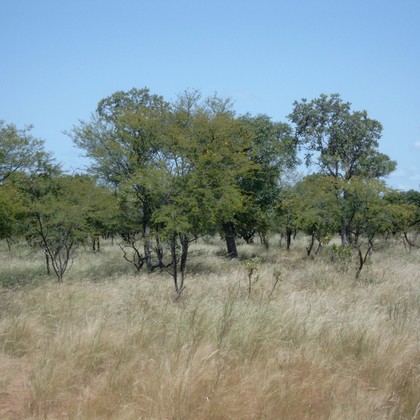
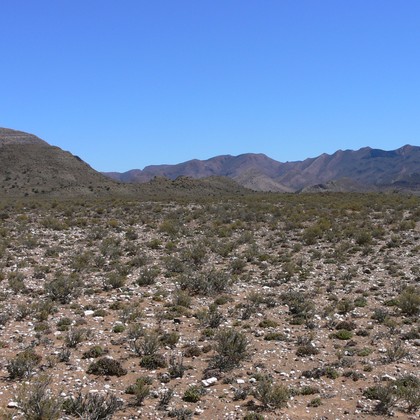
Dry savanna, Kalahari thornveld, semi-desert and the edges of the Namib, also open plains in wetter savanna country; avoids dense woodland and high mountains. It eats carrion, especially skin, sinew and bone, but also kills small animals and robs other raptors. It nests solitarily on a large, flat stick nest on top of a flat-crowned acacia; breeding takes place in the dry season.
Where the bird is most at home, classified by the vegetation units of southern Africa.
Range and movements
Within the region commonest in Namibia (especially in the west and along the edges of the Namib) and Botswana, and also in Zimbabwe, Zambia, southern Angola and Mozambique; very scarce in Malawi. In South Africa confined to the Kgalagadi Transfrontier Park and the Northern Cape, Kruger National Park and surroundings, and a small population in northern KwaZulu-Natal; also in Eswatini. Beyond the region across East Africa to Egypt, in the Sahel and in Arabia, but it has declined steeply or disappeared from much of West Africa.
- Resident
- Summer visitor (c. Oct–Mar)
- Winter visitor (c. Apr–Sep)
- Passage (Mar–Apr, Oct–Nov)
- dark = core range, pale = thinly spread
How and when to look
Search the Kgalagadi, Etosha, the Namib-Naukluft and northern Kruger. At a carcass the Lappet-Faced Vulture usually stands aside until the first scramble is over and then walks up to the carcass, whereupon the smaller vultures give way. In flight it is recognised by its enormous plank-like wings and the way the head sits deep between the shoulders.
Conservation status
Endangered on the Red List. The population has fallen steeply within a few generations through poisoning, both incidental from poison laid for jackals and cats and deliberate by poachers, trade in vulture parts for traditional use, collisions with power lines and drowning in farm reservoirs. Ringing programmes and anti-poisoning projects are running in Namibia and South Africa.
Scientific name
Torgos tracheliotos | (Forster, 1796)
Forster described the species in 1796 as Vultur tracheliotus; because it was later moved to another genus, the author and year stand in brackets. The genus Torgos was introduced in 1828 by Kaup. Torgos is an ancient Greek word for 'vulture'. tracheliotos comes from Greek trachēlos, 'neck', and ous, ōtos, 'ear' — for the skin folds ('ears') on the sides of the bare neck. The specimen the first description was based on came from Great Namaqualand, Namibia.