All species › Birds of prey › Hawks, eagles and kites › White-Headed Vulture
White-Headed Vulture | Trigonoceps occipitalis
Witkopgier | Buitre Cabeciblanco
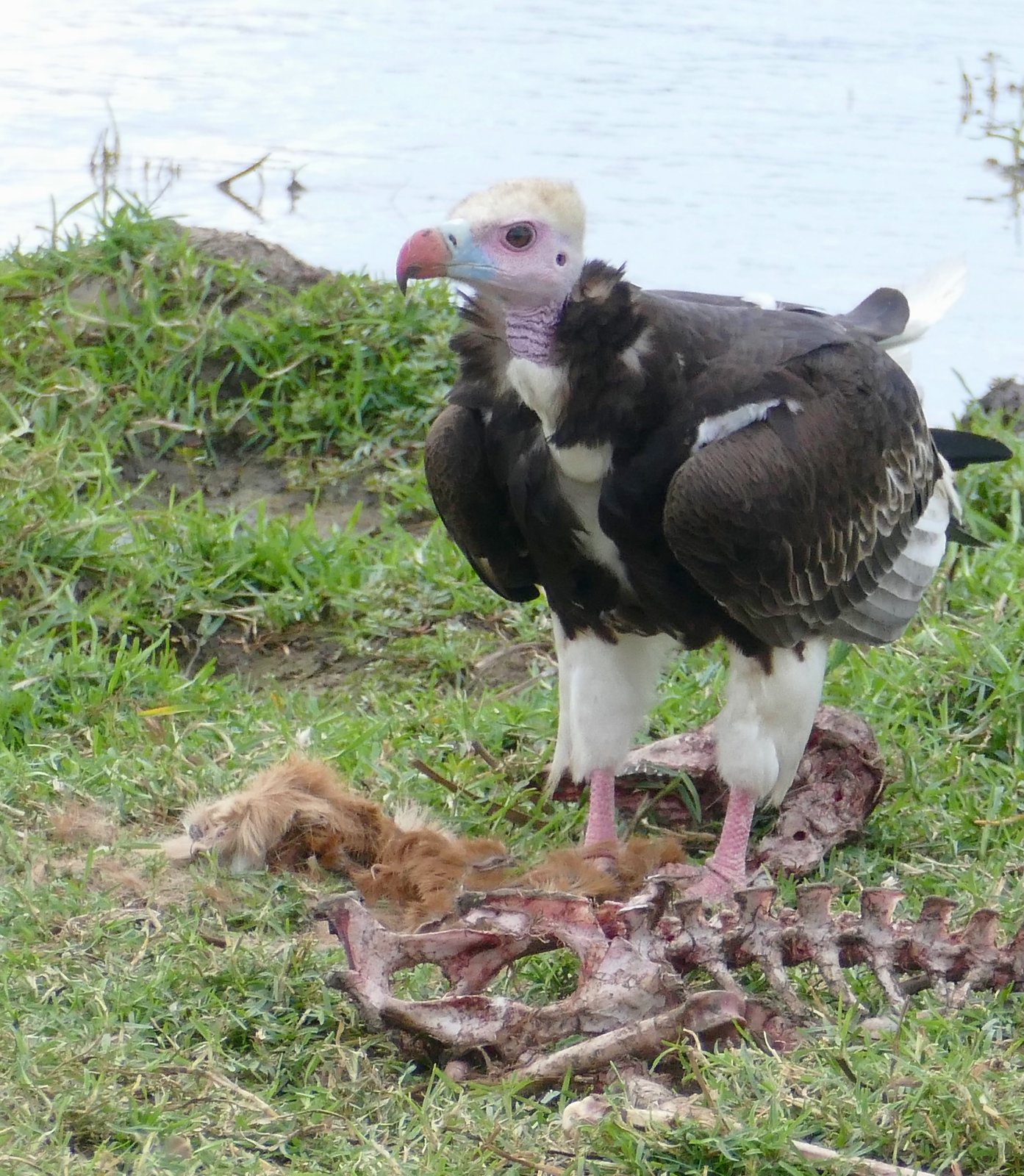
The White-Headed Vulture is a medium-sized, strikingly patterned vulture with a triangular white head, a red bill with a blue cere and a pink face. Unlike most vultures it lives in fixed pairs in its own territory and is often first at a carcass, although it then yields to the larger species.
Voice
Silent. At carcasses sometimes a high chittering and hissing sounds when squabbling with other vultures.
No recording with a suitable Creative Commons licence is available for this species yet.
Identification
About 80 cm, wingspan more than two metres. The head is large and angular, covered in white down that forms a small crest. The bill is bright orange-red with a pale blue base, the face pink. The body is blackish-brown with a white belly and white thighs, and the legs are pink. The sexes are easily told in flight: the female has white inner secondaries, the male dark ones, and both show a narrow white line across the underwing. Juveniles are uniformly dark brown with a brown head and attain adult plumage in five to six years; they too have the red bill. In flight the white belly against the dark wings and the angular, projecting head stand out.
Confusion species
Lappet-Faced Vulture (Torgos tracheliotos) is much larger, with a bare red head with skin folds, and has only white thighs, not a white belly. White-Backed Vulture (Gyps africanus) has a long neck with a bare grey head and a dark bill. Palm-Nut Vulture (Gypohierax angolensis) is white with black wingtips and a yellow-and-red face, and is tied to palms along the coast and rivers. The patterned head with the red bill and the white belly are distinctive.
Habitat
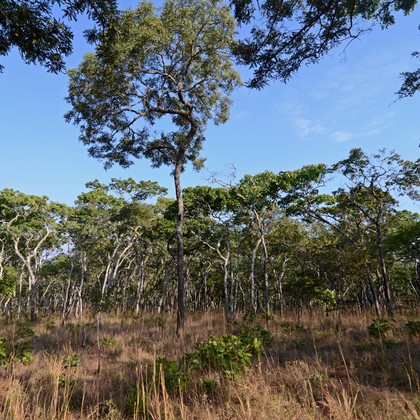
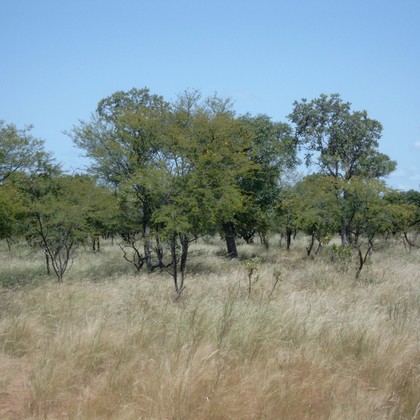
Low-lying savanna and woodland with tall trees, especially mopane, miombo and mixed thornveld; often uses more densely wooded terrain than other vultures. It eats carrion but also kills prey itself, such as young antelopes, flamingos and large lizards, and often takes the smaller carcasses that large vulture groups miss. It nests solitarily on a stick platform at the top of a large tree such as a baobab or acacia.
Where the bird is most at home, classified by the vegetation units of southern Africa.

Range and movements
Thinly distributed through the savannas of the north and east of the region: Angola, Zambia, Malawi, Mozambique, Zimbabwe, northern Botswana and northern Namibia (including Etosha and the Zambezi Region). In South Africa almost confined to Kruger National Park and adjoining reserves and to northern KwaZulu-Natal; rare in Eswatini. Beyond the region across the savanna belt of sub-Saharan Africa, from Senegal to Ethiopia and Tanzania, but scarce almost everywhere.
- Resident
- Summer visitor (c. Oct–Mar)
- Winter visitor (c. Apr–Sep)
- Passage (Mar–Apr, Oct–Nov)
- dark = core range, pale = thinly spread
How and when to look
Search large protected areas such as Kruger, Hwange, South Luangwa and Etosha. At a carcass look at the edges of the group and in the surrounding treetops: White-Headed Vulture often lands first and keeps its distance from the jostling White-Backed Vultures. Pairs often fly together, so female and male can be compared side by side in flight.
Conservation status
Critically Endangered on the Red List, after a steep and rapid decline across almost its entire range. The main causes are poisoning, especially by poachers who kill vultures with poisoned carcasses so as not to be betrayed, together with the use of vulture parts in belief-based practices, habitat loss and the decline of game outside protected areas. The southern African population depends largely on large national parks.
Scientific name
Trigonoceps occipitalis | (Burchell, 1824)
Burchell described the species in 1824 as Vultur occipitalis; because it was later moved to another genus, the author and year stand in brackets. The genus Trigonoceps was introduced in 1842 by Lesson. Trigonoceps comes from Greek trigonos, 'triangular', and -ceps, 'head' — for the angular head with its high, flat crown. occipitalis is Latin for 'of the back of the head', from occiput — for the white, downy hindcrown. The specimen the first description was based on came from Makkwari (Matlowing River), Botswana.