All species › Birds of prey › Hawks, eagles and kites › Bateleur
Bateleur | Terathopius ecaudatus
Bateleur | Águila Volatinera
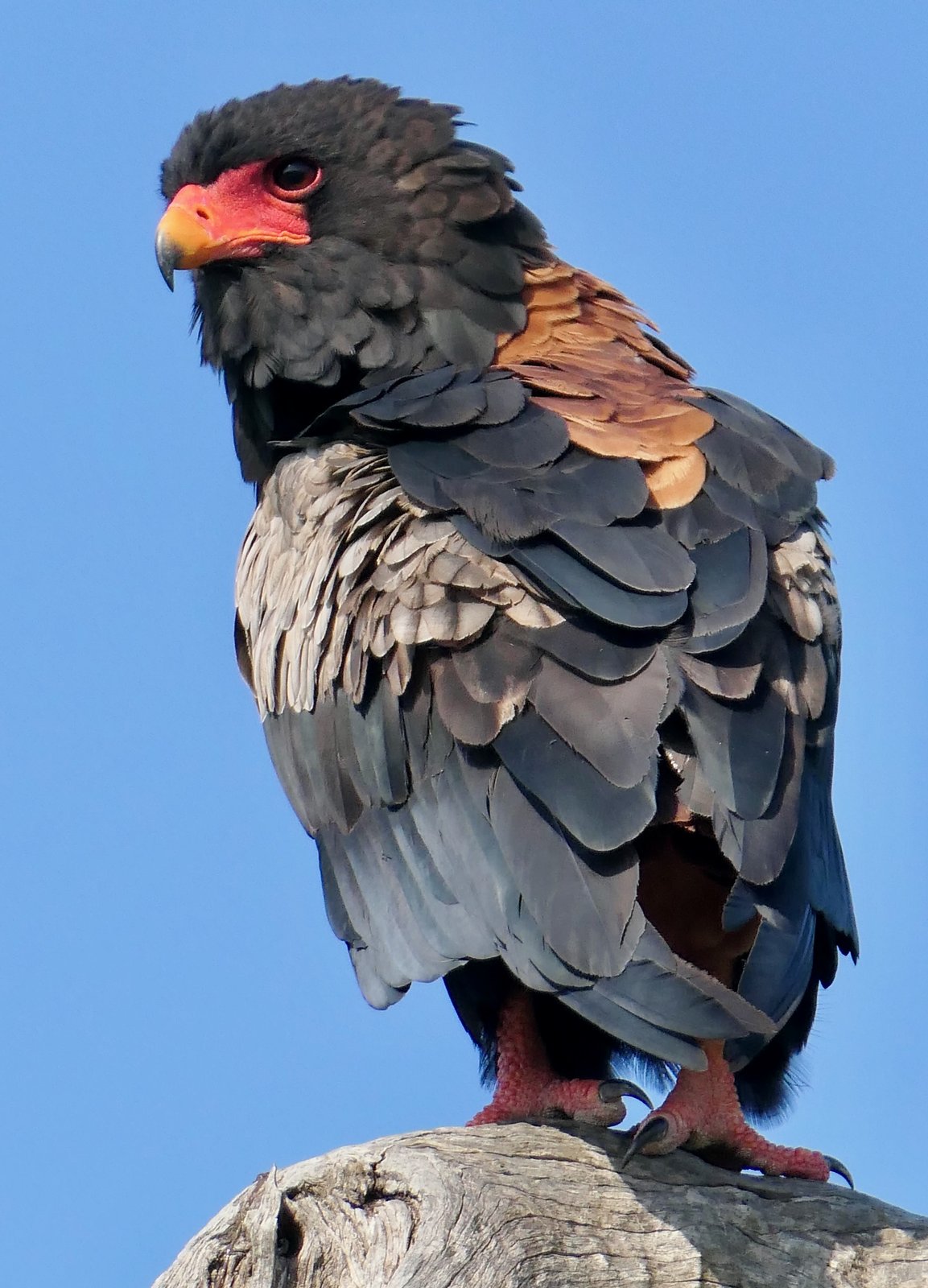
The Bateleur is the acrobat among African eagles: for hours it glides low over the savanna on long, slightly upswept wings, with a tail so short that the bird looks almost tailless in the air. With its red face and legs and its black-and-chestnut plumage it can hardly be confused in the field.
Voice
Mostly silent. Occasionally a loud, barking kow-aow or a hoarse, swelling schaaaa-aw, mainly in the breeding season and around the nest. During display the bird claps its wings audibly.
Recording: Vikram — CC BY-NC-SA 4.0 · converted to mono · xeno-canto
Identification
55–70 cm, wingspan 160–180 cm. The adult is black with a chestnut back and tail, greyish-brown wing coverts and bare bright red facial skin and red legs; a rare form has a cream rather than chestnut back. The tail is extremely short; in flight the feet project beyond it. From below the underwing coverts are white. The male has a broad black trailing edge to the wing; the female a narrow black trailing edge and grey secondaries, which form a grey panel on the upperwing. Juveniles are plain brown with greenish to bluish-grey facial skin and a slightly longer tail; adult plumage is reached only after seven or eight years, through mottled intermediate stages. In flight the bird constantly tilts from side to side and rarely flaps.
Confusion species
Adults are unmistakable. The brown juvenile recalls Brown Snake Eagle (Circaetus cinereus) or Tawny Eagle (Aquila rapax), but always shows the short tail, the long wings tapering towards the rear and the rocking flight; Brown Snake Eagle has a round head with large yellow eyes and a longer, banded tail. Palm-Nut Vulture has a white body and yellow facial skin.
Habitat
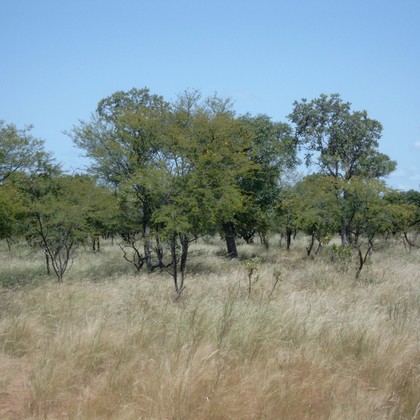
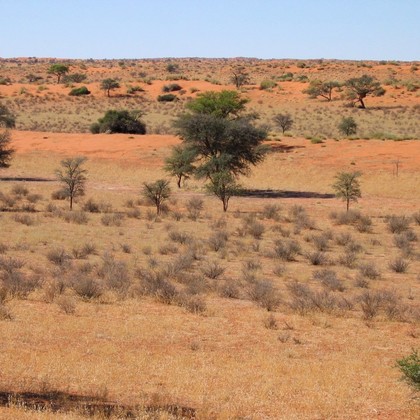
Open savanna and woodland: acacia savanna, mopane, Kalahari thornveld and dry miombo, preferably with clearings and waterholes. It avoids dense forest and treeless highlands. It eats carrion, small mammals, birds and reptiles, and often hunts low over roads and open plains. The nest is placed in a large tree below the canopy.
Where the bird is most at home, classified by the vegetation units of southern Africa.

Range and movements
The north and east of the region: Angola, Zambia, Malawi, Mozambique, Zimbabwe, Botswana and northern Namibia; in South Africa now largely confined to the large protected areas of the Lowveld (Kruger and surroundings), northern KwaZulu-Natal and the Kalahari on the Botswana border, and scarce in eastern Eswatini. Beyond the region it ranges across the savanna belt of Africa south of the Sahara, from Senegal to Ethiopia and Somalia, and into south-western Arabia.
- Resident
- Summer visitor (c. Oct–Mar)
- Winter visitor (c. Apr–Sep)
- Passage (Mar–Apr, Oct–Nov)
- dark = core range, pale = thinly spread
How and when to look
In Kruger, Chobe, Etosha or the Okavango, look up in mid-morning as the first thermals rise: the bird patrols low over the savanna and can be recognised by its silhouette at a kilometre's distance. Perched birds often sit near waterholes, where they drink and bathe in the heat of the day. With a flying adult, check the width of the black trailing edge to sex it.
Conservation status
Endangered on the Red List; raised from Near Threatened to Endangered in 2020 after a steep decline across much of Africa. The causes are poisoning, both incidental through baits laid for jackals and other predators and deliberate by poachers, loss and fragmentation of savanna, and capture for traditional use. In southern Africa the species has declined sharply outside large parks; in South Africa it has almost disappeared outside protected areas.
Scientific name
Terathopius ecaudatus | (Daudin, 1800)
Daudin described the species in 1800 as Falco ecaudatus; because it was later moved to another genus, the author and year stand in brackets. The genus Terathopius was introduced in 1830 by Lesson. Terathopius comes from Greek teras, 'marvel', and ops, 'face' — for the Bateleur's bright red, bare face. ecaudatus is Latin for 'tailless', from e-, 'without', and cauda, 'tail' — for the strikingly short tail. The specimen the first description was based on came from Knysna, South Africa.