All species › Woodpeckers and allies › Honeyguides › Least Honeyguide
Least Honeyguide | Indicator exilis
Kleinste honingspeurder | Indicador Chico
The Least Honeyguide is a dark, compact honeyguide of equatorial forest that reaches only the extreme northern edge of the region. It often sits still for long periods in the canopy and is noticed mainly by its call.

Voice
Poorly documented. A series of five to ten quick, slightly trilled notes, tree-tree-tree, from a fixed calling branch, and short high calls.
Recording: James Bradley — CC BY-NC-SA 4.0 · shortened to the first 60 s, mono · xeno-canto
Identification
About 13 cm, small but with a strikingly thick, short bill. Upperparts dark olive-green with yellow edges to the wing feathers; head dark olive-grey with a distinct white loral spot and a black malar stripe. Underparts grey with an olive tinge, paler towards the belly; the flanks are sometimes finely streaked. The outer tail feathers are white. Sexes alike.
Confusion species
Pallid Honeyguide (Indicator meliphilus) is paler and plainer, with no malar stripe and a finer bill. Lesser Honeyguide (Indicator minor) is larger, with a greyer head and paler underparts. Cassin's Honeybird (Prodotiscus insignis) has a thin, pointed bill and no malar stripe.
Habitat
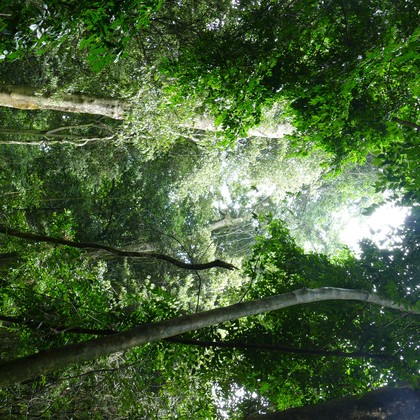
Evergreen forest, gallery forest along rivers, forest edge and old secondary growth. It eats wax, bee larvae and insects. A brood parasite of small hole-nesters, especially tinkerbirds and small barbets.
Where the bird is most at home, classified by the vegetation units of southern Africa.

Range and movements
Only on the northern edge of the region: northern and north-western Angola and north-western and northern Zambia, mainly in gallery forest. Beyond the region across the forest zone of West and Central Africa from Senegal to Uganda and western Kenya.
- Resident
- dark = core range, pale = thinly spread
How and when to look
In the region the best chances are in the gallery forests of Mwinilunga district in Zambia and the forests of northern Angola. Listen for the call in the canopy and check every honeyguide for the black malar stripe and thick bill.
Conservation status
Not threatened and widespread in Central Africa. Scarce and local in the region, and vulnerable to the clearance of gallery forest.
Scientific name
Indicator exilis | (Cassin, 1856)
Cassin described the species in 1856 as Melignothes exilis; because it was later moved to another genus, the author and year stand in brackets. The genus Indicator was introduced in 1815 by Stephens. Indicator is Latin for 'pointer, informer' — for the famous behaviour of the Greater Honeyguide, which leads people to bees' nests. exilis is Latin for 'small, slender' — for its small size. The specimen the first description was based on came from Moonda River, Gabon.