All species › Passerines › Waxbills › Lesser Seedcracker
Lesser Seedcracker | Pyrenestes minor
Granta-astrild | Estrilda Piquigorda Chica
The Lesser Seedcracker is a shy, little-known estrildid with a disproportionately heavy, glossy black bill, with which it cracks the hard seeds of sedges. It lives hidden in dense streamside vegetation in the east of the region.

Voice
A sharp, metallic tseek and a soft chirping; the song is a melodious series of squeaky and trilling notes. Often detected only by its call from dense cover.
Recording: Daniel Lopez Velasco — CC BY-NC-SA 4.0 · converted to mono · xeno-canto
Identification
13–14 cm, with a very heavy, glossy black conical bill. The male is olive-brown with a crimson forehead, face, throat and upper breast, a red rump and a reddish-brown tail. The female has less red on the head, often limited to forehead, lores and chin, but does have the red rump and tail. Juveniles are plain olive-brown with a reddish-brown tail and a dark bill.
Confusion species
The Red-Faced Crimsonwing (Cryptospiza reichenovii) has a much smaller bill, red only around the eye and a dark red back, and lives in montane forest. The Red-Throated Twinspot (Hypargos niveoguttatus) has a red face and breast, but a black belly with white spots and a fine bill. The male Black-Bellied Seedcracker (Pyrenestes ostrinus) is largely black and occurs only in the north-west of the region, with no overlap.
Habitat
Dense, rank vegetation along forest edges and streams in lowlands and mid-altitudes: rank grass, sedges, brambles and shrubs at the edges of forest, bamboo and plantations, also in abandoned gardens. It feeds mainly on hard seeds of sedges (Scleria) and grasses, which it cracks with its heavy bill.
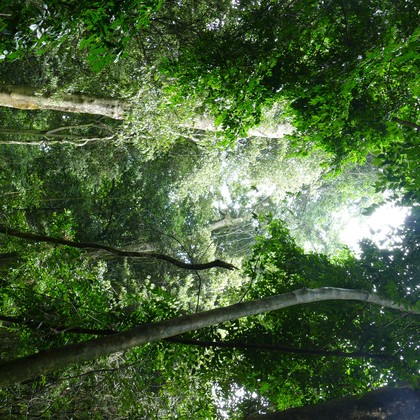
Where the bird is most at home, classified by the vegetation units of southern Africa.

Range and movements
Within the region in southern and central Malawi (including the Shire Highlands, Mulanje and Zomba), central and northern Mozambique and eastern Zimbabwe (Chimanimani, Haroni-Rusitu and the lowlands around Mutare). Beyond the region only in southern and eastern Tanzania. Reports from South Africa are unconfirmed.
- Resident
- dark = core range, pale = thinly spread
How and when to look
In Zimbabwe the Haroni-Rusitu area and the Burma Valley near Mutare are the best sites; wait in the early morning at the edge of dense cover or at a drinking spot along a stream. The species is shy and flies off fast and low; look for the red rump and the outsized bill.
Conservation status
Not threatened. Scarce and local, and probably often overlooked. Clearing of forest edges and streamside vegetation for agriculture is the main threat within the region.
Scientific name
Pyrenestes minor | Shelley, 1894
Shelley described the species in 1894 and placed it straight away in the genus where it still stands. The genus Pyrenestes was introduced in 1836 by Swainson. Pyrenestes combines the Greek purēn, 'fruit-stone', with -estēs, 'eater' — for the heavy bill with which these birds crack hard seeds. minor is Latin for 'smaller' — this species is smaller and finer-billed than the related Black-bellied Seedcracker. The specimen the first description was based on came from Zomba, Malawi.