All species › Passerines › Waxbills › Woodhouse's Antpecker
Woodhouse's Antpecker | Parmoptila woodhousei
Mierenpikker | Estrilda Piquifina de Woodhouse
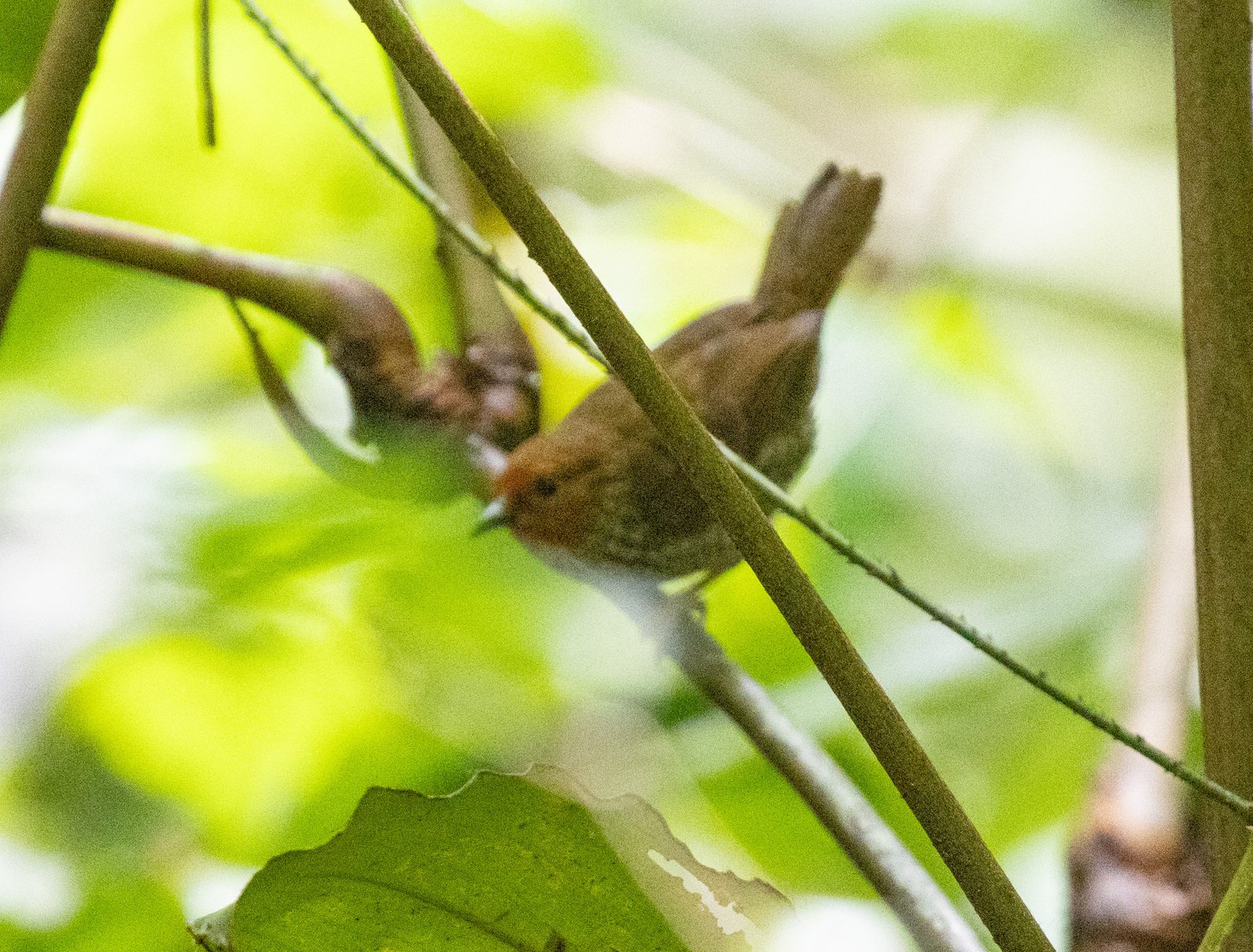
Woodhouse's Antpecker is an inconspicuous, warbler-like waxbill of lowland rainforest with a thin, pointed bill. Unlike almost all other waxbills it eats no seeds but ants and other small insects, which it seeks in mixed-species flocks in the middle storey of the forest.
Voice
A soft, high tsip or tseet, often lost among the other calls of a mixed flock. A true song has hardly been described.
No recording with a suitable Creative Commons licence is available for this species yet.
Identification
10 to 11 cm, small with a short tail and a fine, pointed dark bill that recalls a warbler rather than a waxbill. Male: upperparts warm olive-brown, forehead bright red, face and underparts rufous to cinnamon, finely barred on the flanks. Female: lacks the red forehead; the underparts are paler and densely marked with white and dark spots or scales, giving a speckled breast. The rump is rufous-brown in both sexes. Juveniles are plain brown.
Confusion species
The nigritas are larger, with heavier bills and contrasting black-and-grey or black-and-white plumage; the White-Breasted Nigrita (Nigrita fusconotus) has a black cap and white underparts. Females can suggest a warbler, but the compact waxbill build, rufous-brown rump and speckled breast are distinctive. The red forehead of the male is shown by no other forest bird of this size.
Habitat
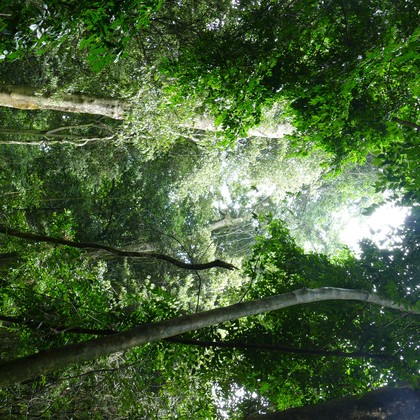
Evergreen lowland forest and older secondary forest, forest edges and overgrown clearings, mainly in the middle and lower storeys, among lianas and dense foliage. It forages actively like a warbler, alone, in pairs or in mixed flocks of insectivores, and eats mainly ants.
Where the bird is most at home, classified by the vegetation units of southern Africa.
Range and movements
Within the region only in northern Angola: Cabinda and the forests of Uíge, Cuanza Norte and Bengo, with a few records from Lunda Norte. Beyond the region from south-eastern Nigeria and Cameroon through Gabon and Congo-Brazzaville to the Central African Republic and western and central DR Congo.
How and when to look
A difficult species, found almost only by patiently checking mixed flocks in forests such as those near Quitexe and Tombingo (Uíge). Watch for a small brown bird creeping through the lianas like a warbler; the male gives itself away with its red forehead.
Conservation status
Not threatened. Poorly known and scarce in Angola, with few records. It depends on lowland forest, which in northern Angola is declining through logging and conversion to farmland.
Scientific name
Parmoptila woodhousei | Cassin, 1859
Cassin described the species in 1859 and placed it straight away in the genus where it still stands. He introduced the genus Parmoptila in that same work. Parmoptila comes from the Greek parmē, 'small round shield', and ptilon, 'feather' — possibly for the scaly breast feathers. woodhousei honours the American physician Samuel Washington Woodhouse (1821–1904), US Army surgeon (1849–1862), explorer and naturalist in the United States and Central America. The specimen the first description was based on came from Camma River, Gabon.