All species › Passerines › Waxbills › Locust Finch
Locust Finch | Paludipasser locustella
Sprinkhaanastrild | Estrilda Saltamontes
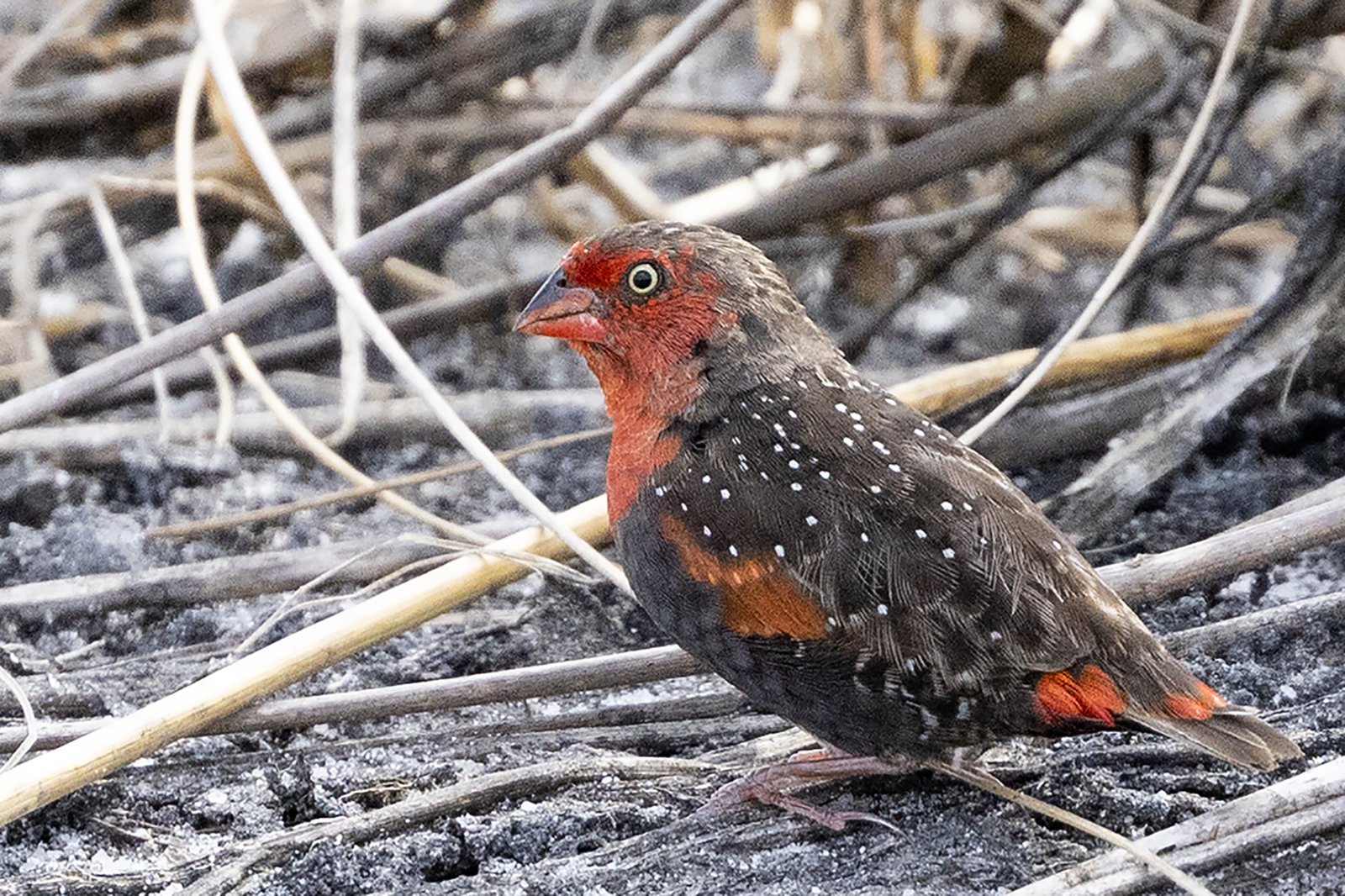
The Locust Finch is a tiny, short-tailed waxbill of wet grassland and dambos, best known for its habit of flying off low and whirring like a grasshopper before dropping straight back into the grass. The male has a red face and black underparts.
Voice
A soft, thin tink-tink or tseep, mainly when flushed, and a dry, short rattled chirrr. The call is weak and does not carry far.
Recording: Dries Van de Loock — CC BY-NC-SA 4.0 · converted to mono · xeno-canto
Identification
9 to 10 cm, compact, with a very short black tail. The male has face, throat and upper breast bright scarlet; the rest of the underparts is black. The upperparts are dark blackish brown with fine white speckling; the flight feathers are orange-red and flash in flight. The female lacks the red face: the head is brown, throat and belly whitish to buff, with dark barring on breast and flanks, and she also shows orange in the wing. The bill is red in both sexes. Juveniles are plain dark brown, with a dark bill and already some orange in the wing.
Confusion species
Quailfinch (Ortygospiza atricollis) is slightly larger, has black-and-white barred flanks, a white chin patch and, in southern birds, white 'spectacles', and no orange in the wing; its flight call is a metallic tinkling. Orange-Breasted Waxbill (Amandava subflava), which inhabits the same wet grassland, has a longer black tail, a red rump and an orange-yellow belly. The red face of the male Locust Finch is unique in this habitat.
Habitat
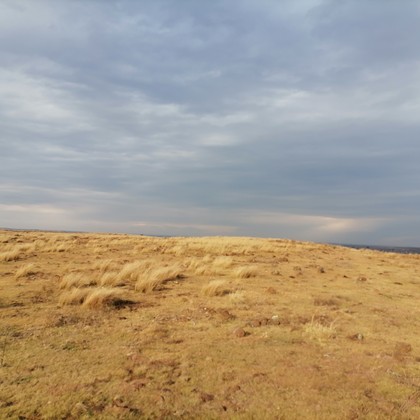
Short, wet grass in dambos, floodplains, marsh edges and damp plateau grasslands, often with pools of water in between; sometimes also rice fields. It lives in pairs or small groups low in the grass, eats small grass seeds and moves seasonally with the water level.
Where the bird is most at home, classified by the vegetation units of southern Africa.

Range and movements
Within the region in eastern and northern Angola, across much of Zambia (especially the northern and western provinces and the Kafue Flats), in Malawi (including Kasungu, Vwaza and the Nyika), in central Mozambique (Gorongosa and the Zambezi delta) and in north-eastern and eastern Zimbabwe, where it is scarce and local around Harare, Marondera and in the Eastern Highlands; there are museum specimens from the northern Okavango Delta in Botswana. Beyond the region in the DR Congo, Tanzania and patchily in West and Central Africa.
- Resident
- dark = core range, pale = thinly spread
How and when to look
Search wet dambos with short grass during and after the rains, for example on the Kafue Flats, around Mwinilunga or at Kasungu in Malawi. Walk slowly through the grass: a tiny bird that whirs off low over the ground on orange wings and drops in again after a few metres is this species. Stand still and wait; the male often then climbs up a grass stem.
Conservation status
Not threatened. Fairly common locally but seldom seen because of its secretive behaviour; scarce in Zimbabwe and Mozambique. The draining, grazing and cultivation of dambos is the main threat.
Scientific name
Paludipasser locustella | Neave, 1909
Neave described the species in 1909 and placed it straight away in the genus where it still stands. He introduced the genus Paludipasser in that same work. Paludipasser comes from the Latin palus, 'marsh', and passer, 'sparrow' — for its habitat of marshy grassland. locustella is a Latin diminutive of locusta, 'grasshopper' — for its small size and fluttering, grasshopper-like flight from the grass. The specimen the first description was based on came from Upper Luansenshi River, north-east of Lake Bangweulu, Zambia.