All species › Passerines › Waxbills › Quailfinch
Quailfinch | Ortygospiza atricollis
Kwartelastrild | Estrilda Codorniz
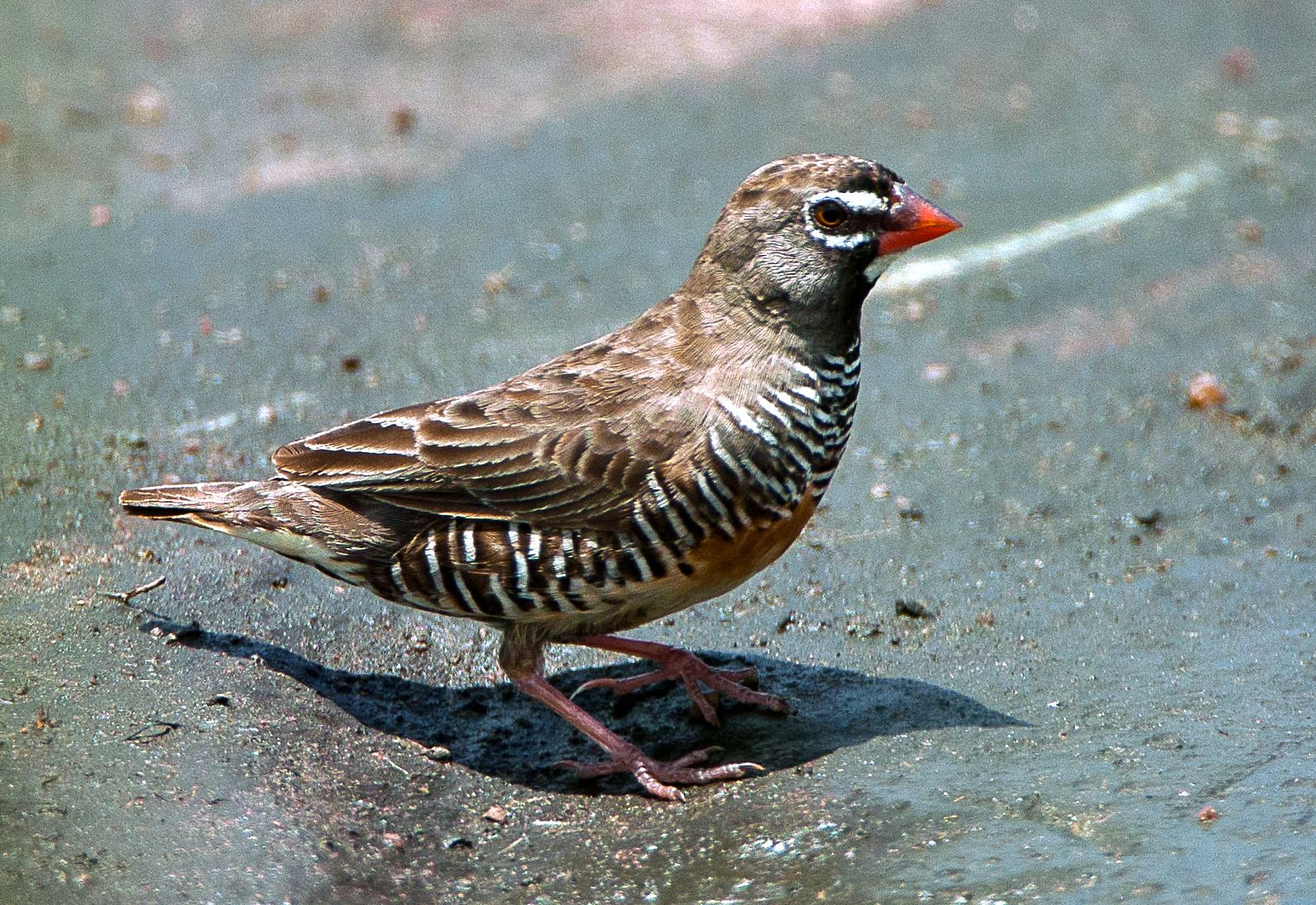
The Quailfinch is a small, dumpy ground waxbill of open grassland, usually noticed only when it flushes from underfoot and flies off high and erratically with a metallic tinkling. On the ground, with its barred flanks and short tail, it looks like a miniature quail.
Voice
The flight call is diagnostic: a metallic, tinkling tirrilink-tirrilink or tink-tink-tink, repeated on take-off and during the high, bouncing flight. On the ground a soft chip; the song is a series of dry clicking and croaking notes.
Recording: Dries Van de Loock — CC BY-NC-SA 4.0 · converted to mono · xeno-canto
Identification
9 to 10 cm, with a very short tail with white corners. The upperparts are plain grey-brown. The male has a black face and black throat with a white chin patch and, in birds from the south of the region, a white ring around the eye; breast and flanks are boldly barred black and white, the centre of breast and belly orange-brown. The bill is red, the upper mandible often darker. The female is duller, with a grey-brown rather than black face, less white around the eye and a duller pinkish bill. Juveniles are browner and more faintly marked, with a dark bill. In northern Angola and Zambia there are forms with an entirely black chin without white spectacles and an all-red bill, which are sometimes treated as a separate species.
Confusion species
Locust Finch (Paludipasser locustella) of wet dambos is smaller, shows orange-red wings in flight and in the male has a red face and a black belly; it flies off low and whirring rather than high and erratically. Flushed pipits such as African Pipit (Anthus cinnamomeus) and cisticolas such as Zitting Cisticola (Cisticola juncidis) are slimmer, with longer tails, and give different calls. Orange-Breasted Waxbill (Amandava subflava) has a longer tail and an orange-yellow belly.
Habitat
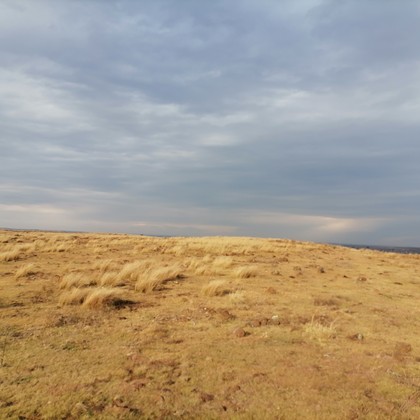
Short, open grassland, often damp or around vleis, dambos and the edges of pans and dams, also overgrazed veld, fallow land, sports fields and airfields; in the mountains up into montane grassland. It walks like a mouse between grass tufts in search of fallen seeds, usually in pairs or small groups, and outside the breeding season in larger flocks that wander with water and seed.
Where the bird is most at home, classified by the vegetation units of southern Africa.


Range and movements
Distributed over most of the region: from Angola, Zambia, Malawi and Mozambique to Zimbabwe, northern and eastern Botswana, northern Namibia, most of South Africa, Lesotho and Eswatini. Absent from the Namib, the dry western Karoo, the central Kalahari and closed forest; only local in the Western Cape. Beyond the region widespread over much of sub-Saharan Africa, from Senegal to Ethiopia.
- Resident
- Summer visitor (c. Oct–Mar)
- Winter visitor (c. Apr–Sep)
- Passage (Mar–Apr, Oct–Nov)
- dark = core range, pale = thinly spread
How and when to look
Walk through short, damp grass around a vlei or dam and listen for the tinkling overhead: the birds usually flush before you see them, circle round and drop in again some distance away. Mark where they land and approach carefully; sometimes they come to drink at the water's edge, where the barred flanks and white spectacles show well.
Conservation status
Not threatened. Common and widespread; it benefits locally from grazed and cleared grassland. The loss of vleis and wet grassland to drainage and development can cause local declines.
Scientific name
Ortygospiza atricollis | (Vieillot, 1817)
Vieillot described the species in 1817 as Fringilla atricollis; because it was later moved to another genus, the author and year stand in brackets. The genus Ortygospiza was introduced in 1850 by Sundevall. Ortygospiza comes from the Greek ortux, 'quail', and spiza, 'finch' — for its quail-like life on the ground. atricollis comes from the Latin ater, 'black', and collum, 'neck' — for the male's black throat. The specimen the first description was based on came from Senegal.