All species › Passerines › Waxbills › Pale-Fronted Nigrita
Pale-Fronted Nigrita | Nigrita luteifrons
Bleekkopnigrita | Negrita Frentigualda
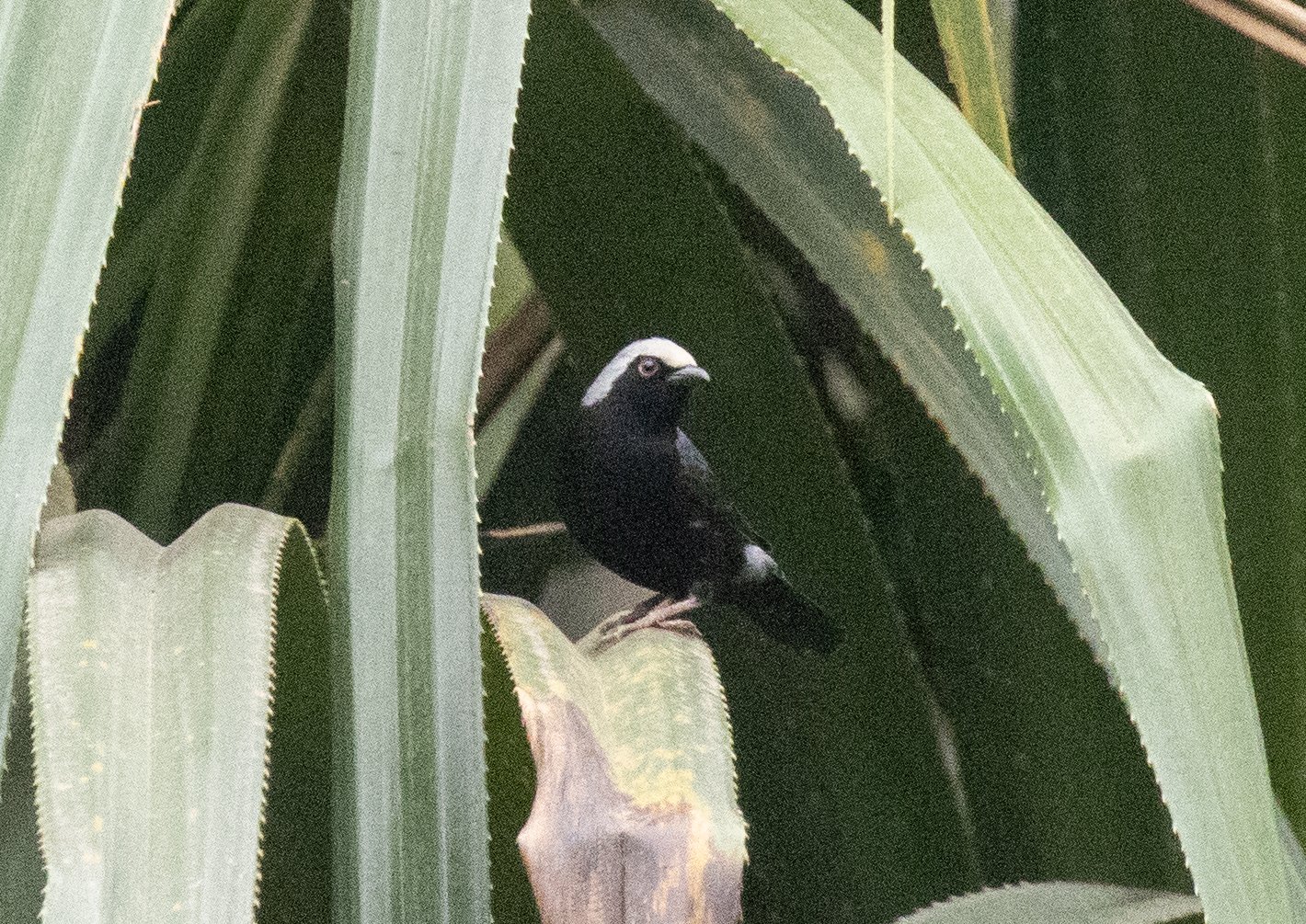
The Pale-Fronted Nigrita is a small grey-and-black nigrita of the lowland forest canopy, the male with a pale yellow-buff forehead. In Angola it is scarce and little known, and is found mainly in flowering and fruiting trees at forest edges.
Voice
A soft, high tsee or tsip as a contact call. The song is a series of a few soft, pure whistles, less loud than that of the Grey-Headed Nigrita.
No recording with a suitable Creative Commons licence is available for this species yet.
Identification
11 to 12 cm, compact with a short black bill. Male: face, throat and underparts black; forehead and forecrown pale yellow-buff to creamy, grading behind into the pale grey crown, nape and back; rump pale grey, wings grey without white dots, tail black. Female: almost entirely grey, with blackish lores and often paler underparts, lacking the pale forehead or showing only a trace of it. Juveniles are plain dark grey-brown.
Confusion species
The Grey-Headed Nigrita (Nigrita canicapillus) is clearly larger, has fine white dots on the wing coverts and a narrow white border between grey crown and black face, but no yellow-buff forehead. The Chestnut-Breasted Nigrita (Nigrita bicolor) is chestnut below. The plain grey female can suggest a grey flycatcher, but has a thick waxbill bill and forages in pairs with the male.
Habitat
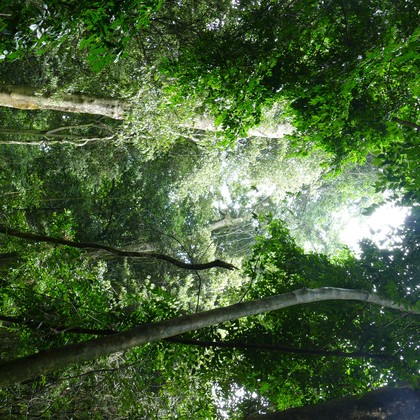
The canopy and edges of evergreen lowland forest, gallery forest and older secondary forest, often in flowering and fruiting trees and in mistletoe. It forages in pairs or small groups, sometimes with other nigritas and with sunbirds, on insects, fruit and seeds.
Where the bird is most at home, classified by the vegetation units of southern Africa.

Range and movements
Within the region only in northern Angola: the forests of Uíge and Cuanza Norte, with a few records from the escarpment forests of Cuanza Sul (Kumbira). Beyond the region from Nigeria and Cameroon through Gabon and both Congos to the Central African Republic and Uganda.
How and when to look
One of the least recorded nigritas of the region. Search for pairs in the canopy near Quitexe and in the forests around Quibaxe and Quiculungo, and check every grey nigrita for the absence of white wing dots and for the pale forehead.
Conservation status
Not threatened. Locally fairly common in its large Central African range, but scarce in Angola and dependent on the shrinking northern lowland forest.
Scientific name
Nigrita luteifrons | Verreaux & Verreaux, 1851
Verreaux & Verreaux described the species in 1851 and placed it straight away in the genus where it still stands. The genus Nigrita was introduced in 1843 by Strickland. Nigrita comes from the Modern Latin nigritus, 'black' (related to niger) — for the largely dark plumage of these nigritas. luteifrons comes from the Latin luteus, 'yellow', and frons, 'forehead' — for the male's pale yellowish forehead. The specimen the first description was based on came from Gabon.