All species › Passerines › Waxbills › Grey-Headed Nigrita
Grey-Headed Nigrita | Nigrita canicapillus
Grijskopnigrita | Negrita Canosa
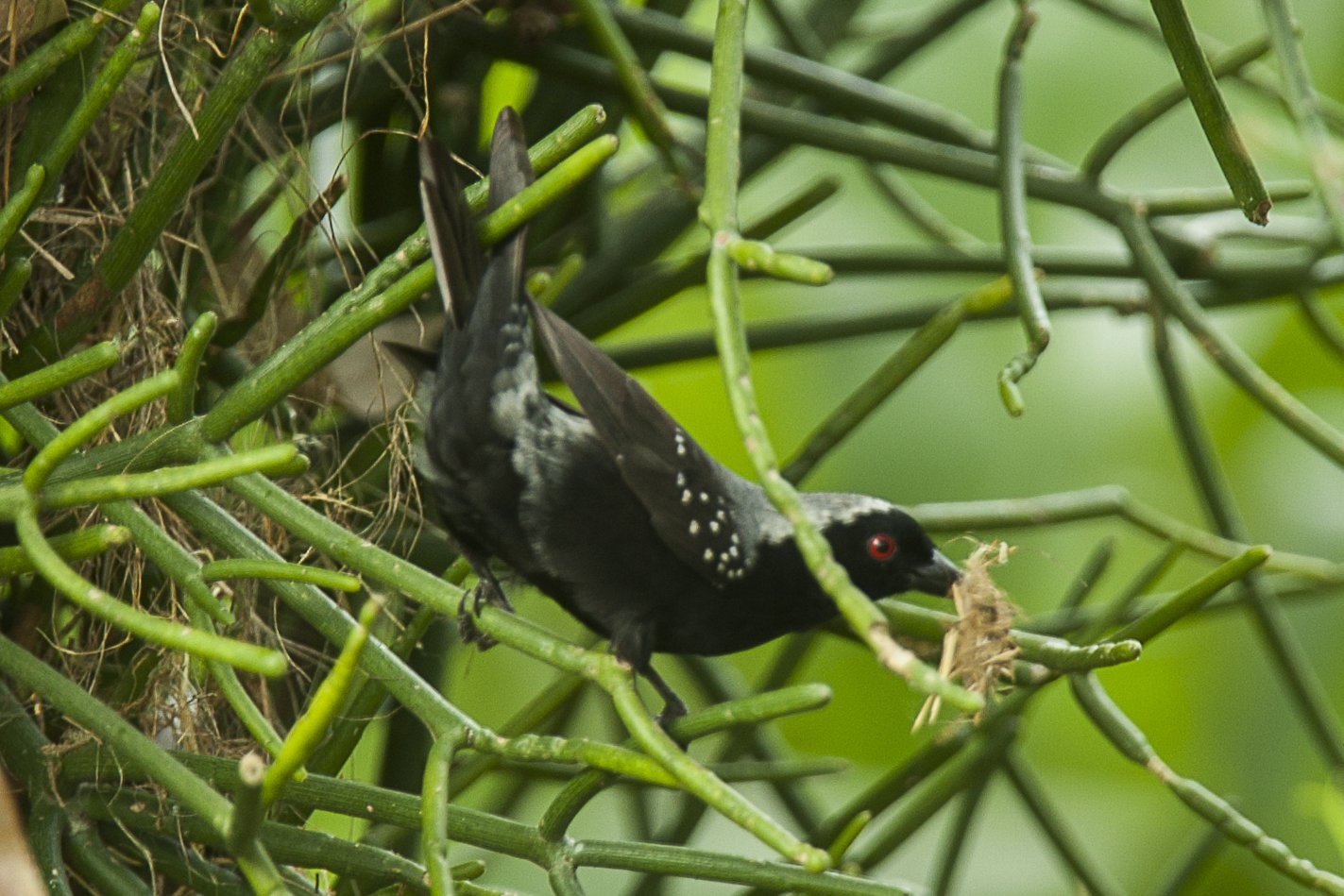
The Grey-Headed Nigrita is the largest and most conspicuous nigrita: grey above, black below, with fine white dots on the wings. In northern and western Angola it is the commonest nigrita and the only one regularly seen in the escarpment forests of Cuanza Sul as well.
Voice
A loud, pure whistled song of three or four notes, often slightly descending or up-and-down, tee-too-tee or fee-foo-foo, repeated at length from a song post in the canopy. The call is a sharp tsip.
Recording: Bram Piot — CC BY-NC-SA 4.0 · converted to mono · xeno-canto
Identification
14 to 15 cm, large for a waxbill, with a fairly long tail and a heavy black bill. The forehead, face and entire underparts are black. Crown, nape and back are pale grey, separated from the black face by a narrow white border; the rump is pale grey, the tail black. The dark wing coverts carry small white dots. The eye is red. The sexes are alike. Juveniles are plain dark grey-brown without a black face or white dots.
Confusion species
The Pale-Fronted Nigrita (Nigrita luteifrons) is smaller, lacks the white dots on the wing, and the male has a pale yellow-buff forehead; the female is almost wholly grey. The Chestnut-Breasted Nigrita (Nigrita bicolor) is chestnut below. The Black-and-White Mannikin (Spermestes bicolor) has a white belly and lives in flocks low in open country.
Habitat
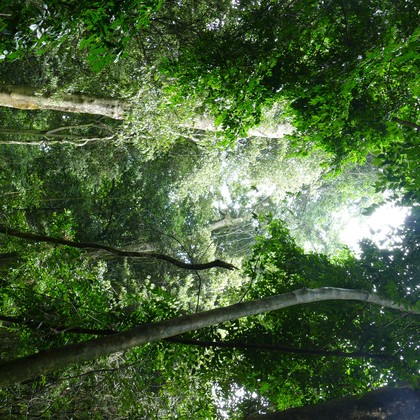
Edges and clearings of lowland and mid-altitude forest, gallery forest, secondary forest, plantations and wooded gardens, down to the shade-coffee plantations of the Angolan escarpment forests. It forages in pairs or small groups, in the canopy and in bushes, on insects, fruit and seeds.
Where the bird is most at home, classified by the vegetation units of southern Africa.


Range and movements
Within the region only in northern and western Angola: from Cabinda and Uíge south through Cuanza Norte, Bengo and Malanje to the escarpment forests of Cuanza Sul (Kumbira, Gabela, Conda). Beyond the region from Guinea through West and Central Africa to South Sudan, Uganda, Kenya and western Tanzania.
- Resident
- dark = core range, pale = thinly spread
How and when to look
In Kumbira Forest and around Gabela it is often the first nigrita encountered, singing from a tall tree at the forest edge. Learn the clear whistled song; it helps to find the species even when it sits high in the foliage.
Conservation status
Not threatened. Common and tolerant of secondary growth and plantations; in Angola the most frequently recorded nigrita. Loss of the escarpment forest is nevertheless a threat to the local populations.
Scientific name
Nigrita canicapillus | (Strickland, 1841)
Strickland described the species in 1841 as Aethiops canicapillus; because it was later moved to another genus, the author and year stand in brackets. The genus Nigrita was introduced in 1843 by Strickland. Nigrita comes from the Modern Latin nigritus, 'black' (related to niger) — for the largely dark plumage of these nigritas. canicapillus comes from the Latin canus, 'grey', and capillus, 'hair of the head' — for the grey crown. The specimen the first description was based on came from Bioko, Equatorial Guinea.