All species › Waders, gulls and terns › Plovers and lapwings › Little Ringed Plover
Little Ringed Plover | Thinornis dubius
Kleine plevier | Chorlitejo Chico
The Little Ringed Plover breeds in Europe and Asia and spends the northern winter mainly in the Sahel and East Africa. Southern Africa lies at the very edge of its winter range: it is seen now and then in Zambia and Malawi, and only a handful of records exist south of the Zambezi. Anyone who finds one has a genuine rarity.
Voice
A clear, descending pee-oo, often on take-off; characteristic and easily told from the softer, rising too-ee of Common Ringed Plover. Also a short pip. Usually silent in its winter quarters.
No recording with a suitable Creative Commons licence is available for this species yet.
Identification
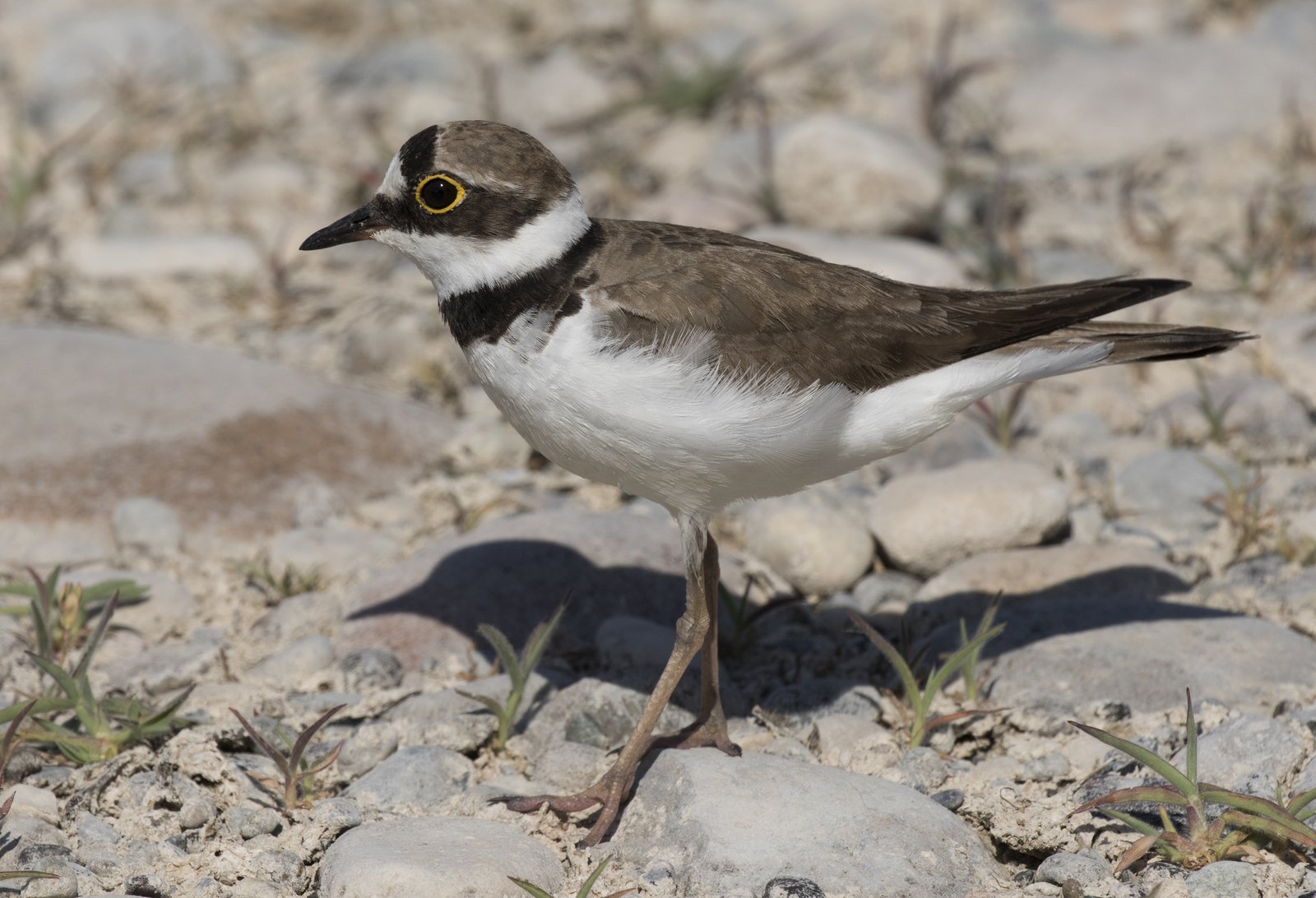
14–17 cm. A small, slim plover with brown back and crown, white underparts and a complete black breast band. In all plumages it has a conspicuous yellow eye-ring. The forehead is white with a black band above it, itself narrowly edged white on top. The bill is entirely dark, with at most a faint yellow base to the lower mandible; the legs are dull yellow to flesh-coloured. In flight a white wing bar is almost completely lacking. In non-breeding plumage and in juveniles the breast band is brown and sometimes broken, and the eye-ring is duller but still visible.
Confusion species
Common Ringed Plover Charadrius hiaticula, a fairly common non-breeding visitor in the region, is stockier, with an orange bill base and orange legs, lacks the yellow eye-ring and shows a clear white wing bar in flight. Three-Banded Plover Thinornis tricollaris has two black breast bands, a red eye-ring and a red bill base. Kittlitz's Plover Anarhynchus pecuarius has an ochre breast without a complete band. With any 'ringed plover' lacking a wing bar, check the eye-ring and leg colour.
Habitat
Fresh water with bare shores: muddy edges of pans and dams, sandbars in rivers, sewage works and wet gravel sites. It avoids the open coast and intertidal zone more than Common Ringed Plover does. It forages in the typical plover rhythm of run, stop and peck.
Where the bird is most at home, classified by the vegetation units of southern Africa.

Range and movements
A rare visitor to the region: irregular in Zambia and Malawi, and otherwise only a few records, including Hwange in Zimbabwe (2002) and near Port Elizabeth and Hermanus in South Africa (2017). It breeds in Europe, North Africa and Asia and winters mainly in Africa south of the Sahara as far as East Africa, and in South Asia.
How and when to look
In the summer months, check the plovers along the edges of dams and sewage works, especially in the north of the region. A plover that shows no wing bar on take-off and calls pee-oo deserves a second look; photographs of the eye-ring and leg colour are needed for a record to be accepted.
Conservation status
Not threatened; a large and widespread population worldwide. Southern Africa is of no significance to the species, but records are assessed by the rarities committees.
Scientific name
Thinornis dubius | (Scopoli, 1786)
Scopoli described the species in 1786 as Charadrius dubius; because it was later moved to another genus, the author and year stand in brackets. The genus Thinornis was introduced in 1845 by Gray. Thinornis is Greek, from this, thinos 'beach, sandbank' and ornis 'bird'. dubius is Latin for 'doubtful': it was doubted whether the bird was more than a variety of the common ringed plover. The specimen the first description was based on came from Luzon, Philippines.