All species › Waders, gulls and terns › Sandpipers and snipes › Little Stint
Little Stint | Calidris minuta
Kleine strandloper | Correlimos Menudo
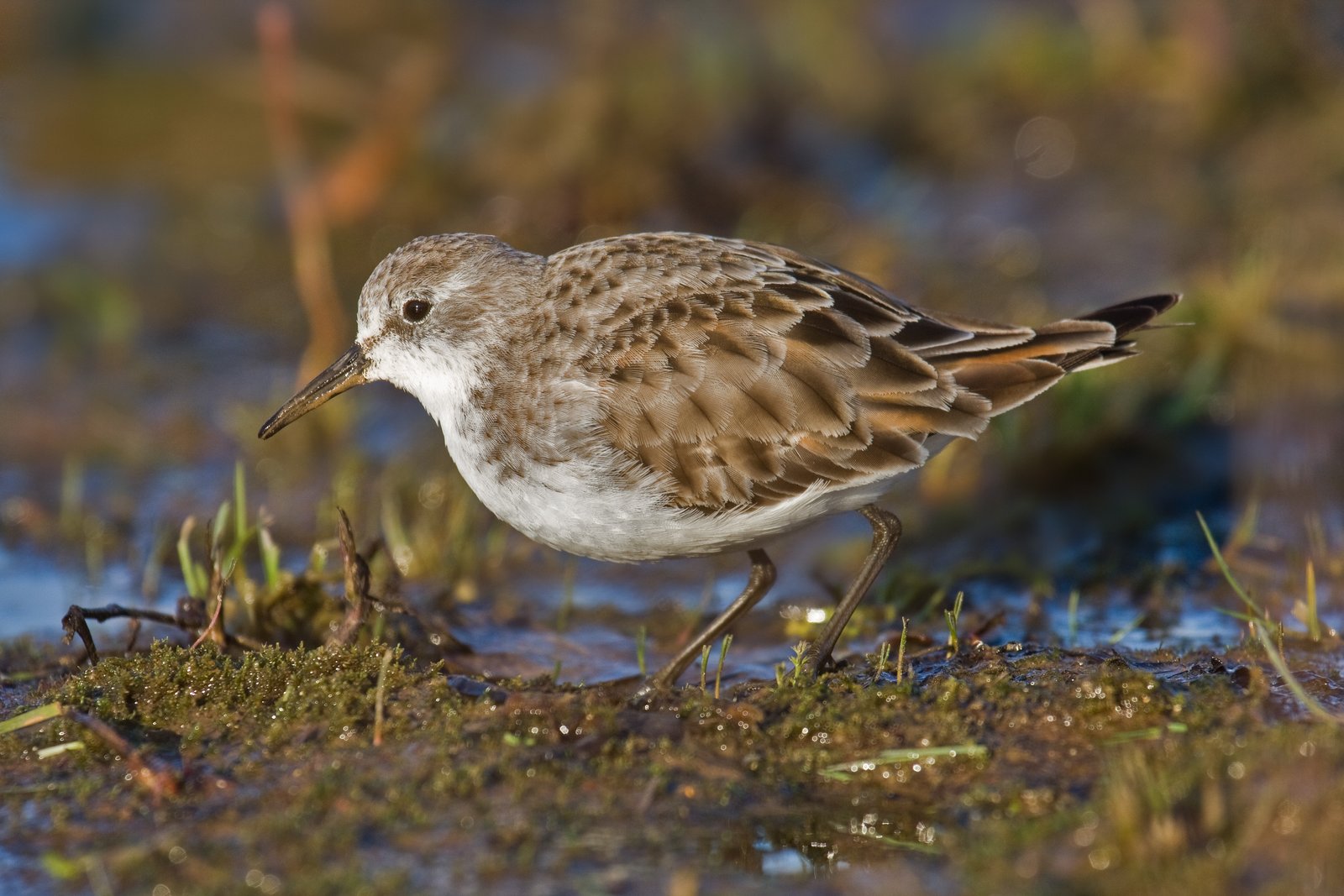
The Little Stint is the smallest and one of the most numerous waders of southern Africa. In the southern summer flocks of tens to hundreds of birds scurry over the mud of salt pans, sewage works and lagoons with rapid, nervous pecking, both on the coast and far inland.
Voice
A short, dry stit or tit, often in short series, tit-tit-tit, on take-off; flocks give a soft twittering.
Recording: Stanislas Wroza — CC BY-NC-SA 4.0 · converted to mono · xeno-canto
Identification
13–15 cm. A tiny, compact sandpiper with a short, straight, finely pointed black bill and black legs. In non-breeding plumage grey-brown above with dark shaft streaks, white below with a grey-brown wash on the breast sides; a pale supercilium and dark lores. Juveniles, from September into November, are warmer, with rufous fringes to the mantle feathers, a white V on the mantle and a split white supercilium. In spring some birds already acquire an orange-brown head and breast. In flight a narrow white wingbar and a white rump with a dark central stripe, with grey tail sides.
Confusion species
Temminck's Stint Calidris temminckii is plainer grey-brown, with a complete grey breast band, yellowish legs and white outer tail feathers, and towers steeply when flushed with a trilling call. Sanderling Calidris alba is clearly larger, paler and runs in the surf. Broad-Billed Sandpiper Calidris falcinellus is larger, with a longer bill kinked at the tip and a double supercilium. Rare American sandpipers such as Baird's Sandpiper Calidris bairdii are larger and longer-winged.
Habitat
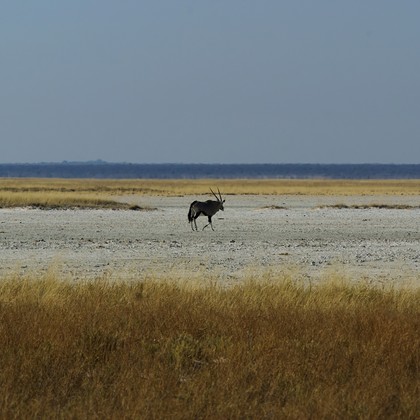
Shallow margins of salt and brackish pans, sewage works, dams with muddy shores, lagoons, estuaries and salt works; less on open sandy beaches. In dry years large numbers concentrate on the few pans that still hold water. It feeds by rapid pecking at the surface rather than deep probing.
Where the bird is most at home, classified by the vegetation units of southern Africa.


Range and movements
Throughout the region: South Africa, Lesotho, Eswatini, Namibia, Botswana, Zimbabwe, Mozambique, Zambia, Malawi and Angola; most numerous on the pans of the Highveld and Free State, in the Makgadikgadi and around Walvis Bay, scarcer in the moist north where suitable muddy shores are fewer. It winters across almost all of sub-Saharan Africa and in southern Asia, and breeds on the Arctic tundra from northern Norway to eastern Siberia.
- Resident
- Summer visitor (c. Oct–Mar)
- Passage (Mar–Apr, Oct–Nov)
- dark = core range, pale = thinly spread
How and when to look
Best seen at sewage works and salt pans in the southern summer, where birds can often be approached to within a few metres. Take time to scan the flock: Temminck's Stints or a rare American vagrant sometimes hide among the Little Stints. Birds with the orange spring head appear in March and April, just before departure.
Conservation status
Not threatened and numerous in southern Africa, although numbers fluctuate strongly with rainfall. Levelling and draining of pans and declining water quality at sewage works are harmful locally; at the same time, wastewater treatment works are important feeding sites.
Scientific name
Calidris minuta | (Leisler, 1812)
Leisler described the species in 1812 as Tringa minuta; because it was later moved to another genus, the author and year stand in brackets. The genus Calidris was introduced in 1804 by Merrem. Calidris goes back to Ancient Greek kalidris or skalidris, a name Aristotle used for an unidentified grey waterside bird. minuta is Latin for 'small', after the size of these smallest European stints. The specimen the first description was based on came from Hanau, Germany.