All species › Waders, gulls and terns › Gulls and terns › Little Tern
Little Tern | Sternula albifrons
Dwergstern | Charrancito Común
The Little Tern is a small, lively tern that breeds in Europe and Asia and occurs in the region mainly as a non-breeding visitor along the east coast. Here it is nearly always seen in non-breeding or transitional plumage, which makes separation from the resident Damara Tern one of the trickier puzzles on the coast.
Voice
A quick, high kreet or kee-ick, and a hurried chattering kirrikikki during chases. On the wintering grounds it calls little except at communal roosts.
Recording: David Darrell-Lambert — CC BY-NC-SA 4.0 · converted to mono · xeno-canto
Identification
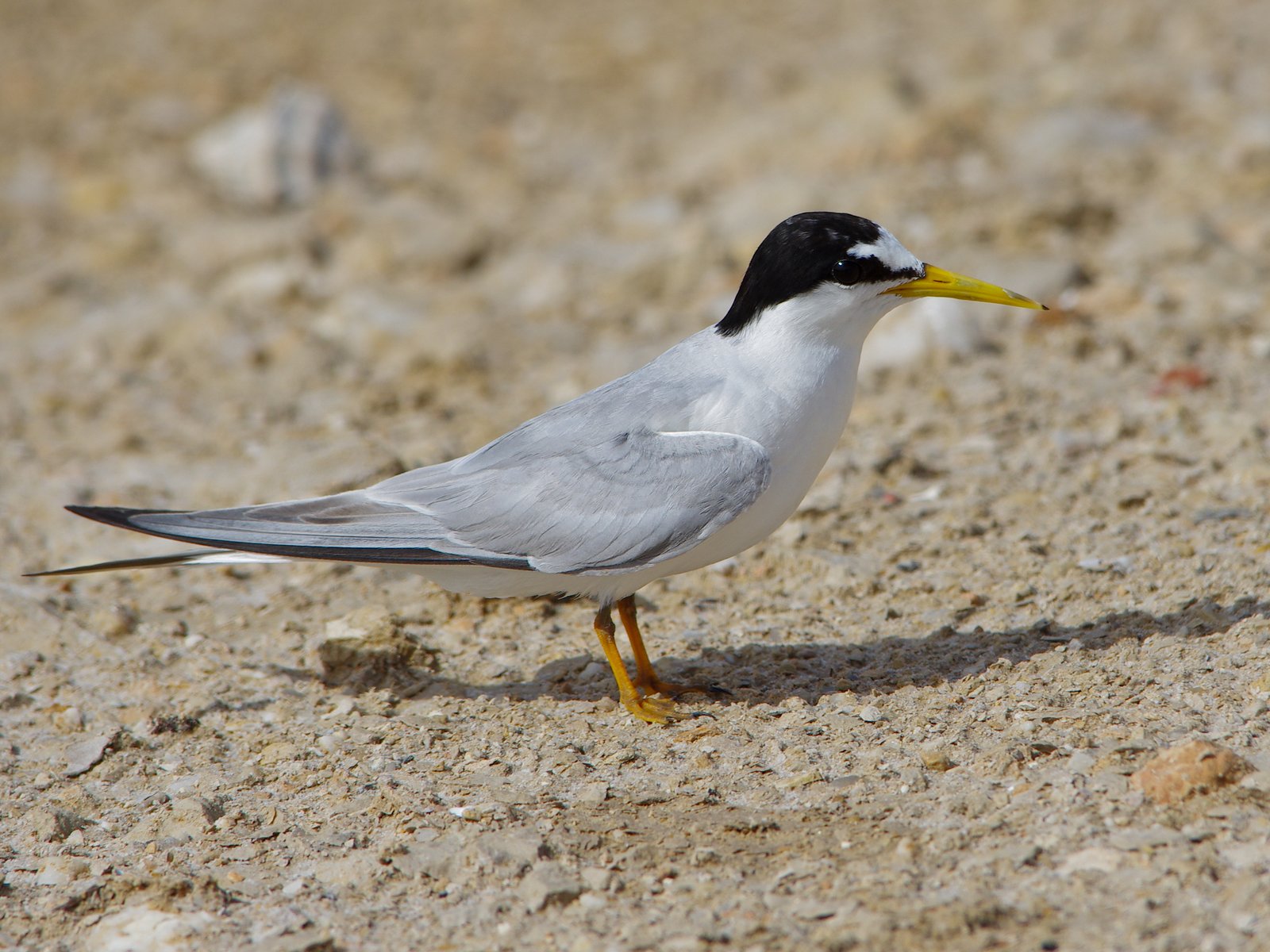
About 23 cm, with narrow, pointed wings and a short, forked tail. In non-breeding plumage the forehead and forecrown are white, the rear crown and nape black, and a black eye-stripe runs forward to just in front of the eye. The bill is then black, sometimes with a yellowish base, and the legs duller yellow to brownish. The back is pale grey and contrasts with the white rump and tail. The outer two or three primaries are dark grey, forming a dark wedge on the leading edge of the wing; juveniles also show a dark carpal bar. In breeding plumage, only partly seen here in March and April, the bird has a yellow bill with a black tip, orange-yellow legs and a sharply defined white forehead patch.
Confusion species
Damara Tern Sternula balaenarum has a longer, slightly decurved, all-black bill, a uniform grey rump and tail and dark legs. Saunders's Tern Sternula saundersi has a grey rump and tail, three or four dark outer primaries with black shafts, and in breeding plumage a square-cut white forehead patch that does not extend behind the eye. White-Winged Tern Chlidonias leucopterus in non-breeding plumage has a shorter, barely forked tail, hunts over fresh water and does not plunge-dive.
Habitat
Shallow coastal waters: estuaries, lagoons, bays and the calm sea just beyond the surf. It roosts in small groups on sandbanks and beaches, often among other terns. It hunts by hovering rapidly and repeatedly before plunging vertically into the water for small fish and shrimps. It rarely comes inland.
Where the bird is most at home, classified by the vegetation units of southern Africa.

Range and movements
Mainly along the coasts of Mozambique and KwaZulu-Natal, with the largest numbers in the estuaries around Maputo, Inhambane and Richards Bay; scarcer along the south coast of South Africa. On the west coast in smaller numbers, including around Walvis Bay in Namibia and along the coast of Angola. It breeds from western Europe and North Africa to eastern Asia and also winters along the coasts of Africa, southern Asia and Australasia.
- Resident
- Summer visitor (c. Oct–Mar)
- Passage (Mar–Apr, Oct–Nov)
- dark = core range, pale = thinly spread
How and when to look
Search high-tide roosts in east-coast estuaries between November and March, where Little Terns sit on sandbanks among larger terns. With every small tern, check the colour of the rump and tail and the length and shape of the bill. On the west coast every small tern from October to April deserves careful checking for Damara Tern.
Conservation status
Not threatened. The world population is large, although breeding colonies in Europe are sensitive to disturbance on beaches. On the wintering grounds, disturbance at roosts and the degradation of estuaries are the main concerns.
Scientific name
Sternula albifrons | (Pallas, 1764)
Pallas described the species in 1764 as Sterna albifrons; because it was later moved to another genus, the author and year stand in brackets. The genus Sternula was introduced in 1822 by Boie. Sternula is a Latin diminutive of Sterna and so means 'little tern'. albifrons is Latin, from albus 'white' and frons 'forehead', after the white forehead below the black cap. The specimen the first description was based on came from the Meuse region, Netherlands.