All species › Birds of prey › Hawks, eagles and kites › Lizard Buzzard
Lizard Buzzard | Kaupifalco monogrammicus
Hagedisbuizerd | Busardo Gavilán
The Lizard Buzzard is a stocky, grey raptor of woodland, the size of a small goshawk but built like a buzzard. The white throat with a single black central stripe is unique. It sits motionless for long periods on a visible branch and drops from there onto lizards, large insects and small rodents on the ground.

Voice
Very vocal in the breeding season: a melodious, whistled kloo-oo or klioo-klu-klu-klu-klu, often from a high branch or in flight, and a plaintive, falling peeoo.
Recording: Jonathan Onongo — CC BY-NC-SA 4.0 · converted to mono · xeno-canto
Identification
35–37 cm, wingspan 75–85 cm. Plain grey above and on the head and breast; the belly is finely barred grey and white. The white throat is split by a narrow black central stripe. The tail is black with a broad white band across the middle (sometimes a second, narrower band) and a white tip; the white uppertail band is striking when the bird flies off. Cere and legs orange-red, eyes dark. In flight the wings are fairly broad and rounded, the underwing pale with dark tips. The sexes are alike. Juveniles are browner in tone, with a paler supercilium and a less distinct throat stripe.
Confusion species
Gabar Goshawk Micronisus gabar is slimmer, with a longer, multi-banded tail, a grey throat without a stripe and red eyes. Shikra Tachyspiza badia has a rufous-barred breast, yellow legs and no throat stripe. Dark Chanting Goshawk Melierax metabates is much larger, with long red legs and a barred rump. Grey Kestrel Falco ardosiaceus and Dickinson's Kestrel Falco dickinsoni have pointed wings and a yellow cere.
Habitat
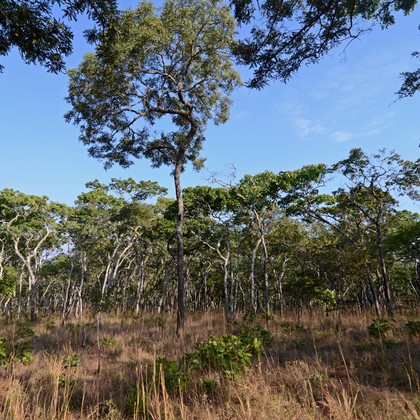
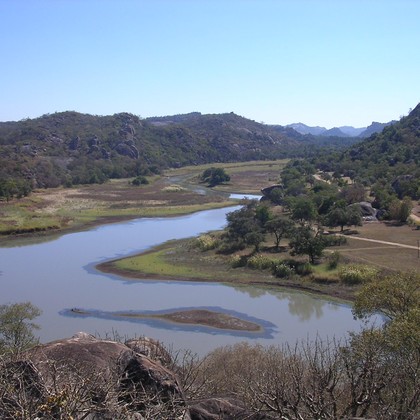
Moist to semi-arid woodland, especially miombo, mixed broadleaf woodland and mopane, also forest edges, riverine woodland and open country with scattered tall trees, sometimes around fields and villages. It hunts patiently from a branch a few metres up. The nest is a small stick platform in a tree fork, often lined with green leaves.
Where the bird is most at home, classified by the vegetation units of southern Africa.

Range and movements
In the north and east of the region: Angola, Zambia, Malawi, Mozambique, Zimbabwe, northern Botswana, the Caprivi Strip and north-eastern Namibia, Eswatini and north-eastern South Africa, from Limpopo and the Mpumalanga lowveld to northern KwaZulu-Natal. Absent from the arid west and the interior of South Africa. Beyond the region it occurs in savannas across almost all of sub-Saharan Africa.
- Resident
- Summer visitor (c. Oct–Mar)
- Winter visitor (c. Apr–Sep)
- Passage (Mar–Apr, Oct–Nov)
- dark = core range, pale = thinly spread
How and when to look
In the breeding season, September–December, the species is easiest to find by its whistled call from the woodland. Look for a compact grey raptor sitting upright on a dead branch; through binoculars the black throat stripe is then obvious at once. In miombo in Zambia, Malawi and Mozambique it is one of the most frequently seen raptors.
Conservation status
Not threatened; common in suitable woodland. Clearing of miombo for farming and charcoal reduces habitat locally, but the species tolerates a fair amount of disturbance and also hunts in semi-open farmland.
Scientific name
Kaupifalco monogrammicus | (Temminck, 1824)
Temminck described the species in 1824 as Falco monogrammicus; because it was later moved to another genus, the author and year stand in brackets. The genus Kaupifalco was introduced in 1854 by Bonaparte. Kaupifalco honours the German naturalist Johann Jakob Kaup (1803–1873), combined with the Latin falco, 'falcon'. monogrammicus comes from the Greek monos, 'single', and gramma, 'line' — for the single black stripe down the white throat. The specimen the first description was based on came from Senegal.