All species › Birds of prey › Hawks, eagles and kites › Long-Crested Eagle
Long-Crested Eagle | Lophaetus occipitalis
Afrikaanse zwarte kuifarend | Águila Crestilarga
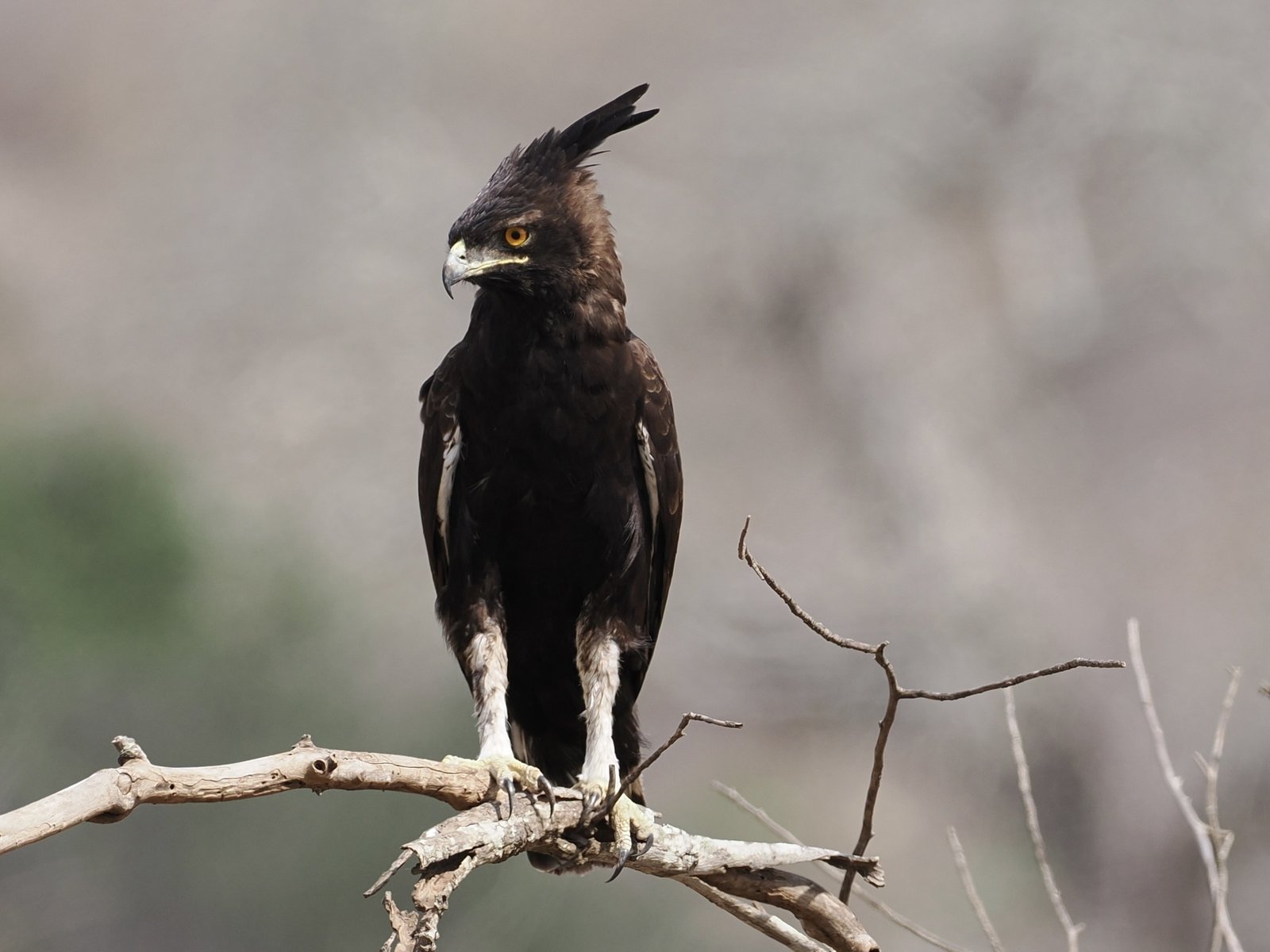
The Long-Crested Eagle is a medium-sized, almost entirely black eagle with a long, floppy crest that whips to and fro in every gust of wind. It likes to sit conspicuously on poles and dead trees along roads and moist grasslands, watching for rodents.
Voice
Noisy, especially in flight and in the breeding season: a high kee-ee-ee-ee-eh or kik-kik-kik-keee, sometimes also at night.
Recording: Sreekar — CC BY-NC-SA 4.0 · converted to mono · xeno-canto
Identification
53–58 cm, wingspan 115–130 cm. Dark blackish brown, with a long, upright or backward-flowing crest of loose feathers, bright yellow eyes and yellow cere and feet. The thighs are whitish in the male, browner and mottled in the female; the female also has a shorter crest. In flight large white patches at the base of the primaries stand out, above and below, along with a white leading edge to the underwing, barred white flight feathers and a black-and-white barred tail. The juvenile is duller brown, with a short crest and grey eyes.
Confusion species
The dark morph of Wahlberg's Eagle (Hieraaetus wahlbergi) has only a small crest, dark eyes and a narrow, square tail without white wing patches. Verreaux's Eagle (Aquila verreauxii) is much larger, jet black with a white V on the back and a white rump. The dark morph of Booted Eagle lacks the crest and has pale 'landing lights' on the shoulders.
Habitat
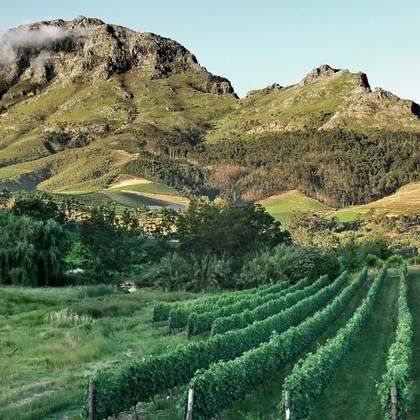
Moist open landscapes with trees: edges of riverine forest and thickets, vleis and marshy grassland, forest edges, eucalyptus and pine plantations and farmland with scattered trees. It hunts mainly rats and mice, such as vlei rats, from a perch, and sometimes small birds and reptiles. The nest is placed in the crown of a tree, often in a plantation or along a stream.
Where the bird is most at home, classified by the vegetation units of southern Africa.


Range and movements
The moist east and north of the region: the eastern half of South Africa (Eastern Cape, KwaZulu-Natal, Mpumalanga, Limpopo and the eastern Free State), Eswatini, Zimbabwe (mainly the east and the plateau), Mozambique, Malawi, Zambia and Angola; scarce in northern Botswana and north-eastern Namibia. Beyond the region throughout Africa south of the Sahara, from Senegal to Ethiopia.
- Resident
- Summer visitor (c. Oct–Mar)
- Winter visitor (c. Apr–Sep)
- Passage (Mar–Apr, Oct–Nov)
- dark = core range, pale = thinly spread
How and when to look
Drive the roads through the moist grasslands and plantations of Mpumalanga and KwaZulu-Natal and check every telephone pole and dead tree: a black eagle with a flowing crest is instantly recognisable. In flight the white wing patches give the species away even at a distance.
Conservation status
Not threatened. The species benefits locally from plantations and farmland with rodents, but suffers from rodent poisoning and collisions with traffic.
Scientific name
Lophaetus occipitalis | (Daudin, 1800)
Daudin described the species in 1800 as Falco occipitalis; because it was later moved to another genus, the author and year stand in brackets. The genus Lophaetus was introduced in 1847 by Kaup. Lophaetus comes from the Greek lophos, 'crest', and aetos, 'eagle' — for the long, floppy crest of Long-crested Eagle. occipitalis is Latin for 'of the back of the head' (occiput) — for the long crest that grows from there. The specimen the first description was based on came from Knysna district, Cape Province.