All species › Bustards › Bustards and korhaans › Northern Black Korhaan
Northern Black Korhaan | Afrotis afraoides
Botswanatrap | Sisón Negro Aliclaro
The Northern Black Korhaan is the northern counterpart of the Southern Black Korhaan and one of the most frequently seen bustards of the interior, from the Kalahari to the Highveld. The male is conspicuous for its display flight: calling loudly it flutters up, then drops slowly on slow wingbeats with its yellow legs dangling, showing large white patches in the wings.

Voice
A loud, rasping kraak-kraak-kraak or kerrak-kerrak, from the ground and during the display flight, sometimes in a rapid series that fills the whole valley. The male calls throughout the day, most in the morning and in the breeding season; the female is largely silent.
Recording: Yoann Blanchon — CC BY-NC-SA 4.0 · converted to mono · xeno-canto
Identification
50–53 cm. The male has a black head, neck and underparts with a large white cheek and ear patch and a narrow white band across the hindneck; the upperparts are finely barred black and cream. Bill red with a dark tip, legs bright yellow. In flight a broad white patch across the base of the primaries, which on the standing male is sometimes visible as a white line along the wing edge. The female has a tawny, finely barred head and neck, a whitish breast and a black belly. Juveniles resemble the female.
Confusion species
The Southern Black Korhaan (Afrotis afra) of the south-west is almost identical, but the male has wholly black primaries in flight and the female a rufous-barred breast; hybrids occur in the narrow contact zone along the Karoo. The Red-Crested Korhaan (Lophotis ruficrista) has a grey head and neck and V-markings on the back. The White-Bellied Bustard (Eupodotis senegalensis) and Blue Korhaan (Eupodotis caerulescens) lack the black neck.
Habitat
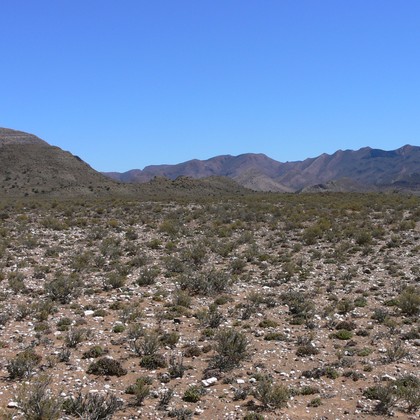
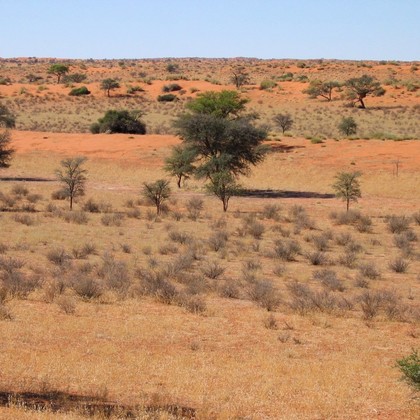
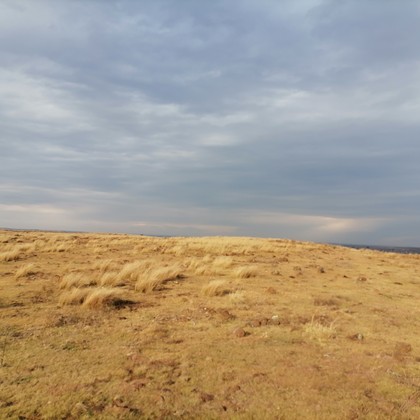
Open, dry plains with grass and low shrubs: Nama Karoo, Kalahari thornveld, dry highveld grassland and open acacia savanna, also fallow land and extensively grazed farms. It avoids dense woodland and tall, dense grassland. It eats insects, especially termites, ants and beetles, as well as seeds and green plant material.
Where the bird is most at home, classified by the vegetation units of southern Africa.
Range and movements
Almost endemic to the region: most of Namibia except the barren Namib Desert, all of Botswana except the north with the Okavango and Chobe, the South African interior (Northern Cape, Free State, North West, Gauteng, southern Limpopo and the northern Karoo into the Eastern Cape), western Lesotho and the extreme south-west of Angola. Not known outside the region.
- Resident
- Summer visitor (c. Oct–Mar)
- Winter visitor (c. Apr–Sep)
- Passage (Mar–Apr, Oct–Nov)
- dark = core range, pale = thinly spread
How and when to look
One of the easiest bustards to see: drive through the Kgalagadi, Mokala National Park or the Free State and watch for males calling from the ground or hanging over the veld in display flight. The female usually hides among the bushes and is often noticed only when the male accompanies her.
Conservation status
Not threatened and common across much of the interior. It declines locally through intensive agriculture and collisions with power lines, but tolerates extensive stock farming well and has a large, largely intact range.
Scientific name
Afrotis afraoides | (Smith, 1831)
Smith described the species in 1831 as Otis Afraoïdes; because it was later moved to another genus, the author and year stand in brackets. The genus Afrotis was introduced in 1855 by Gray. Afrotis combines the Latin Afer, 'African', with the Greek ōtis, 'bustard' — an 'African bustard'. afraoides means 'resembling afra', with the Greek suffix -oides — for its close resemblance to Southern Black Korhaan. The specimen the first description was based on came from Flats near the Orange River.