All species › Passerines › Reed warblers › Olive-Tree Warbler
Olive-Tree Warbler | Hippolais olivetorum
Griekse spotvogel | Zarcero Grande
The Olive-Tree Warbler is the largest Hippolais warbler: a grey, long-billed bird from the Balkans and the Middle East that winters from November to March in dense acacia thickets in the north-east of the region. It is shy and unobtrusive, but gives itself away by its low, grating song, which it also utters in Africa.

Voice
The song is low, slow and grating, a series of harsh, clacking notes with some more melodious passages, recalling Great Reed Warbler but less loud and calmer in rhythm. The call is a hard, dry chak or tak, often repeated.
Recording: Stanislas Wroza — CC BY-NC-SA 4.0 · shortened to the first 60 s, mono · xeno-canto
Identification
16–17 cm, large and elongated, with a long, heavy, dagger-shaped bill with a yellow-orange lower mandible and a flat forehead. The upperparts are plain grey, the underparts off-white with a grey wash on the flanks. A short white supercilium runs in front of the eye and a pale eye-ring gives a ‘spectacled’ look. The wings are long, with a conspicuous pale wing panel formed by white edges to the secondaries and tertials, and a long primary projection. The tail is dark grey with white edges to the outer feathers. The legs are sturdy and blue-grey. The sexes are alike. It moves slowly and heavily through dense foliage and sometimes dips its tail.
Confusion species
Upcher's Warbler Hippolais languida, not certainly recorded in the region, is smaller, has a shorter bill and constantly waves its dark tail. Icterine Warbler Hippolais icterina is smaller and green and yellow. Barred Warbler Curruca nisoria is also large and grey with pale wingbars, but has a short, thick bill, a yellow iris and (in adults) barred underparts. Garden Warbler Sylvia borin is smaller and brownish grey with a short, stubby bill. Great Reed Warbler Acrocephalus arundinaceus is warm brown with a rounded tail and lives in reeds.
Habitat
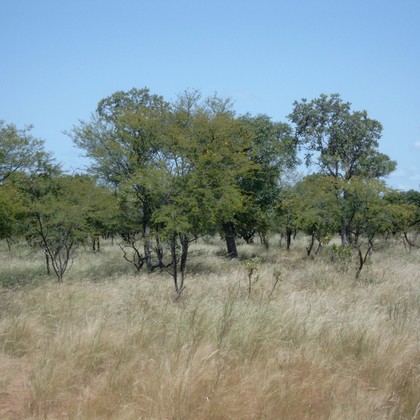
Dense, tall thorn scrub and acacia clumps in savanna, especially around termite mounds and along dry riverbeds, and dense patches in mixed woodland. It forages low to mid-level in thick foliage for insects.
Where the bird is most at home, classified by the vegetation units of southern Africa.

Range and movements
Within the region mainly in eastern Botswana, southern and western Zimbabwe and in South Africa in Limpopo, North West, Gauteng and Mpumalanga; scarcer in north-eastern Namibia, southern Zambia, Malawi and Mozambique. It breeds in south-eastern Europe, Turkey and the Levant and winters in eastern and southern Africa, from Kenya and Tanzania southwards.
- Summer visitor (c. Oct–Mar)
- dark = core range, pale = thinly spread
How and when to look
From December to March; search dense acacia thickets in, for example, the Mapungubwe and Marakele areas, the Pilanesberg area or southern Kruger National Park, and listen for the low, grating song and hard chak. Wait by a bush the song is coming from; the bird sometimes shows briefly at the edge, when the long bill and white wing panel stand out.
Conservation status
Not threatened. The breeding population is small and fragmented and declining locally through the loss of olive groves and scrub in the breeding range. In southern Africa the species is scarce, unobtrusive and little known.
Scientific name
Hippolais olivetorum | (Strickland, 1837)
Strickland described the species in 1837 as Salicaria olivetorum; because it was later moved to another genus, the author and year stand in brackets. The genus Hippolais was introduced in 1827 by Conrad von Baldenstein. Hippolais goes back to Greek hupolais, a small bird mentioned by Aristotle, misspelt by Linnaeus; the word may be onomatopoeic or formed from hupo 'under' and laas 'stone'. olivetorum is Latin for 'of the olive groves', after the habitat in which the bird breeds. The specimen the first description was based on came from Zakynthos, Greece.