All species › Passerines › Reed warblers › Icterine Warbler
Icterine Warbler | Hippolais icterina
Spotvogel | Zarcero Icterino
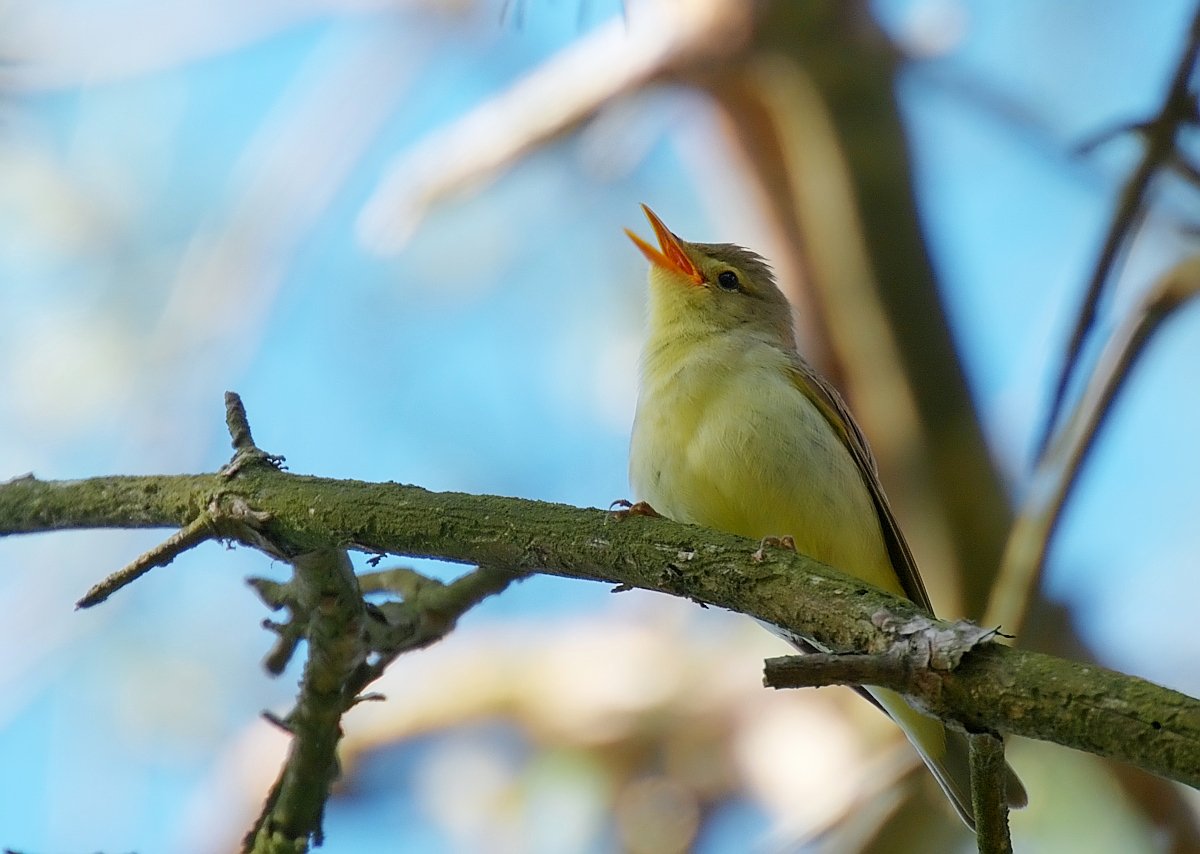
The Icterine Warbler is a green-and-yellow Palearctic warbler with a broad, orange-pink bill that winters from November to March in the acacia savannas of the west of the region. Unlike many migrant warblers it sings regularly in Africa, giving its loud, varied song full of mimicry, so that it is often heard before it is seen.
Voice
The song is loud, fast and highly varied, a mixture of melodious whistles, high and nasal sounds and mimicry, in which a characteristic gee-gee-woo or hete-hweet keeps recurring; long phrases, often from cover. The call is a short tek and a three-syllable de-de-roi.
Recording: Radek Grochowski — CC BY-NC-SA 4.0 · converted to mono · xeno-canto
Identification
13–14 cm, with a flat forehead, an often slightly peaked crown and a broad, fairly long bill with an orange-pink lower mandible. The upperparts are olive-green, the underparts lemon to pale yellow. A short yellow supercilium reaches just behind the eye; the eye-stripe is weak, giving the head an open, ‘friendly’ expression. The long primary projection (about as long as the tertials) and a pale panel on the secondaries are good features, although the panel is faint in worn birds. The legs are blue-grey. Some birds are paler and greyer, with hardly any yellow. It moves rather heavily and forages in the canopy of acacias.
Confusion species
African Yellow Warbler Iduna natalensis is warmer yellow-brown above, has shorter wings without a panel, a rounder head and a dark bill, and lives in rank growth near water, not in dry savanna. Willow Warbler Phylloscopus trochilus is smaller, with a fine, pointed bill, a clearer supercilium and restless, leaf-warbler behaviour. Olive-Tree Warbler Hippolais olivetorum is larger and grey, without yellow. Garden Warbler Sylvia borin is grey-brown with a short, stubby bill. Yellow-Bellied Eremomela Eremomela icteropygialis is much smaller and grey with only a yellow belly.
Habitat
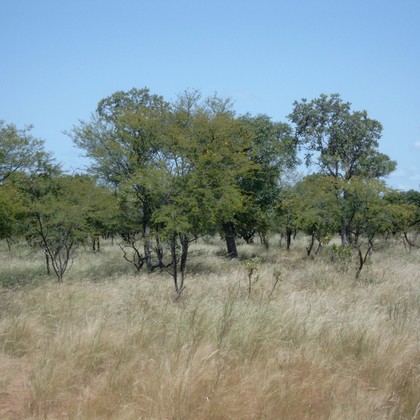
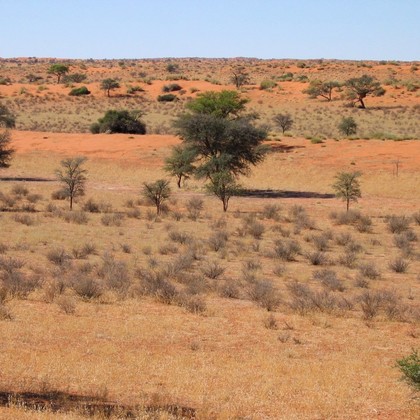
Acacia savanna and thornveld, Kalahari thornveld, dry mixed woodland and scrub, often in tall, dense acacias and along dry riverbeds; also in gardens and tree clumps in the dry west. It forages in the canopy for insects and also takes berries.
Where the bird is most at home, classified by the vegetation units of southern Africa.

Range and movements
Within the region mainly in the west and centre: Namibia (north and centre), Botswana, western and southern Zambia, western Zimbabwe and in South Africa in Limpopo, North West, Gauteng, the Free State and the Northern Cape; scarce in southern Angola, Malawi and Mozambique. It breeds in Europe and western Russia and winters almost entirely in southern and south-central Africa.
- Summer visitor (c. Oct–Mar)
- Passage (Mar–Apr, Oct–Nov)
- dark = core range, pale = thinly spread
How and when to look
From late November to March; listen in the morning in acacia savanna for the loud, varied song with its nasal repetitions, for example in the Kgalagadi Transfrontier Park, the Pilanesberg area or the savannas around Windhoek. Wait patiently by a singing tree: the bird often shows briefly on the outside, and then the long wings and orange-pink bill are easy to see.
Conservation status
Not threatened. The European breeding population is large and fairly stable, although the species is declining in western Europe. There are no clear threats in the wintering range; loss of acacia savanna to clearance plays a local role.
Scientific name
Hippolais icterina | (Vieillot, 1817)
Vieillot described the species in 1817 as Sylvia icterina; because it was later moved to another genus, the author and year stand in brackets. The genus Hippolais was introduced in 1827 by Conrad von Baldenstein. Hippolais goes back to Greek hupolais, a small bird mentioned by Aristotle, misspelt by Linnaeus; the word may be onomatopoeic or formed from hupo 'under' and laas 'stone'. icterina is Greek for 'jaundice-yellow', from ikteros, which denoted both jaundice and yellow-green birds, after the yellow underparts. The specimen the first description was based on came from France.