All species › Waders, gulls and terns › Plovers and lapwings › Pacific Golden Plover
Pacific Golden Plover | Pluvialis fulva
Aziatische goudplevier | Chorlito Dorado Siberiano
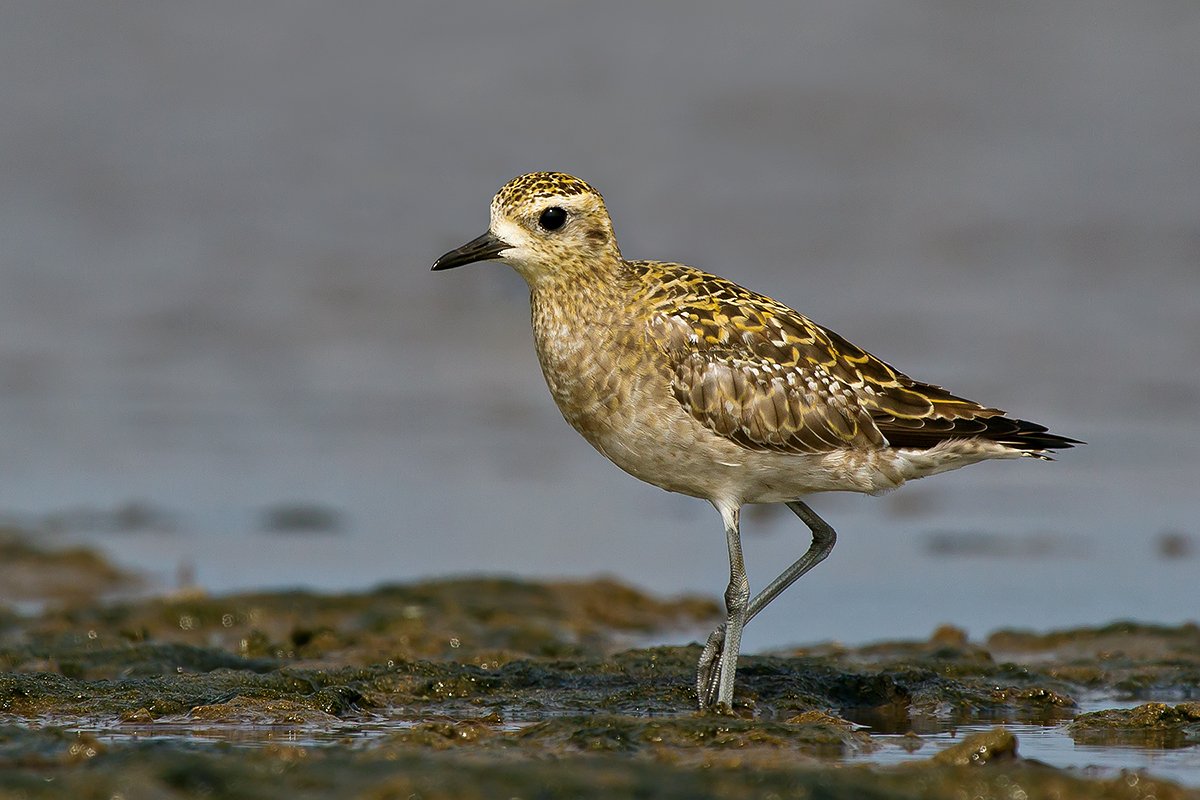
The Pacific Golden Plover is a slender, golden-yellow plover of the Siberian tundra that reaches the east coast of Africa in small numbers. In southern Africa it is scarce but almost annual, usually as a single bird among Grey Plovers on a tidal flat.
Voice
A clear, quick disyllabic chu-weet, rising slightly at the end, softer and more melodious than the call of American Golden Plover; often on take-off.
Recording: Feather V — CC BY-NC-SA 4.0 · converted to mono · xeno-canto
Identification
23–26 cm. Smaller, slimmer and longer-legged than Grey Plover, with a small head and a fine bill. In non-breeding plumage warm buff-brown, with golden and pale spotting on the upperparts, a buff-tinged breast and face and a pale, often yellowish supercilium. The tertials are long and show only two or three primary tips; the wing tips barely reach beyond the tail. In flight a faint wing bar and a grey-brown underwing. In breeding plumage black from face to belly, with a white band down the side of the neck that continues along the flanks.
Confusion species
American Golden Plover Pluvialis dominica is greyer, with a sharper white supercilium, shorter legs, short tertials and a long primary projection of four or five tips reaching well past the tail. Grey Plover Pluvialis squatarola is larger and greyer, with a heavy bill, a white rump and black axillaries in flight.
Habitat
Tidal mudflats, estuaries, saltmarsh, and short grassland and fields close to the coast, also salt pans and the shores of coastal lakes. It roosts on small beaches or grassland with other waders and then also feeds on land.
Where the bird is most at home, classified by the vegetation units of southern Africa.


Range and movements
In the region mainly along the coast of Mozambique, KwaZulu-Natal and the Eastern Cape, rarer west to the Western Cape and Namibia; occasional inland, including in Zimbabwe, Zambia and Botswana. It breeds on the tundra of northern Siberia and western Alaska and winters in South and South-East Asia, Australia, on Pacific islands and in smaller numbers along the East African coast.
- Summer visitor (c. Oct–Mar)
- Passage (Mar–Apr, Oct–Nov)
- dark = core range, pale = thinly spread
How and when to look
Search the estuaries of Mozambique and KwaZulu-Natal from November to March, for example around Inhambane, at the Mlalazi mouth and in the St Lucia estuary, among the Grey Plovers. The smaller size, buffy tone and lack of black axillaries on take-off are the first clues; then always check the primary projection.
Conservation status
Not threatened, although numbers on the East Asian–Australasian Flyway are falling through the loss of intertidal habitat around the Yellow Sea. In southern Africa it involves only a few birds a year.
Scientific name
Pluvialis fulva | (Gmelin, 1789)
Gmelin described the species in 1789 as Charadrius fulvus; because it was later moved to another genus, the author and year stand in brackets. The genus Pluvialis was introduced in 1760 by Brisson. Pluvialis is Latin for 'relating to rain', from pluvia 'rain', from the old belief that these plovers flocked when rain was imminent. fulva is Latin for 'tawny, yellowish-brown', after the golden spangling of the upperparts. The specimen the first description was based on came from Tahiti.