All species › Waders, gulls and terns › Plovers and lapwings › Grey Plover
Grey Plover | Pluvialis squatarola
Zilverplevier | Chorlito Gris
The Grey Plover is the largest plover of the coast: a stocky grey wader with a heavy bill that walks alone over the mud, pauses and then strikes. In flight its black axillaries give it away at long range.

Voice
A plaintive, three-syllable whistle tlee-oo-ee, the middle note lower, often given on take-off and carrying far across the flats. Usually silent at rest.
Recording: Teet Sirotkin — CC BY-NC-SA 4.0 · converted to mono · xeno-canto
Identification
27–31 cm. In non-breeding plumage, which predominates in southern Africa, the bird is grey-brown with fine white and dark spotting on the upperparts, a faintly streaked grey breast and a white belly; the head is large, the eye dark and the bill short, heavy and black. In flight it shows a white wing bar, a white rump and a white, finely barred tail, and above all black axillaries against a white underwing. In March and April some birds are already moulting into breeding plumage: silvery-white spangled upperparts and black cheeks, throat, breast and belly, bordered with white.
Confusion species
Pacific Golden Plover Pluvialis fulva and American Golden Plover Pluvialis dominica are smaller and slimmer, with a smaller bill, a more buffy-yellow tone and an obvious pale supercilium; in flight they have a grey underwing without black axillaries and no white rump. Red Knot Calidris canutus has a similar grey tone but is a sandpiper with a longer, thinner bill and a different, busier feeding action.
Habitat
Tidal mudflats, estuaries, lagoons, coastal salt pans and sandy beaches; only rarely inland on large lakes and salt pans. It forages dispersed and territorially for worms, molluscs and crabs, with the typical plover action of run, stop and peck; it roosts at high tide in flocks with other waders.
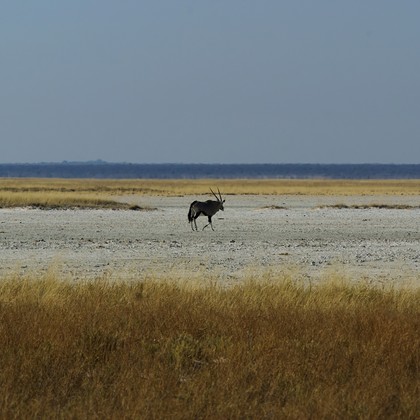
Where the bird is most at home, classified by the vegetation units of southern Africa.

Range and movements
Along almost the whole coast of the region: Angola, Namibia, South Africa and Mozambique, with the largest numbers in the lagoons and bays of Walvis Bay, Langebaan and the Mozambican coast. Inland a scarce passage migrant, including in Zambia, Botswana and Zimbabwe. It breeds on the Arctic tundra of Eurasia and North America and winters along the coasts of every continent.
- Resident
- Summer visitor (c. Oct–Mar)
- Winter visitor (c. Apr–Sep)
- Passage (Mar–Apr, Oct–Nov)
- dark = core range, pale = thinly spread
How and when to look
Best from October to March on a rising tide in an estuary or lagoon, when the birds are pushed closer to the shore; Langebaan, Walvis Bay and the estuaries of KwaZulu-Natal and Mozambique are reliable. Let a bird take flight or wait until it stretches its wings: the black axillaries settle the matter at once.
Conservation status
Vulnerable on the global Red List, after steep declines on several flyways, partly through loss of intertidal habitat around the Yellow Sea and in western Europe. A few thousand birds winter in southern Africa, and numbers there are also falling. Disturbance on beaches and mudflats and the degradation of estuaries are the main local threats.
Scientific name
Pluvialis squatarola | (Linnaeus, 1758)
Linnaeus described the species in 1758 as Tringa Squatarola; because it was later moved to another genus, the author and year stand in brackets. The genus Pluvialis was introduced in 1760 by Brisson. Pluvialis is Latin for 'relating to rain', from pluvia 'rain', from the old belief that these plovers flocked when rain was imminent. squatarola is a Latinised form of sgatarola, a Venetian name for some kind of plover. The specimen the first description was based on came from Sweden.