All species › Cranes, rails and allies › Flufftails › White-Winged Flufftail
White-Winged Flufftail | Sarothrura ayresi
Witvleugelral | Polluela Especulada
The White-Winged Flufftail is one of Africa's rarest and most enigmatic birds: a small rail of high-altitude, seasonal marshy grasslands, known from a handful of sites in South Africa and Ethiopia. It is the only rail in the region to show a bright white patch on the wing in flight.
No photograph of a living wild bird of this species with a suitable Creative Commons licence exists. Do you have one that meets the rules? Send it in.
Voice
On the breeding grounds a series of low, soft, hollow notes, woop-woop-woop, mainly at dusk and at night. In South Africa it is rarely heard; calling birds are known mainly from Ethiopia.
No recording with a suitable Creative Commons licence is available for this species yet.
Identification
About 14 cm, the smallest rail in the region. The male has a chestnut head, neck and breast, a black back with fine white streaks and black-and-white barred flanks; the short tail is chestnut with black barring. The female is browner, with pale scaling above and fine barring below, but has the same wing pattern. In flight both sexes show white secondaries forming a square white panel. The male's throat is whitish. It flushes briefly, low and fluttering, and quickly drops back into cover.
Confusion species
The Red-Chested Flufftail (Sarothrura rufa) and the Striped Flufftail (Sarothrura affinis) are slightly larger and have no white in the wing; the Red-chested has a black tail, the Striped a rufous one. The female Red-chested is darker and more densely barred. In flight, a white wing patch on a rail of this size is decisive.
Habitat
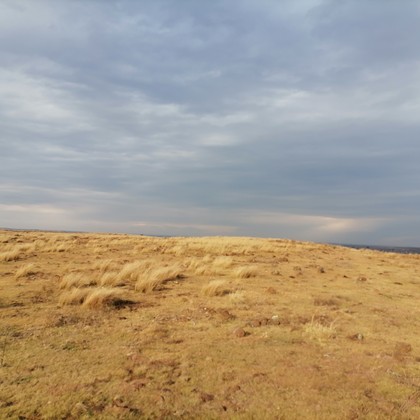
High-altitude vleis and marshy grasslands with dense, roughly knee-high sedges, rushes and grasses in shallow, still water, often flooded only in the wet season. It feeds on small invertebrates and seeds. The South African sites lie at 1,300–2,000 m.
Where the bird is most at home, classified by the vegetation units of southern Africa.

Range and movements
In the region known almost only from a few high-altitude vleis in Mpumalanga and north-western KwaZulu-Natal, such as Middelpunt and Wakkerstroom, with older or isolated records from the Free State, the Eastern Cape and Zimbabwe; an early specimen comes from Zambia. Beyond the region a small population breeds on the Ethiopian highlands. Whether South African birds migrate or remain all year is still uncertain.
How and when to look
Searching for this species is only advisable with local guides and conservation staff; trampling of breeding vleis is harmful. Organised rope-drags at Wakkerstroom and Middelpunt occasionally flush a bird, and camera traps have confirmed the species there. A fast-flushing small rail with white wing panels is the only field identification.
Conservation status
Critically Endangered. The world population is estimated at a few hundred mature birds and is declining through the draining, overgrazing, burning and peat mining of high-altitude vleis, and in Ethiopia chiefly through mowing and grazing of the breeding sites. In South Africa conservation projects are under way around the key vleis.
Scientific name
Sarothrura ayresi | (Gurney, 1877)
Gurney described the species in 1877 as Coturnicops ayresi; because it was later moved to another genus, the author and year stand in brackets. The genus Sarothrura was introduced in 1890 by Heine. Sarothrura comes from the Greek sarōtron, 'broom', and oura, 'tail' — for the short, brush-like tail of these small rails. ayresi honours Thomas Ayres (1828–1913), an English bird collector in Natal and the Transvaal, who found the first specimen near Potchefstroom. The specimen the first description was based on came from Potchefstroom, South Africa.