All species › Cranes, rails and allies › Flufftails › Striped Flufftail
Striped Flufftail | Sarothrura affinis
Strepenral | Polluela Estriada
The Striped Flufftail is a tiny, mouse-like rail of dry, rank grassland on mountain slopes, not of marshes like most rails. It is almost impossible to see in dense grass and is recorded nearly always by its low, owl-like series of hoots.
Voice
A series of low, hollow, owl-like notes, hoo-hoo-hoo-hoo, at about two notes per second and sometimes kept up for minutes, mainly at dusk and in overcast weather. Also a sharp, short tick in alarm.
Recording: Murray Christian — CC BY-NC-SA 4.0 · shortened to the first 60 s, mono · xeno-canto
Identification
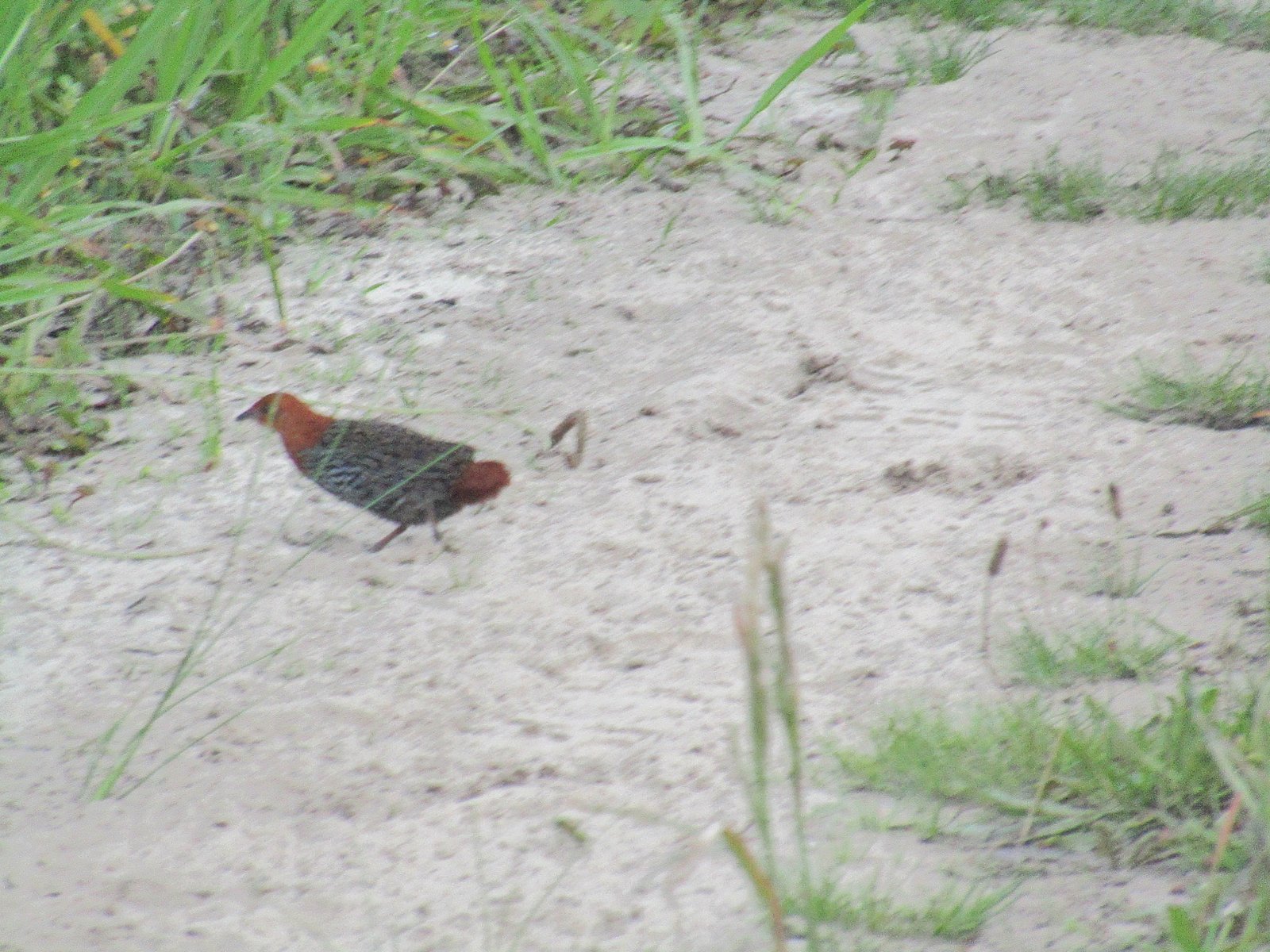
About 15 cm, compact, with a short bill and a short fluffy tail. The male has a chestnut head, neck and breast; the rest of the body is black with long, narrow pale streaks on the back as well as the belly and flanks. The tail is rufous, a feature shown so clearly by no other rail in the region. The female is brown with fine black and pale scaling above, paler and softly barred below, and also has a rufous tail. Juveniles are uniformly dark. It rarely flushes, and then flies briefly and low with legs dangling.
Confusion species
The Red-Chested Flufftail (Sarothrura rufa) has a black, finely streaked tail and chestnut extending well onto the belly; it lives in wet vleis, not on dry slopes. The Buff-Spotted Flufftail (Sarothrura elegans) is spotted rather than streaked and lives in forest. The White-Winged Flufftail (Sarothrura ayresi) has white secondaries and a barred tail. Females are difficult to tell apart; look for the rufous tail and the dry habitat.
Habitat
Dense, rank grassland on mountain slopes and plateaus, often some distance from water, and in the south-west also grassy, sedge-rich fynbos, especially a few years after fire. It creeps between grass tussocks in search of insects, spiders and seeds. The nest is a grass dome on the ground.
Where the bird is most at home, classified by the vegetation units of southern Africa.


Range and movements
Patchy and local in the mountain regions of South Africa: the fynbos ranges of the Western and Eastern Cape, the Drakensberg and the highlands of KwaZulu-Natal and Mpumalanga, and further in Lesotho and Eswatini, the Eastern Highlands of Zimbabwe and adjacent Mozambique, and the Nyika Plateau in Malawi and Zambia. Beyond the region in isolated montane areas of East Africa, from Tanzania to Kenya and South Sudan.
- Resident
- dark = core range, pale = thinly spread
How and when to look
In summer, listen on grassy mountain slopes at dusk or just after rain for the hollow series of hoots; the bird often calls from a fixed spot. Seeing one really requires great patience at the edge of a track or a recently burnt patch of grassland. Do not use playback in breeding areas.
Conservation status
Not threatened, but scarce and fragmented in distribution. The species is sensitive to overgrazing, too-frequent burning, invasion by alien trees and the spread of plantations in montane grassland. Owing to its secretive life, numbers and trends are poorly known.
Scientific name
Sarothrura affinis | (Smith, 1828)
Smith described the species in 1828 as Crex affinis; because it was later moved to another genus, the author and year stand in brackets. The genus Sarothrura was introduced in 1890 by Heine. Sarothrura comes from the Greek sarōtron, 'broom', and oura, 'tail' — for the short, brush-like tail of these small rails. affinis is Latin for 'related' — for its resemblance to other small rails. The specimen the first description was based on came from Not stated.