All species › Cranes, rails and allies › Flufftails › Streaky-Breasted Flufftail
Streaky-Breasted Flufftail | Sarothrura boehmi
Böhms ral | Polluela de Boehm
The Streaky-Breasted Flufftail is a migratory flufftail of seasonally wet grassland that arrives in Zambia and Zimbabwe from Central Africa in the rainy season to breed. It flies more readily than other flufftails and is often flushed when crossing flooded grass.
Voice
A long series of low, hollow notes, hoo hoo hoo hoo, about one per second, like blowing across the neck of a bottle, which can go on for many minutes. It calls mainly at dusk and at night, but also by day in overcast weather, during the breeding season in the rains.
Recording: Dries Van de Loock — CC BY-NC-SA 4.0 · converted to mono · xeno-canto
Identification
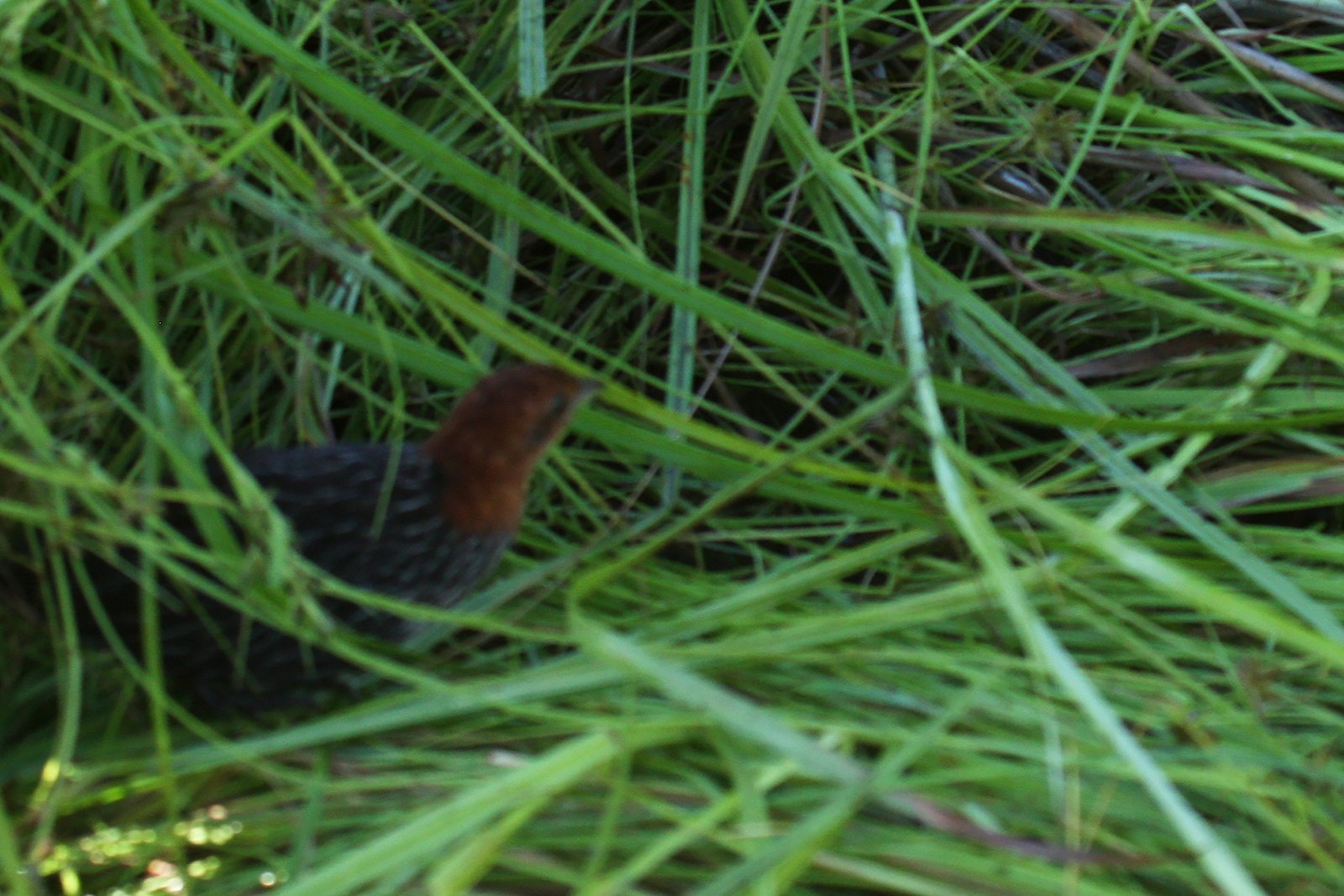
14–16 cm long, with a strikingly short tail and relatively long, pointed wings. The male has a chestnut head and neck, a white chin and throat, and a white breast and belly with black streaks on the breast and flanks; the upperparts are black with fine white streaks. The female is dark grey-brown above with pale buff scaling, has a dark head, not chestnut, and is whitish below with dark barring on the breast and flanks. Juveniles resemble the female but are darker.
Confusion species
Chestnut-Headed Flufftail Sarothrura lugens has dark, white-streaked rather than white underparts and a longer tail. The male Red-Chested Flufftail Sarothrura rufa has chestnut extending onto the breast and mantle and is black below. White-Winged Flufftail Sarothrura ayresi shows white secondaries in flight and has a barred tail. Female flufftails are very difficult; white underparts and a short tail point to Streaky-breasted.
Habitat
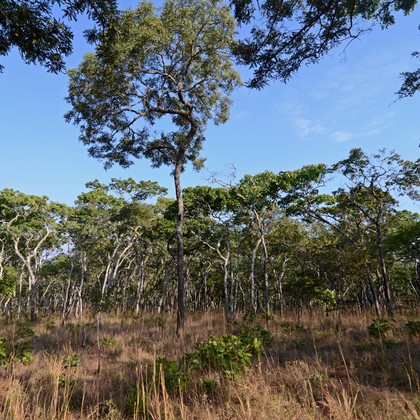
Short to medium-tall, seasonally flooded grassland with termite mounds, dambos in miombo and the edges of marshes, where water stands a few centimetres to decimetres deep. It breeds in dense grass in shallow water.
Where the bird is most at home, classified by the vegetation units of southern Africa.

Range and movements
A summer visitor to the region from November to April. Most widespread in Zambia; locally fairly common in north-eastern Zimbabwe, around Harare and Marondera, and scarce or poorly known in Malawi and Angola. Beyond the region it is patchily distributed in West, Central and East Africa, from Nigeria and Cameroon to Kenya and Tanzania; outside the breeding season the species probably moves to equatorial Africa.
- Summer visitor (c. Oct–Mar)
- dark = core range, pale = thinly spread
How and when to look
Search in December and January in flooded grassland and dambos in Zambia or around Harare, after heavy rain. Listen at dusk for the low, monotonous call series; by day the bird is most often seen when it flushes briefly and drops back in as you walk through wet grass.
Conservation status
Not threatened, but poorly known. Its habitat, seasonally wet grassland, is under local pressure from drainage, cultivation, grazing and development, especially around Harare.
Scientific name
Sarothrura boehmi | Reichenow, 1900
Reichenow described the species in 1900 and placed it straight away in the genus where it still stands. The genus Sarothrura was introduced in 1890 by Heine. Sarothrura comes from the Greek sarōtron, 'broom', and oura, 'tail' — for the short, brush-like tail of these small rails. boehmi honours the German zoologist and explorer Richard Böhm (1854–1884), who collected in East and Central Africa. The specimen the first description was based on came from Likulwe River, Katanga, DR Congo.