All species › Cranes, rails and allies › Flufftails › Chestnut-Headed Flufftail
Chestnut-Headed Flufftail | Sarothrura lugens
Ugallaral | Polluela Cabecirroja
The Chestnut-Headed Flufftail is one of the least known flufftails in Africa. In the region it occurs only very locally in the wet grasslands of the north, and most records are based on voice.
No photograph of a living wild bird of this species with a suitable Creative Commons licence exists. Do you have one that meets the rules? Send it in.
Voice
A long series of soft, hollow notes, hoo-hoo-hoo-hoo, slowly increasing in volume, and fast cackling series during duets. The call resembles that of Red-Chested Flufftail, with which it occurs locally; a recording is often needed to be sure.
Recording: Dries Van de Loock — CC BY-NC-SA 4.0 · converted to mono · xeno-canto
Identification
14–16 cm long, one of the smallest flufftails in the region. The male has a chestnut head and neck with a whitish chin and throat; the chestnut does not extend over the breast. The rest of the body is black with fine white streaks, the tail black with narrow white lines. The female resembles the male, likewise with a chestnut head, but has broader, more buffy streaks on the body. The bill is dark, the legs grey-brown.
Confusion species
The male Red-Chested Flufftail Sarothrura rufa is the most similar, but in that species the chestnut extends over the upper breast and mantle and the throat is not whitish; its female is brown without a chestnut head. Streaky-Breasted Flufftail Sarothrura boehmi has a white breast streaked black, a short tail and a brown- or grey-headed female. Striped Flufftail Sarothrura affinis has a chestnut tail.
Habitat
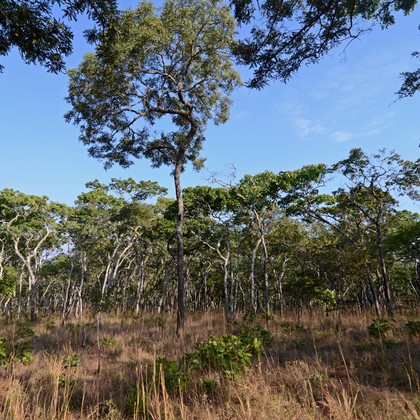
Wet grassland, permanent or seasonal, the edges of marshes and the boggy dambos of the miombo, usually with tall, dense grass and scattered bushes. It lives in drier, grassier vegetation than Red-Chested Flufftail.
Where the bird is most at home, classified by the vegetation units of southern Africa.

Range and movements
In the region very local in northern and north-western Zambia, northern Malawi and on the central plateau of Angola. Beyond the region it is patchily distributed in Central and East Africa: Cameroon, Gabon, DR Congo, Rwanda and Tanzania.
How and when to look
A species for a targeted search with an experienced local guide, for example in the dambos around Mwinilunga in Zambia. Listen along the edges of wet grassland on overcast days in the rainy season; sightings are rare.
Conservation status
Not threatened, but poorly known and rare in the region. Its habitat of wet grassland and dambos is locally threatened by drainage, agriculture and too-frequent burning.
Scientific name
Sarothrura lugens | (Böhm, 1884)
Böhm described the species in 1884 as Crex lugeus; because it was later moved to another genus, the author and year stand in brackets. The genus Sarothrura was introduced in 1890 by Heine. Sarothrura comes from the Greek sarōtron, 'broom', and oura, 'tail' — for the short, brush-like tail of these small rails. lugens is Latin for 'mourning' — for the dark plumage of the body and wings. The specimen the first description was based on came from Ugalla, Tanzania.