All species › Cranes, rails and allies › Flufftails › Red-Chested Flufftail
Red-Chested Flufftail | Sarothrura rufa
Roodborstral | Polluela Rufa
The Red-Chested Flufftail is the commonest flufftail of the region's reed marshes and, with some effort, also the easiest to see. A pair lives hidden in dense sedges and rushes but gives itself away with an endlessly repeated, hollow doo-doo-doo heard day and night, especially in the breeding season.
Voice
A long series of hollow repeated notes, doo-doo-doo-doo, and a louder, rising oo-oo-oo-oo, often in duet with a soft nasal tuk-tuk or a fast ticking kik-kik-kik from the mate. It calls throughout the day, especially in overcast weather, and at night.
Recording: Peter Ward — CC BY-NC-SA 4.0 · shortened to the first 60 s, mono · xeno-canto
Identification
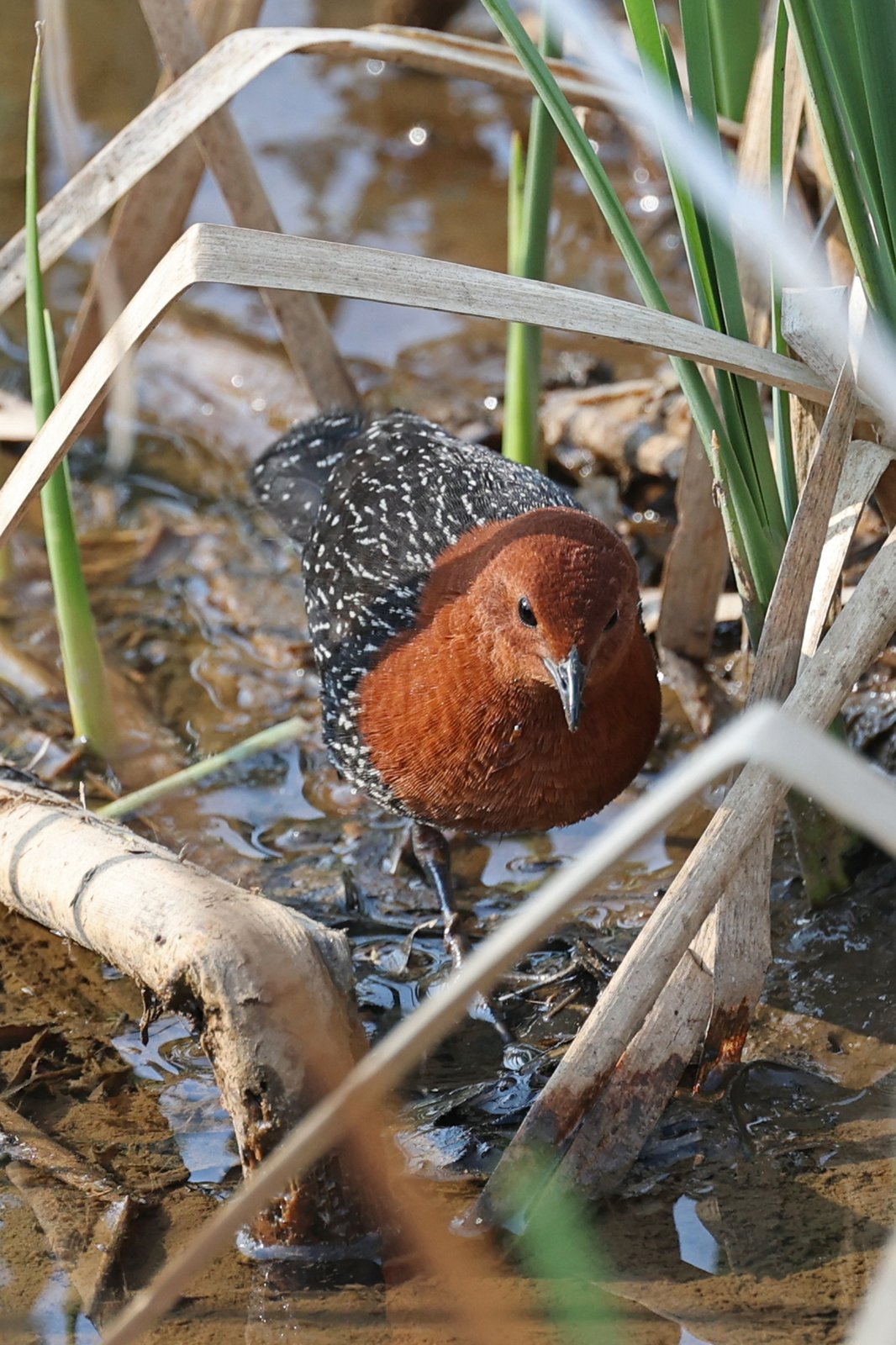
15–17 cm long. The male has a deep chestnut head and neck extending onto the upper breast and upper mantle; the rest of the body, including the tail, is black with fine white streaks, turning to spots on the belly. The female is dark brown with fine buff scaling and spotting, paler brown below with a pale throat, and lacks chestnut entirely. The bill is dark, the legs dark grey. Juveniles are plain dark brown to blackish.
Confusion species
The male Striped Flufftail Sarothrura affinis has a chestnut tail and chestnut restricted to the head; it lives in dry montane grassland. In Chestnut-Headed Flufftail Sarothrura lugens the chestnut is confined to head and neck and the throat is whitish. The male Streaky-Breasted Flufftail Sarothrura boehmi has a white throat and a white breast streaked black. Buff-Spotted Flufftail Sarothrura elegans has buff spots and a rufous tail and lives in forest. Females can only be separated with good views and on habitat.
Habitat
Dense, permanently wet vegetation of sedges, rushes, bulrushes and reeds in marshes, vleis, river margins and the edges of dams, also in small, fragmented wet patches in farmland and even in urban areas. It forages on wet ground and in shallow water among the stems, taking insects, larvae, snails and seeds.
Where the bird is most at home, classified by the vegetation units of southern Africa.

Range and movements
Widespread in the east and north of the region: in South Africa from the Cape Peninsula along the south coast to the Eastern Cape, KwaZulu-Natal, the highveld and Limpopo, and further in Lesotho, Eswatini, Zimbabwe, Mozambique, Malawi and Zambia. In Botswana in the Okavango Delta and along the Chobe, in north-eastern Namibia, and scattered in Angola. Beyond the region it occurs over much of sub-Saharan Africa, from Senegal to Ethiopia and Kenya.
- Resident
- Summer visitor (c. Oct–Mar)
- Winter visitor (c. Apr–Sep)
- Passage (Mar–Apr, Oct–Nov)
- dark = core range, pale = thinly spread
How and when to look
Heard at almost any dense reed marsh in eastern South Africa; seeing one is easiest from a hide or boardwalk, for example in the marshes around Wakkerstroom, at Marievale or in the wetlands of Cape Town. Do not use playback, but wait by an open muddy patch at the reed edge: in the early morning the bird sometimes crosses briefly.
Conservation status
Not threatened and widespread; locally lost through drainage, development and the burning of marsh vegetation. It can persist in small wet patches, even within built-up areas.
Scientific name
Sarothrura rufa | (Vieillot, 1819)
Vieillot described the species in 1819 as Rallus rufus; because it was later moved to another genus, the author and year stand in brackets. The genus Sarothrura was introduced in 1890 by Heine. Sarothrura comes from the Greek sarōtron, 'broom', and oura, 'tail' — for the short, brush-like tail of these small rails. rufa is Latin for 'rufous' — for the rufous head and breast. The specimen the first description was based on came from Africa (not further specified).