All species › Passerines › Chats and flycatchers › Pale Flycatcher
Pale Flycatcher | Agricola pallidus
Vale vliegenvanger | Papamoscas Pálido
The Pale Flycatcher is an inconspicuous, soft brown flycatcher of open woodland. It often sits with a few others low in a tree and drops to the ground like a shrike to seize an insect.

Voice
A rather quiet species. The song is a soft, short mixture of whistled and chattering notes, mainly in the early morning. The call is a soft tchirr or tchip.
No recording with a suitable Creative Commons licence is available for this species yet.
Identification
A fairly large, slender flycatcher of 15–17 cm. The upperparts are plain dull brown to greyish brown, the underparts off-white with a greyish-brown wash across the breast and flanks and no streaking. Flight feathers and coverts have narrow pale fringes, but there is no conspicuous wing panel. The bill is dark, the eye large and dark, sometimes with a faint pale eye-ring. The sexes are alike; juveniles are lightly spotted. It perches upright on a low branch and drops to the ground, then returns to a lookout.
Confusion species
Marico Flycatcher (Bradornis mariquensis) has clean white underparts contrasting sharply with the brown back, and lives in drier acacia savanna in the west; the two overlap in Botswana and Limpopo. Spotted Flycatcher (Muscicapa striata) is smaller, with a streaked crown and breast, and feeds mainly in the air; it is a summer visitor. African Dusky Flycatcher (Muscicapa adusta) is smaller and darker and lives in forest. Chat Flycatcher (Agricola infuscatus) is larger, with a pale wing panel, and lives in the arid west.
Habitat
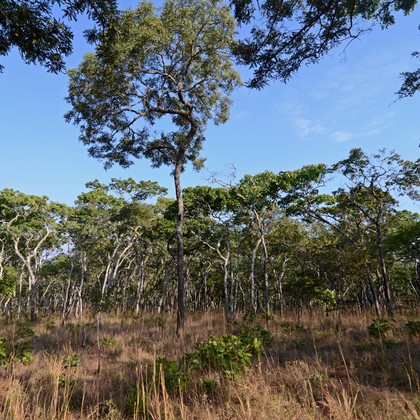
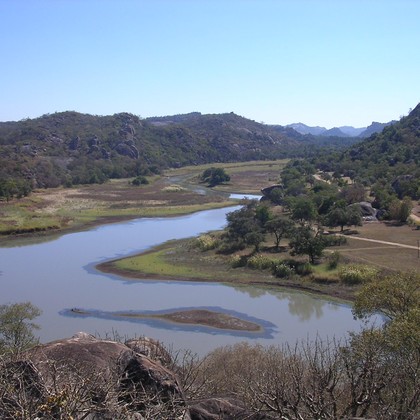
Miombo, mixed woodland and mopane with an open understorey, woodland edges, open riverine woodland and well-wooded gardens. It needs bare or short-grazed ground to forage.
Where the bird is most at home, classified by the vegetation units of southern Africa.

Range and movements
Widespread in Angola, Zambia, Malawi, Mozambique and Zimbabwe, northern and eastern Botswana, north-eastern Namibia and in South Africa in Limpopo, Mpumalanga and northern KwaZulu-Natal; also in Eswatini. Beyond the region in a broad belt from Senegal to Ethiopia and south through East Africa. Largely resident, with local movements outside the breeding season.
- Resident
- Summer visitor (c. Oct–Mar)
- Winter visitor (c. Apr–Sep)
- Passage (Mar–Apr, Oct–Nov)
- dark = core range, pale = thinly spread
How and when to look
In miombo and mixed woodland, look for a plain brown bird perched upright on a low branch that now and then drops to the ground; it also joins mixed foraging flocks. Where it occurs alongside Marico Flycatcher, the off-white, not sharply demarcated underparts are decisive.
Conservation status
Not threatened. The species is widespread and locally common, and numbers appear stable. Large-scale clearance of miombo and other woodland causes local declines.
Scientific name
Agricola pallidus | (Müller, 1851)
Müller described the species in 1851 as Musicapa pallida; because it was later moved to another genus, the author and year stand in brackets. The genus Agricola was introduced in 1854 by Bonaparte. Agricola is Latin for 'farmer, tiller of the fields', from ager, agri, 'field', and -cola, 'dweller' (from colere, 'to dwell in'). pallidus is Latin for 'pale' — for the pale brown plumage. The specimen the first description was based on came from Kordofan, Sudan.