All species › Passerines › Chats and flycatchers › Fiscal Flycatcher
Fiscal Flycatcher | Sigelus silens
Klauwiervliegenvanger | Papamoscas Fiscal
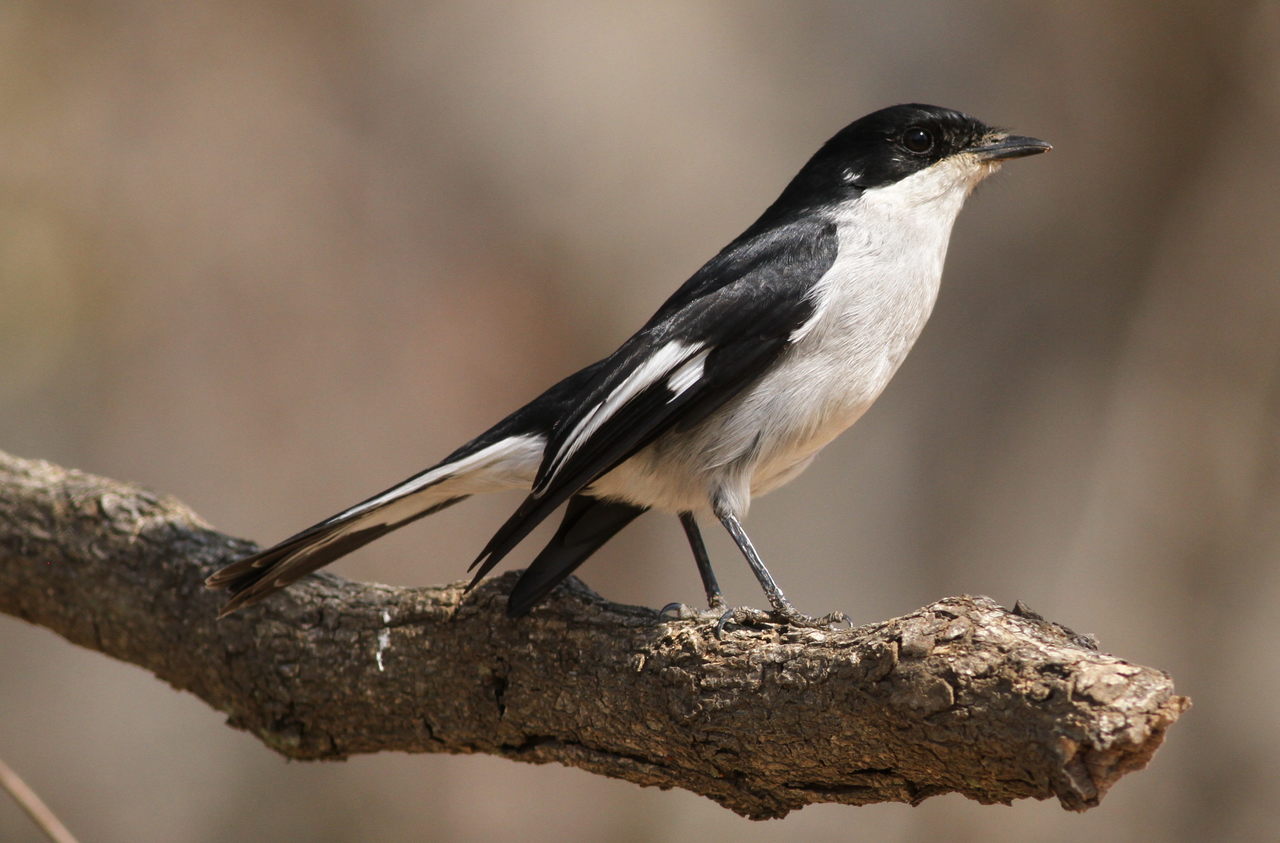
The Fiscal Flycatcher is a black-and-white flycatcher that closely resembles the Southern Fiscal in colour and posture, probably a form of mimicry. It is typical of fynbos, karoo and gardens in the south and west of South Africa.
Voice
Rather quiet and unobtrusive. The song is a soft, thin, high twittering of sibilant and scratchy notes, tsee-tsee-tchweep-srr, at times with mimicry. The call is a thin, high tseep, and a soft scratchy chrr when disturbed.
No recording with a suitable Creative Commons licence is available for this species yet.
Identification
17–20 cm. The male is glossy black above and pure white below, with a narrow white bar across the secondaries that shows on the perched bird as a white line along the edge of the wing, and with white sides to the tail base. The female is dark brown rather than black above, with the same wing and tail pattern. The bill is thin, straight and unhooked. Juveniles are brown with pale spots above and dark scaling on the breast. It perches upright on a post or bush top and drops to the ground to seize an insect.
Confusion species
Southern Fiscal (Lanius collaris) has a heavy hooked bill, a white V on the scapulars (not along the wing edge), white edges to the outer tail feathers rather than white sides at the tail base, and a longer, graduated tail that it swings from side to side. Southern Black Flycatcher (Melaenornis pammelaina) is wholly black. Southern Black Tit (Melaniparus niger) also has a white wing patch, but is smaller, with a black breast and grey belly, and clambers about in the canopy.
Habitat
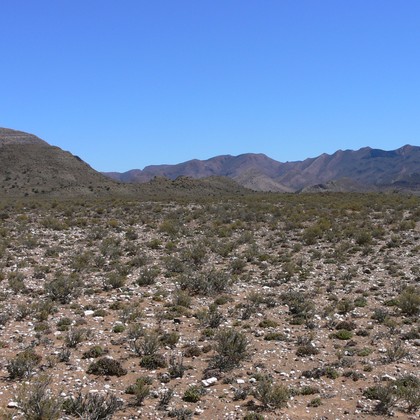
Fynbos, karoo scrub, open woodland edges, plantations and riverine bush, and commonly in gardens, parks and farmyards. It takes insects on the ground and in the air from a lookout perch, visits flowering aloes in winter for nectar and insects, and also eats berries. The nest is a cup in a dense shrub or creeper.
Where the bird is most at home, classified by the vegetation units of southern Africa.


Range and movements
Virtually endemic to the region. The core lies in the west and south of South Africa: the Western and Eastern Cape, the Karoo and Northern Cape, and on through the Free State, Lesotho, KwaZulu-Natal, Gauteng, Mpumalanga and Eswatini, with outliers in south-eastern Botswana and southern Namibia. In winter birds from the highlands move to lower ground in the east, as far as southern Mozambique and occasionally Zimbabwe. It does not occur outside the region.
- Resident
- Winter visitor (c. Apr–Sep)
- Passage (Mar–Apr, Oct–Nov)
- dark = core range, pale = thinly spread
How and when to look
Check every ‘fiscal’ in a Cape garden or fynbos edge: a thin bill and a white line along the wing edge rather than a V on the shoulders mean Fiscal Flycatcher. In winter it is easy to find around flowering aloes in the east of the country.
Conservation status
Not threatened. Common, and benefits from gardens, plantations and the spread of woody vegetation. No decline is known.
Scientific name
Sigelus silens | (Shaw, 1809)
Shaw described the species in 1809 as Lanius silens; because it was later moved to another genus, the author and year stand in brackets. The genus Sigelus was introduced in 1851 by Cabanis. Sigelus comes from the Greek sigēlos, 'silent, quiet' — like the epithet silens, an echo of Levaillant's name 'Le Silencieux' for this bird. silens is Latin for 'silent' — after Levaillant's name 'Le Silencieux' for this rather quiet bird. The specimen the first description was based on came from Knysna district, Western Cape, South Africa.