All species › Passerines › Chats and flycatchers › Böhm's Flycatcher
Böhm's Flycatcher | Myopornis boehmi
Böhms vliegenvanger | Papamoscas de Böhm
Böhm's Flycatcher is a small grey-brown flycatcher with white underparts covered in bold, triangular black spots. It is a speciality of the miombo in the north of the region, sitting quietly high in the trees and attracting little attention.

Voice
Quiet and inconspicuous. The call is a thin, high tseet or tsee-tsee, and the song a short, soft series of high sibilant notes. It is often noticed only when it sallies after an insect.
No recording with a suitable Creative Commons licence is available for this species yet.
Identification
12 cm, a compact flycatcher with a fairly short tail. The upperparts are grey-brown, the crown slightly darker, with pale lores and a narrow pale eye-ring. The underparts are white, with rows of bold, arrowhead-shaped blackish-brown spots across the breast and flanks; the belly and undertail-coverts are unspotted. Bill black, legs dark. The sexes are alike; juveniles also have pale spots on the upperparts. It perches upright on a bare branch in the middle or top of the canopy and makes short sallies.
Confusion species
Spotted Flycatcher (Muscicapa striata) is larger and longer-winged and has fine streaks on breast and crown rather than triangular spots; it is also a summer visitor from October to April. African Dusky Flycatcher (Muscicapa adusta) is darker brown with only faint, blurred breast streaking. Juveniles of other flycatchers are scaled or spotted above, but lack the sharp black arrowheads on white underparts.
Habitat
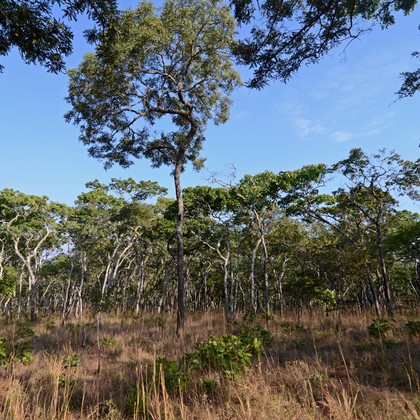
Tall, fairly open miombo with Brachystegia and Julbernardia, especially at the edges of dambos (grassy drainage flats within the woodland) and in places with scattered large trees. It catches insects in the air from a perch in the canopy, and at times in low flight over the grass. The nest is built in a hole or crevice in a tree.
Where the bird is most at home, classified by the vegetation units of southern Africa.
Range and movements
In the region in the miombo of the central and eastern Angolan plateau (mainly Bié, Moxico and the Lunda provinces), northern and north-western Zambia and the Copperbelt, and scarce in northern Malawi. Beyond the region in south-eastern DR Congo and western and south-western Tanzania.
- Resident
- dark = core range, pale = thinly spread
How and when to look
Look for it in Zambia along dambo edges in tall miombo, for example around Mwinilunga, Kasanka and the Copperbelt. Follow mixed foraging flocks and check every small flycatcher perched high on a dead branch: the black arrowheads on the white breast show at once through binoculars.
Conservation status
Not threatened, although a slight decline is suspected due to clearance of miombo for charcoal and agriculture. For the time being its large, sparsely populated habitat protects the species adequately.
Scientific name
Myopornis boehmi | (Reichenow, 1884)
Reichenow described the species in 1884 as Bradyornis Böhmi; because it was later moved to another genus, the author and year stand in brackets. The genus Myopornis was introduced in 1901 by Reichenow. Myopornis combines the Greek muōps, 'horsefly', with ornis, 'bird' — a 'fly bird', for its insect hunting. boehmi honours the German zoologist and explorer Richard Böhm (1854–1884), who collected the first specimen at Kakoma in Tanzania. The specimen the first description was based on came from Kakoma, Tanzania.