All species › Passerines › Crows and jays › Pied Crow
Pied Crow | Corvus albus
Schildraaf | Cuervo Pío
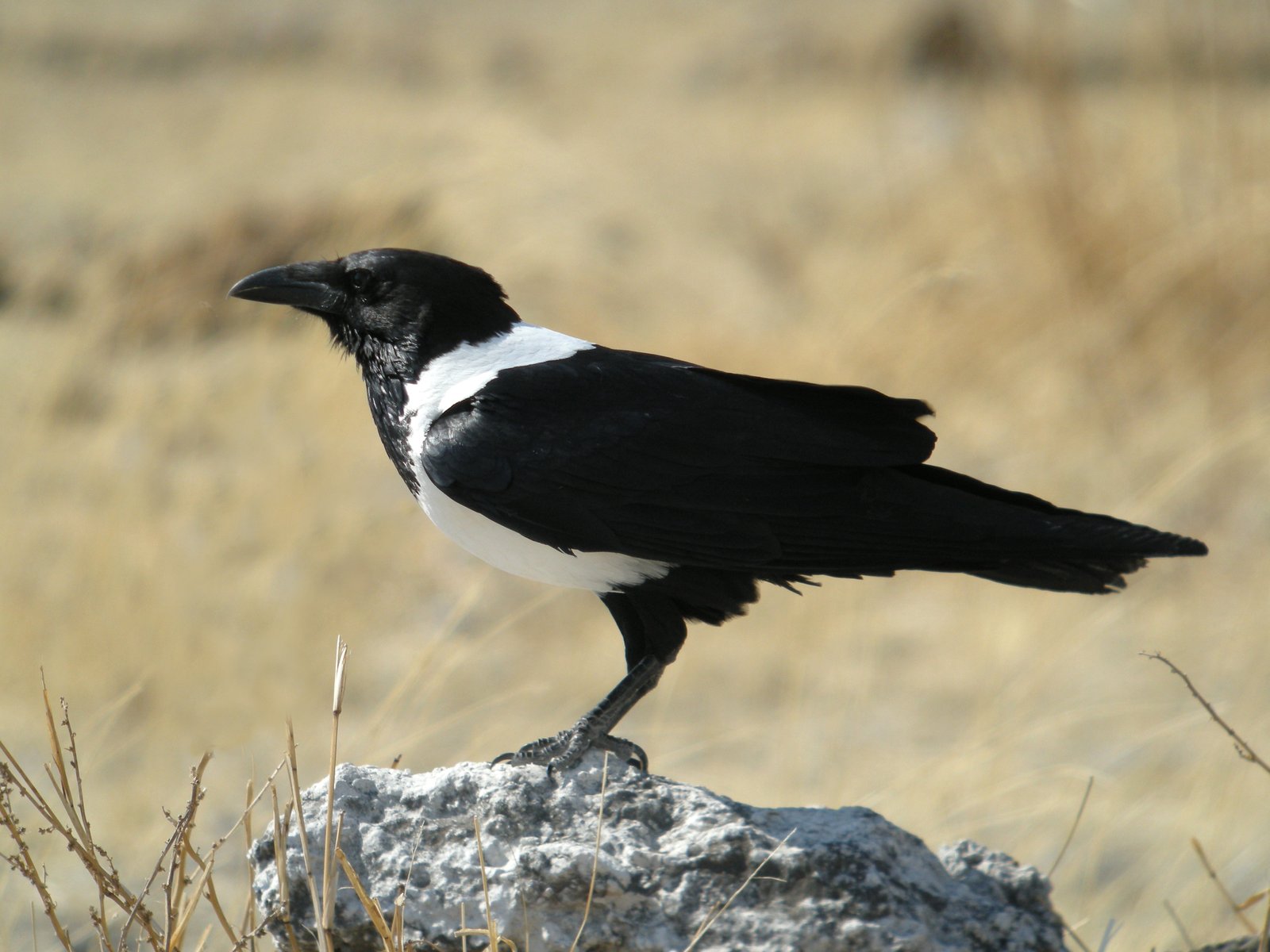
The Pied Crow is the most widespread and best-known crow of southern Africa: black with a bright white breast and collar, and visible almost everywhere people live or roads run. In recent decades the species has expanded strongly into the dry west, along power pylons that provide nest sites in treeless country.
Voice
A harsh, hoarse kraa or kwaak, often repeated and accompanied by a bow of the head and tail. At roosts and nests it also gives grating, clicking and guttural sounds.
Recording: African Bioacoustics Community — CC BY-NC-SA 4.0 · converted to mono · xeno-canto
Identification
46–50 cm. Head, throat, wings, tail and lower belly are glossy black. A broad white breast continues as a white band across the hindneck and upper mantle, so that the bird wears a white shield both front and back. The bill is black, stout and slightly curved, and the legs are black. In flight the white breast can be seen from far off. The sexes are alike. Juveniles are duller, with a dirty white, sometimes black-flecked breast.
Confusion species
White-Necked Raven Corvus albicollis has only a white patch on the hindneck, no white breast, and a very heavy, white-tipped bill and a short tail. House Crow Corvus splendens is smaller and slimmer, with a dull grey neck and breast instead of pure white. Cape Crow Corvus capensis is all black.
Habitat
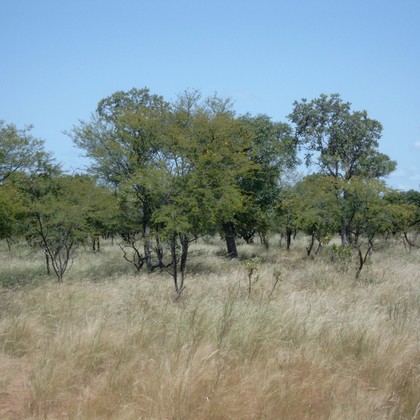
Almost any open country: towns and villages, farmland, roadsides, rubbish dumps, coasts and beaches, dry savanna and the Karoo; it avoids only closed forest and the barest desert. It eats carrion, roadkill, insects, small vertebrates, eggs and nestlings, seeds, fruit and scraps. It nests in tall trees, on pylons and on buildings.
Where the bird is most at home, classified by the vegetation units of southern Africa.


Range and movements
Throughout the region: Angola, Zambia, Malawi, Mozambique, Zimbabwe, Botswana, Namibia, South Africa, Lesotho and Eswatini, most numerous around human settlements and along roads; scarcer in the Namib and in dense miombo. In recent decades it has increased strongly in the Karoo, the west of the Northern Cape and the Western Cape. Beyond the region in almost all of Africa south of the Sahara, and on Madagascar, the Comoros and Aldabra.
- Resident
- Summer visitor (c. Oct–Mar)
- Winter visitor (c. Apr–Sep)
- Passage (Mar–Apr, Oct–Nov)
- dark = core range, pale = thinly spread
How and when to look
Year-round; hard to miss along the main roads and in villages. Check power pylons in the Karoo for nests and rubbish dumps for flocks, sometimes with hundreds of birds at a roost.
Conservation status
Not threatened. The species is expanding and benefits greatly from roads, refuse and pylons. In western South Africa the increase is regarded as a problem, because Pied Crows take young tortoises, including the endangered Geometric Tortoise, and the eggs and young of other birds.
Scientific name
Corvus albus | Müller, 1776
Müller described the species in 1776 and placed it straight away in the genus where it still stands. The genus Corvus was introduced in 1758 by Linnaeus. Corvus is the Latin word for 'raven'. albus is Latin for 'white' — for the white breast and collar of this otherwise black crow. The specimen the first description was based on came from Senegal.