All species › Passerines › Crows and jays › White-Necked Raven
White-Necked Raven | Corvus albicollis
Witnekraaf | Cuervo Cuelliblanco
The White-Necked Raven is the raven of the mountains of eastern and southern Africa: a heavy, short-tailed crow with an enormous bill that soars on thermals along cliffs and passes. Pairs are faithful to their rock face, but the birds are curious and quick to learn, and turn up at picnic sites, mountain passes and hikers with bread.
Voice
A deep, hoarse kraak or a somewhat higher, raw kwaak, often in flight. It also gives knocking, clucking and gurgling sounds between partners, and a series of harsh cries during mock fights while soaring.
Recording: African Bioacoustics Community — CC BY-NC-SA 4.0 · converted to mono · xeno-canto
Identification
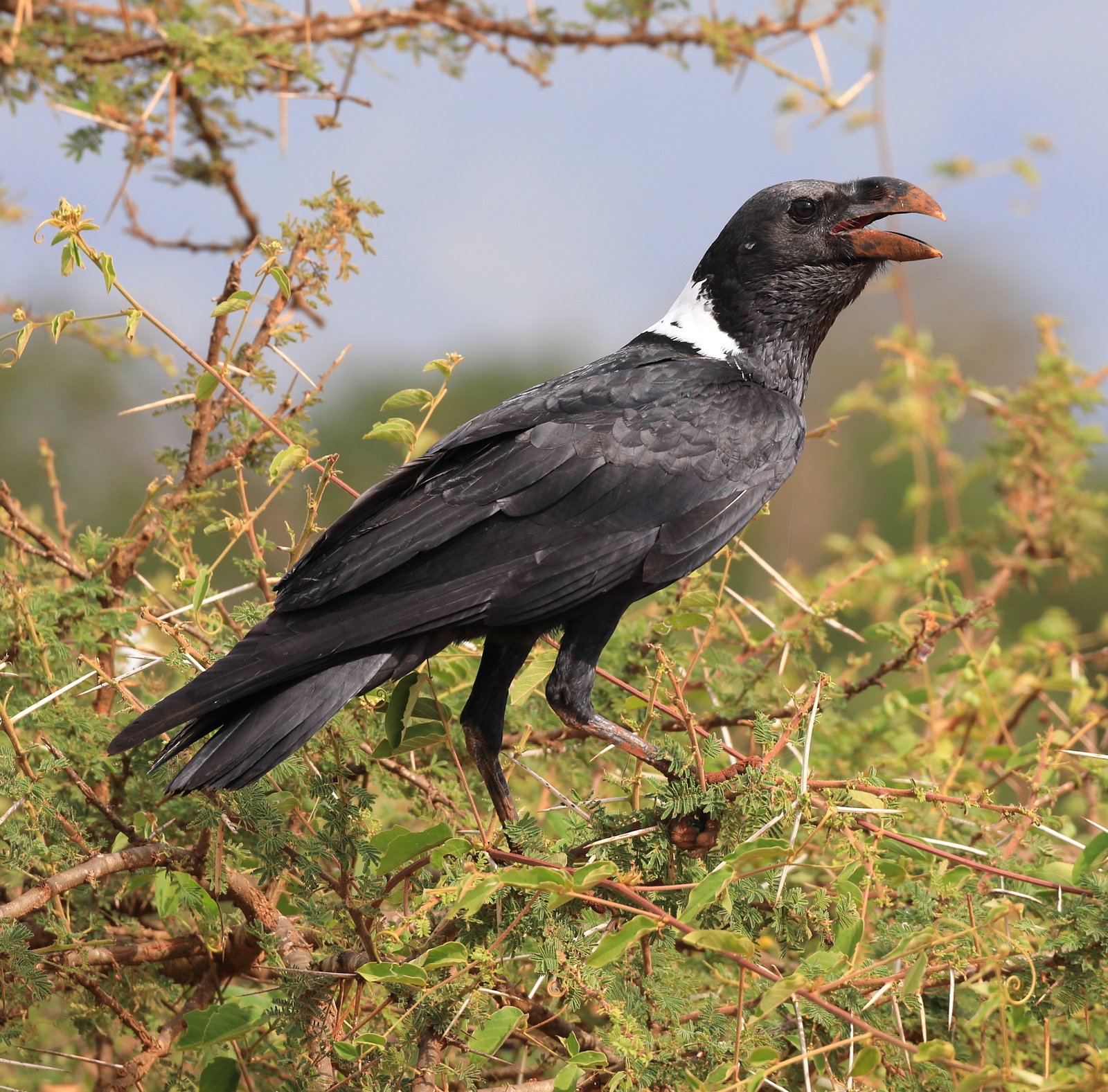
50–54 cm. Glossy black, with a crescent-shaped white patch on the hindneck that is sometimes partly hidden in a perched bird. The bill is very heavy and deep, strongly arched along the culmen, black with a white tip. The wings are broad and the tail is short and broad, so that the bird looks almost tailless in flight. The throat feathers are shaggy. The sexes are alike. Juveniles are duller and browner, with a less clean-cut nape patch.
Confusion species
Pied Crow Corvus albus is slimmer and has not only a white neck but also a white breast, with a much thinner bill and a longer tail. Cape Crow Corvus capensis is all black, with a long, slender bill and a longer tail. Red-Winged Starling Onychognathus morio, which uses the same cliffs, is much smaller and shows rufous primaries in flight.
Habitat
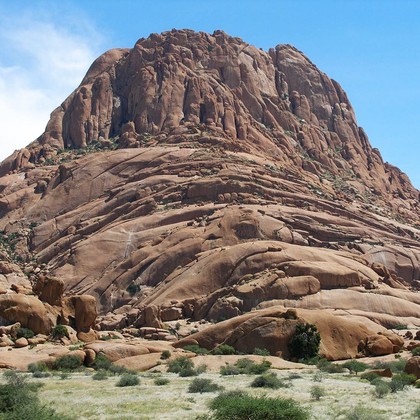
Mountains and hills with cliffs, gorges and rock faces, from sea level in the Cape Fold Mountains to high in the Drakensberg. It also forages in adjacent grassland and farmland, along roads for roadkill, at rubbish dumps and around villages. It eats carrion, invertebrates, small vertebrates, eggs, fruit and scraps, and drops tortoises and bones onto rocks to break them. It nests on a ledge or in a niche in a cliff face.
Where the bird is most at home, classified by the vegetation units of southern Africa.

Range and movements
In South Africa in the mountains of the Western and Eastern Cape, the Drakensberg of KwaZulu-Natal and the Free State, and along the eastern escarpment of Mpumalanga and Limpopo; common throughout Lesotho and in the Eswatini highlands. Further in the Eastern Highlands and granite hills of Zimbabwe, the mountains of western and central Mozambique, Malawi (Nyika, Zomba, Mulanje) and eastern Zambia. Absent from Namibia, Botswana and Angola. Beyond the region north to Tanzania, Kenya, Uganda and eastern DR Congo.
- Resident
- Summer visitor (c. Oct–Mar)
- Winter visitor (c. Apr–Sep)
- Passage (Mar–Apr, Oct–Nov)
- dark = core range, pale = thinly spread
How and when to look
Year-round. Easy to see at mountain passes and viewpoints such as Sani Pass, Golden Gate, the KwaZulu-Natal Drakensberg and the Cape Fold Mountains, and on the Nyika Plateau. Watch for pairs soaring along cliffs in the late morning, when the thermals get going.
Conservation status
Not threatened. The species is common in the mountains and benefits locally from scraps and roadkill. Poisoned bait put out for jackals and feral dogs is a risk, however, as is electrocution on power lines.
Scientific name
Corvus albicollis | Latham, 1790
Latham described the species in 1790 and placed it straight away in the genus where it still stands. The genus Corvus was introduced in 1758 by Linnaeus. Corvus is the Latin word for 'raven'. albicollis is Latin for 'white-necked', from albus, 'white', and collum, 'neck' — for the white patch on the nape. The specimen the first description was based on came from Africa (unspecified; later restricted to Cape Town).