All species › Passerines › Starlings › Pied Starling
Pied Starling | Lamprotornis bicolor
Tweekleurige glansspreeuw | Estornino Bicolor
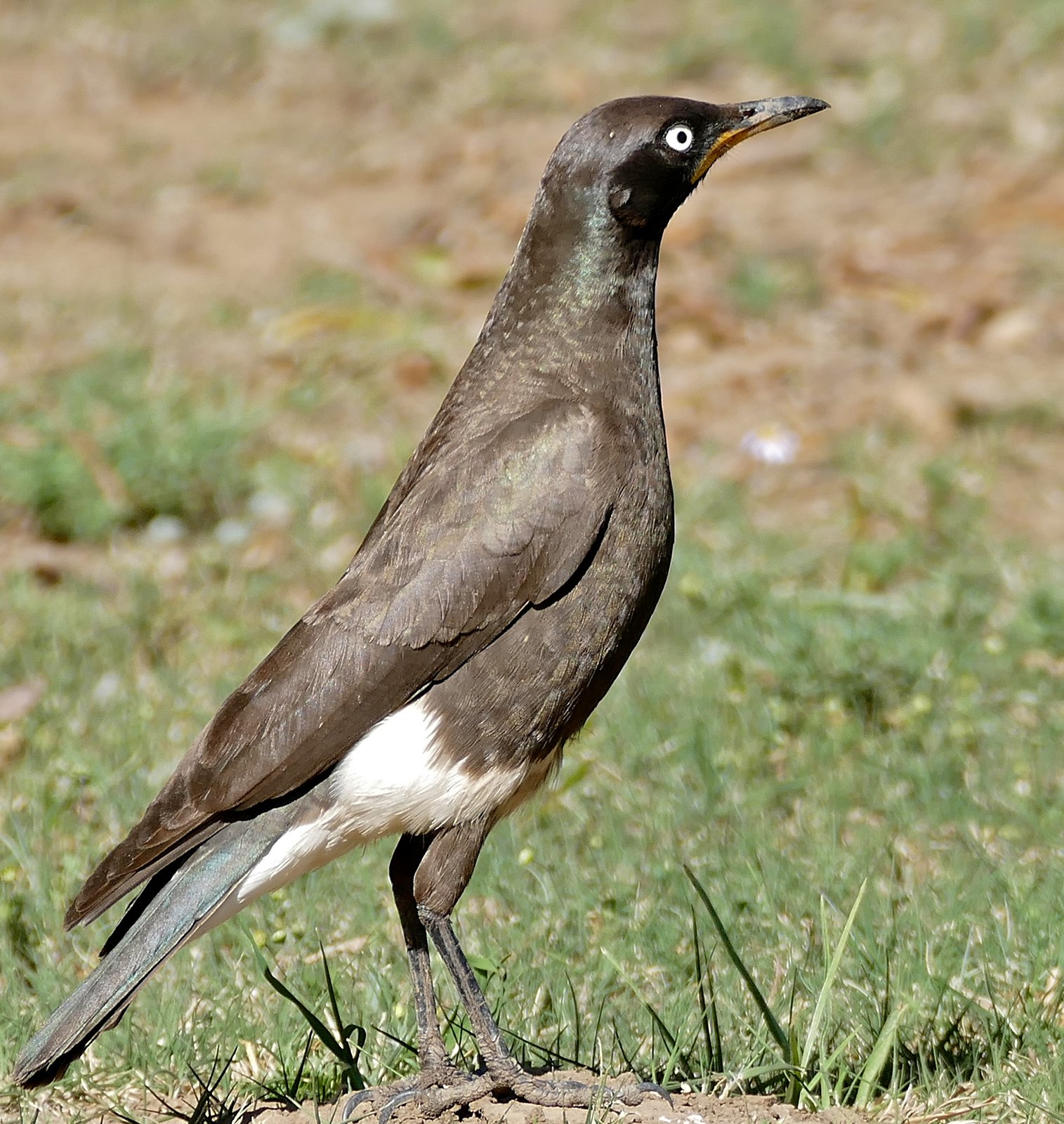
The Pied Starling is a dark, rather dully glossed starling with a white belly and a bright yellow gape, endemic to South Africa, Lesotho and Eswatini. It breeds in groups in tunnels it digs in earth banks and is a familiar sight among livestock on the open plains of the Karoo and Highveld.
Voice
Flocks are noisy: a grating, chattering skeer-kerra-kerra, a harsh cherr and a soft continuous twittering. The song is a jumbled, babbling series of grating and whistled notes.
Recording: Lynette Rudman — CC BY-NC-SA 4.0 · shortened to the first 60 s, mono · xeno-canto
Identification
25–27 cm. Dark blackish-brown with a dull green to bronzy gloss on the head, back and wings; in poor light the bird looks uniformly blackish. The lower belly and undertail coverts are bright white, forming a sharply demarcated patch, clearly visible on walking and flushing birds. The eye is creamy white to pale yellow. The bill is black, with a conspicuous orange-yellow fleshy gape at its base. The legs are black. The sexes are alike. Juveniles are duller brown, with a dark eye and a whitish rather than yellow gape.
Confusion species
Wattled Starling Creatophora cinerea is greyish, with a white rump and, in breeding plumage, bare yellow and black skin on the head. Red-Winged Starling Onychognathus morio and Pale-Winged Starling Onychognathus nabouroup have conspicuous chestnut or pale primaries and no white belly. Common Starling Sturnus vulgaris is smaller, with a pointed yellow or black bill and often pale spots. Common Myna Acridotheres tristis is brown with a black head, yellow eye-skin and white wing patches. The combination of white lower belly, pale eye and yellow gape is unique.
Habitat
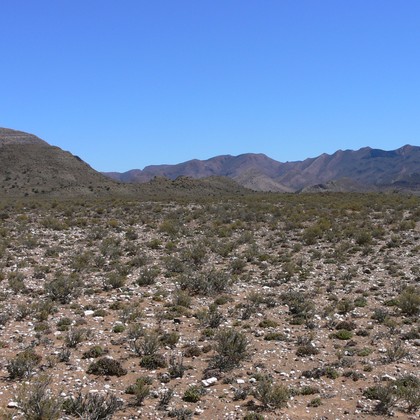
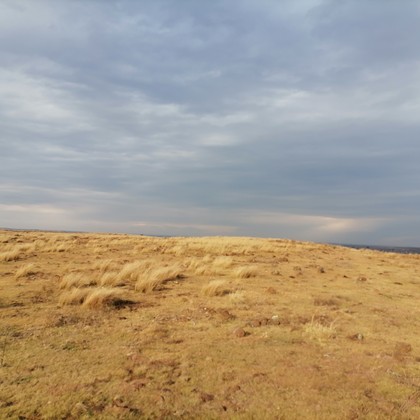
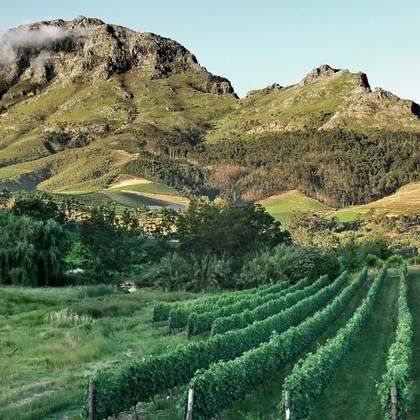
Open country: Karoo shrubland, dry grassland, thornveld, cultivated fields and pastures, often among cattle, sheep and game, and around farmsteads. It forages walking on the ground for insects, spiders and fruit, and picks ticks and other parasites from livestock. It breeds in colonies of cooperatively breeding groups in tunnels dug into sandy or loamy banks: dry riverbanks, erosion gullies, road cuttings and quarries.
Where the bird is most at home, classified by the vegetation units of southern Africa.
Range and movements
Most of South Africa: the Karoo, Free State, Highveld, Eastern Cape, inland KwaZulu-Natal and the Northern Cape to the Orange River, and in the Western Cape mainly in the Karoo and Overberg; absent from the north-eastern lowveld and the moist coastal belt. Also in Lesotho and western Eswatini. Sporadic in the extreme south of Namibia and south-eastern Botswana. It does not occur outside the region.
- Resident
- Summer visitor (c. Oct–Mar)
- Winter visitor (c. Apr–Sep)
- dark = core range, pale = thinly spread
How and when to look
All year; easiest to find along country roads in the Karoo and Free State, where flocks sit with livestock or on fences. Look for breeding colonies in erosion gullies and old riverbanks, where birds fly in and out of the tunnels. The white undertail and pale eye are the quickest field marks.
Conservation status
Not threatened; common and locally increasing thanks to farms, stock watering points and roads with earth cuttings. It depends on suitable earth banks for breeding.
Scientific name
Lamprotornis bicolor | (Gmelin, 1789)
Gmelin described the species in 1789 as Turdus bicolor; because it was later moved to another genus, the author and year stand in brackets. The genus Lamprotornis was introduced in 1820 by Temminck. Lamprotornis comes from the Greek lampros, 'shining, brilliant', and ornis, 'bird' — for the metallic, iridescent plumage of the glossy starlings. bicolor is Latin for 'two-coloured' — for the contrast between the dark glossy body and the white belly. The specimen the first description was based on came from Cape of Good Hope.