All species › Passerines › Starlings › Splendid Starling
Splendid Starling | Lamprotornis splendidus
Prachtglansspreeuw | Estornino Espléndido
The Splendid Starling is a large, noisy glossy starling of the forest edges of West and Central Africa, which within the region reaches only northern Angola and the extreme north-west of Zambia. Flocks draw attention from afar with the loud swishing sound of their wings in flight.
Voice
Noisy. A loud nasal chow or choo, a grating keeer and a varied song of whistles, gurgling and grating notes. In flight the wings make a loud, rhythmic swishing or whooshing sound audible for hundreds of metres.
Recording: Étienne Leroy — CC BY-NC-SA 4.0 · converted to mono · xeno-canto
Identification
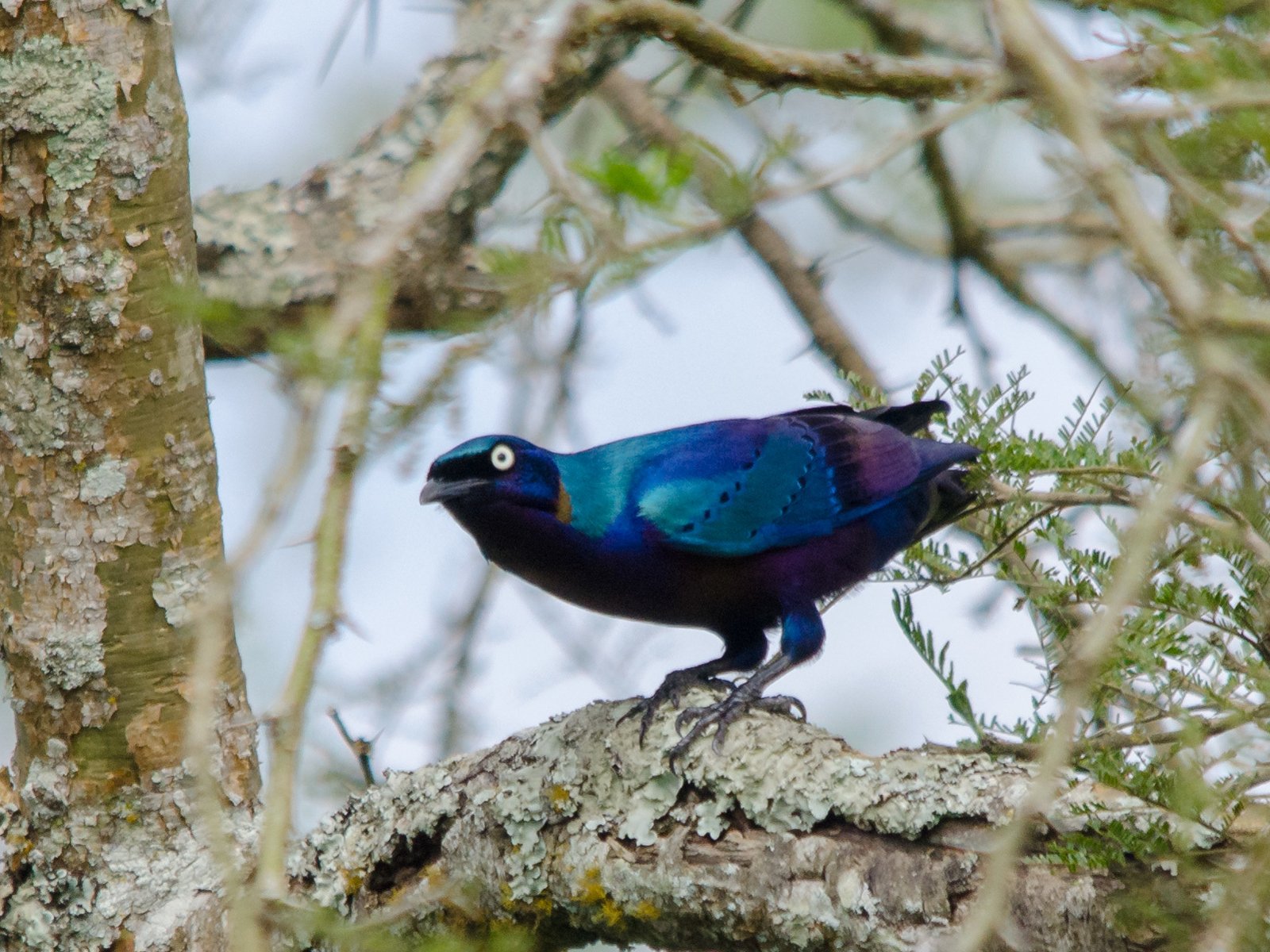
27–30 cm; large and powerfully built. Glossy blue-green with a violet to purple sheen on breast and belly and a coppery to bronze patch on the side of the neck, clearest in the male. A velvety black band crosses the secondaries and the tail has a broad black terminal band; both show well in flight. The eye is pale yellow to creamy white; bill and legs are black. The female is slightly duller, with less bronze on the neck. Juveniles are dull, with little gloss and a dark eye.
Confusion species
Greater Blue-Eared Starling Lamprotornis chalybaeus and Cape Starling Lamprotornis nitens, which occur in southern Angola, are smaller, with a yellow-orange eye and no black band across wing and tail. Sharp-Tailed Starling Lamprotornis acuticaudus is smaller, with a red eye and a wedge-shaped tail. Black-Bellied Starling Notopholia corusca is much smaller and dark below. Narrow-Tailed Starling Poeoptera lugubris, in the forests of northern Angola, is slim and dark with a narrow, pointed tail. The swishing wing noise is characteristic.
Habitat
Lowland forest edges, gallery forest along rivers, clearings and old felling areas with tall trees, and farmland with scattered forest giants in the forest-savanna belt. It feeds mainly high in the trees on fruit, especially figs, and insects. It nests in holes high in trees. Flocks wander in search of fruiting trees.
Where the bird is most at home, classified by the vegetation units of southern Africa.

Range and movements
Within the region only in northern Angola: Cabinda and the northern provinces of Zaire and Uíge to Cuanza Norte, Malanje and the Lundas, with the gallery forests as its southern outliers. In Zambia rare and irregular in the extreme north-west (Mwinilunga District). Beyond the region widespread in the forest belt from Senegal to South Sudan, Uganda, western Kenya and north-western Tanzania, and on Bioko.
- Resident
- dark = core range, pale = thinly spread
How and when to look
All year in northern Angola; in Zambia a rare find in the gallery forests around Mwinilunga. Listen for the swishing wings of passing flocks, then search the crowns of tall fig trees at the forest edge; the pale eyes and the black band across the wing confirm the species.
Conservation status
Not threatened; common across its large West and Central African range. Within the region it is confined to the extreme northern edge, where clearing of gallery forest locally costs habitat.
Scientific name
Lamprotornis splendidus | (Vieillot, 1822)
Vieillot described the species in 1822 as T[urdus] splendidus; because it was later moved to another genus, the author and year stand in brackets. The genus Lamprotornis was introduced in 1820 by Temminck. Lamprotornis comes from the Greek lampros, 'shining, brilliant', and ornis, 'bird' — for the metallic, iridescent plumage of the glossy starlings. splendidus is Latin for 'brilliant, splendid' — for the richly iridescent, multicoloured plumage. The specimen the first description was based on came from Malimbe (Malembo), Cabinda, Angola.