All species › Passerines › Starlings › Cape Starling
Cape Starling | Lamprotornis nitens
Roodschouderglansspreeuw | Estornino del Cabo
The Cape Starling is the most widespread glossy starling of southern Africa and the glossy starling of gardens, farmyards and picnic sites in the interior. It is almost endemic to Africa south of the equator and is absent only from the wettest and coldest parts of the region.

Voice
A rolling, whistled trrr-chree-chrrr as a contact call, and a long, varied song of chattering, whistles and mimicry, often from a high perch. The wings make an audible swishing sound in flight. The nasal squee-aar of Greater Blue-eared is lacking.
Recording: Filippo Ceccolini — CC BY-NC-SA 4.0 · converted to mono · xeno-canto
Identification
23–25 cm. Uniform glossy blue-green, the head and ear coverts matching the rest of the body, without a dark ear patch. The lesser wing coverts form a purple to bronzy-violet shoulder patch, often half hidden on perched birds; the greater coverts carry a row of dark spots. The belly and flanks are blue-green to blue, without magenta. The eye is bright orange-yellow; bill and legs are black. The sexes are alike. Juveniles are duller, with blackish, poorly glossed underparts and a darker eye.
Confusion species
Greater Blue-Eared Starling Lamprotornis chalybaeus has a dark steel-blue ear patch and a blue belly with magenta flanks, and gives a nasal squee-aar. Lesser Blue-Eared Starling Lamprotornis chloropterus is smaller, with a sharp dark ear stripe and a violet belly. Sharp-Tailed Starling Lamprotornis acuticaudus has a wedge-shaped tail and a red eye. Burchell's Starling Lamprotornis australis and Meves's Starling Lamprotornis mevesii are larger and long-tailed, with a dark eye. Black-Bellied Starling Notopholia corusca of coastal forest is smaller and has a dark belly.
Habitat
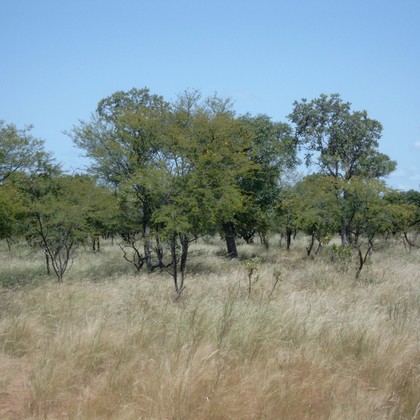
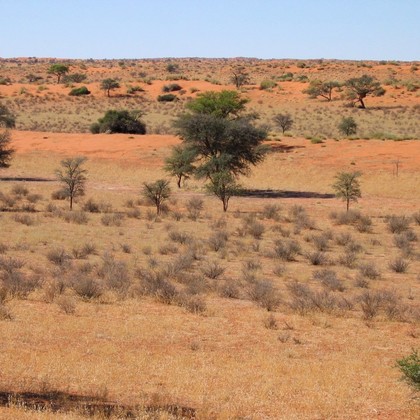
Acacia savanna, Kalahari thornveld, open woodland and dry riverine woodland, also gardens, parks, farms, campsites and town edges. It forages mainly on the ground for insects, spiders, fruit and scraps, and visits aloes and coral trees for nectar. It nests in tree holes and nest boxes, sometimes in holes in posts or buildings.
Where the bird is most at home, classified by the vegetation units of southern Africa.

Range and movements
Widespread in South Africa, though largely absent from the south-western fynbos, the high Drakensberg and the driest Namaqualand coast; also in the lowlands of Lesotho and throughout Eswatini. Common in Namibia except the Namib, throughout Botswana, in western and southern Zimbabwe, southern Mozambique (south of the Save), south-western Zambia and western and southern Angola. Beyond the region north along the west coast to western DR Congo, Republic of the Congo and southern Gabon.
- Resident
- Summer visitor (c. Oct–Mar)
- Winter visitor (c. Apr–Sep)
- Passage (Mar–Apr, Oct–Nov)
- dark = core range, pale = thinly spread
How and when to look
All year and common around camps and farmyards throughout the interior. Being so common, it is the yardstick against which to judge Greater Blue-Eared Starling: look for the plain head without a dark ear, the rolling trrr-chree and the purple shoulder that shows as the bird takes off.
Conservation status
Not threatened; common and in many areas increasing thanks to tree planting, water points and buildings. Competition for nest holes with the introduced Common Starling and Common Myna plays a role locally in urban areas.
Scientific name
Lamprotornis nitens | (Linnaeus, 1766)
Linnaeus described the species in 1766 as Turdus nitens; because it was later moved to another genus, the author and year stand in brackets. The genus Lamprotornis was introduced in 1820 by Temminck. Lamprotornis comes from the Greek lampros, 'shining, brilliant', and ornis, 'bird' — for the metallic, iridescent plumage of the glossy starlings. nitens is Latin for 'shining, glossy' — for the metallic blue-green plumage. The specimen the first description was based on came from Angola (not further specified).