All species › Passerines › Starlings › Greater Blue-Eared Starling
Greater Blue-Eared Starling | Lamprotornis chalybaeus
Groenstaartglansspreeuw | Estornino Orejiazul
The Greater Blue-Eared Starling is the common blue-eared glossy starling of the savannas of the north-east of the region, Kruger being its best-known haunt. Noisy flocks walk on the ground around camps and picnic sites and catch the eye in sunshine with their metallic blue-green gloss.
Voice
The best feature against Cape Starling: a nasal rising squee-aar or sque-eeaar, often in flight. Also a grating chatter and a long babbling song of whistled and harsh notes.
Recording: African Bioacoustics Community — CC BY-NC-SA 4.0 · converted to mono · xeno-canto
Identification
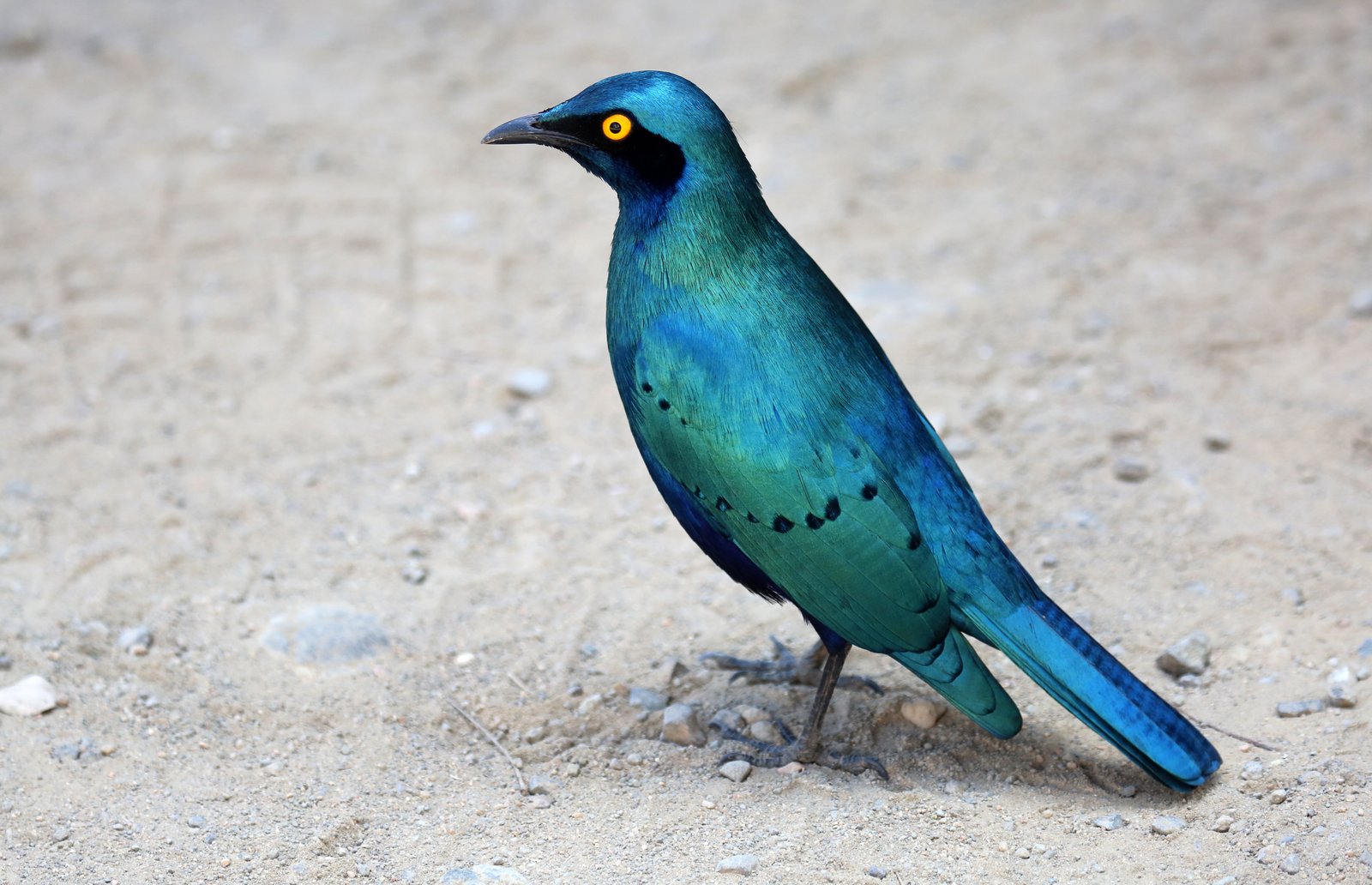
21–23 cm. Glossy blue-green, greener on the head and back, with a dark steel-blue ear patch that is broad and rather vaguely bordered. The belly and flanks are royal blue, with a magenta to purple sheen on the flanks. The wing coverts show two rows of black spots. The eye is bright yellow-orange; bill and legs are black, and the bill is fairly long and strong. The sexes are alike. Juveniles are duller, blackish with little gloss, and have a darker, brownish eye.
Confusion species
Cape Starling Lamprotornis nitens has no dark ear patch (the ear coverts match the head), a blue-green belly without magenta and a purple shoulder patch; its call is a rolling trrr-chree-chrrr. Lesser Blue-Eared Starling Lamprotornis chloropterus is smaller, with a finer bill, a narrower, more sharply defined ear stripe and a more violet belly; its juveniles are rufous below. Burchell's Starling Lamprotornis australis and Meves's Starling Lamprotornis mevesii are larger, long-tailed and dark-eyed. Black-Bellied Starling Notopholia corusca of coastal forest is smaller, with a dark belly.
Habitat
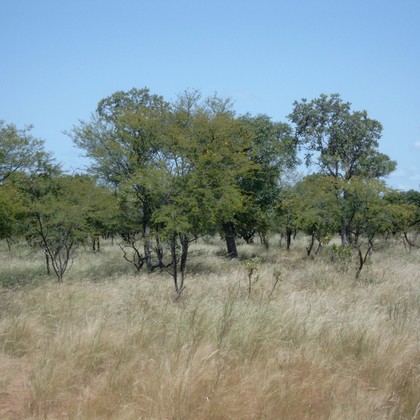
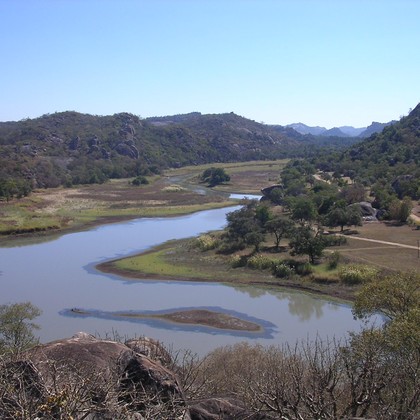
Mopane, acacia savanna, mixed woodland and open woodland with tall trees, often near water; also around camps, villages and game lodges. It feeds mainly on the ground on insects and termites, but also takes fruit and nectar from aloes and coral trees. It nests in tree holes. In the dry season flocks of tens to hundreds gather to roost in reedbeds or dense trees.
Where the bird is most at home, classified by the vegetation units of southern Africa.

Range and movements
North-eastern South Africa (the Limpopo and Mpumalanga lowveld, including the whole of Kruger), the eastern lowveld of Eswatini, Zimbabwe (almost throughout except the highlands), Mozambique, Malawi and Zambia (mainly the lower, drier parts), northern Botswana, north-eastern Namibia (Kavango and the Zambezi Region) and southern and eastern Angola. Beyond the region from Senegal east through the Sahel and Sudan zones to Eritrea and Somalia, and south through East Africa.
- Resident
- Summer visitor (c. Oct–Mar)
- Winter visitor (c. Apr–Sep)
- Passage (Mar–Apr, Oct–Nov)
- dark = core range, pale = thinly spread
How and when to look
All year; in Kruger one of the first birds you see around camps. In mixed flocks with Cape Starlings the nasal squee-aar is the quickest confirmation. In sunshine check the ear coverts and belly: a dark blue ear and magenta-tinged flanks point to this species, a plain head and blue-green belly to Cape Starling.
Conservation status
Not threatened; common and widespread. It benefits locally from human presence around camps and villages. It was formerly trapped for the cage-bird trade, which now has little effect on numbers.
Scientific name
Lamprotornis chalybaeus | Hemprich & Ehrenberg, 1828
Hemprich & Ehrenberg described the species in 1828 and placed it straight away in the genus where it still stands. The genus Lamprotornis was introduced in 1820 by Temminck. Lamprotornis comes from the Greek lampros, 'shining, brilliant', and ornis, 'bird' — for the metallic, iridescent plumage of the glossy starlings. chalybaeus is Latin for 'steel-blue', from the Greek khalups, 'steel' — for the steely blue sheen of the plumage. The specimen the first description was based on came from Ambukol, near Dongola, Sudan.