All species › Passerines › Starlings › Sharp-Tailed Starling
Sharp-Tailed Starling | Lamprotornis acuticaudus
Pijlstaartglansspreeuw | Estornino Colifino
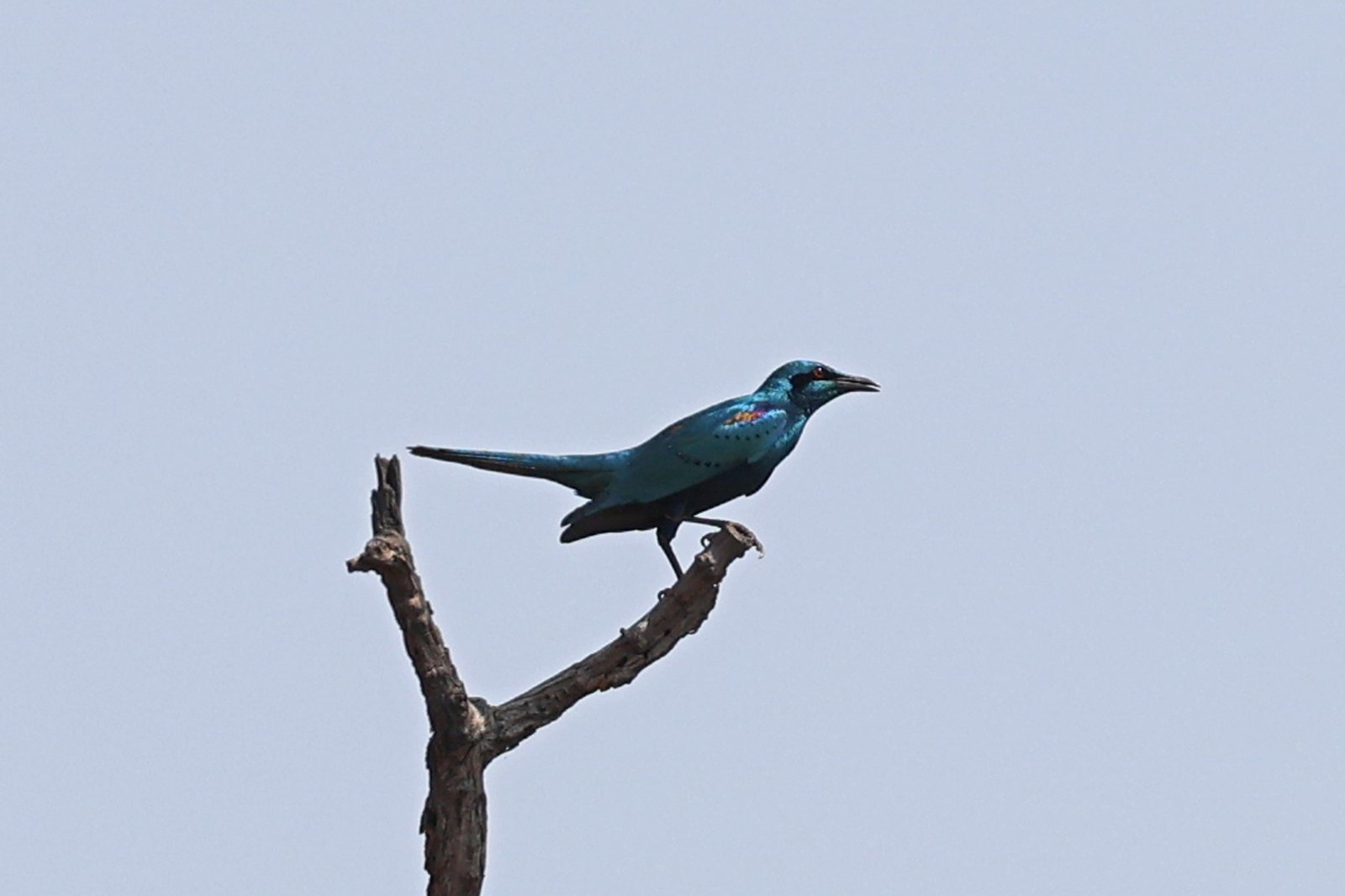
The Sharp-Tailed Starling is a little-known glossy starling of the dry deciduous forests on Kalahari sand in Angola and western Zambia, reaching the southern edge of its range in the extreme north-east of Namibia and northern Botswana. The wedge-shaped tail and red eye separate it from all other short-tailed glossy starlings.
Voice
Higher and thinner than the other glossy starlings: a high whistled cheep or tweeee as a flight call, often repeated by a whole flock, and a soft squeaky twittering. The song consists of short series of whistles.
Recording: Dries Van de Loock — CC BY-NC-SA 4.0 · converted to mono · xeno-canto
Identification
22–26 cm. Glossy green-blue, bluer below with a violet to purple sheen on belly and flanks; a dark ear patch is lacking or at most faint. The wing coverts are spotted dark. The tail is clearly graduated and wedge-shaped, with elongated, pointed central feathers; this shows well in flight and from below on perched birds. The eye of adults is orange-red to red, brightest in the male. Bill and legs are black. Juveniles are duller and greyish below, with a dark eye.
Confusion species
Greater Blue-Eared Starling Lamprotornis chalybaeus and Lesser Blue-Eared Starling Lamprotornis chloropterus have a dark ear patch, a yellow-orange eye and a square or slightly rounded tail. Cape Starling Lamprotornis nitens also has a plain head, but has a yellow-orange eye, a purple shoulder patch and a square tail. Meves's Starling Lamprotornis mevesii also has a graduated tail, but it is far longer and the eye is dark. Pay attention to call, tail shape and habitat.
Habitat
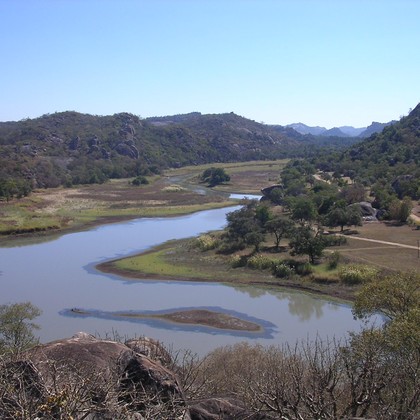
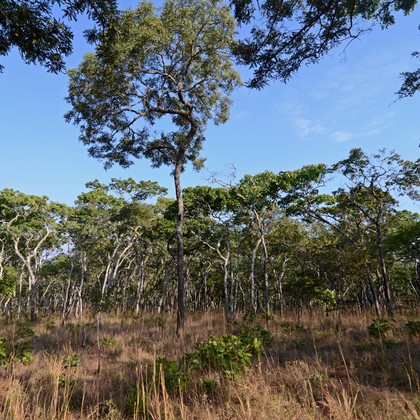
Dry deciduous forest and woodland on Kalahari sand, with Zambezi Teak (Baikiaea plurijuga), Burkea and Pterocarpus, also dry miombo and the edges of riverine forest. It feeds mainly in the canopy on fruit, figs and insects. It nests in tree holes. Flocks wander outside the breeding season and can then be suddenly numerous in places.
Where the bird is most at home, classified by the vegetation units of southern Africa.
Range and movements
Central, eastern and southern Angola and western Zambia (Western Province, the western edge of Kafue National Park and the north-west). Scarce and irregular in north-eastern Namibia (Kavango, east to the Zambezi Region) and rare in the extreme north of Botswana. Outside the region only in southern DR Congo.
- Resident
- dark = core range, pale = thinly spread
How and when to look
All year, but hard to predict because of its wandering. The best chance is in the dry forests of Zambia's Western Province and in southern and eastern Angola. In Namibia any record is worth documenting. With glossy starlings in Baikiaea forest, listen for the high flight call and watch for the wedge-shaped tail as a flock takes off.
Conservation status
Not threatened; locally common within its core range. Logging of Zambezi Teak and other hardwoods and increasing fires in the Kalahari forests reduce its habitat, but much of the range is remote.
Scientific name
Lamprotornis acuticaudus | (Bocage, 1869)
Bocage described the species in 1869 as Lamprocolius acuticaudus; because it was later moved to another genus, the author and year stand in brackets. The genus Lamprotornis was introduced in 1820 by Temminck. Lamprotornis comes from the Greek lampros, 'shining, brilliant', and ornis, 'bird' — for the metallic, iridescent plumage of the glossy starlings. acuticaudus is Latin for 'sharp-tailed', from acutus, 'pointed', and cauda, 'tail' — for the wedge-shaped tail with pointed central feathers. The specimen the first description was based on came from Caconda, Huíla, Angola.