All species › Passerines › Shrikes › Red-Backed Shrike
Red-Backed Shrike | Lanius collurio
Grauwe klauwier | Alcaudón Dorsirrojo
The Red-Backed Shrike is one of the most numerous Palearctic migrants in the dry savannas of southern Africa. From November to March it sits on almost every bush top along the roads in thornveld and Kalahari, dropping from there onto insects on the ground. The birds arrive late, after a long stopover in East Africa, and leave again in March and April by a more easterly route.

Click a thumbnail to switch the photo above.
Voice
Mostly silent on the wintering grounds. In alarm a dry, hard chek or a harsh, rolling kerrr. Towards the end of the summer some males sing a soft, scratchy song with mimicry of other species woven in.
Recording: Azens — CC BY-NC-SA 4.0 · converted to mono · xeno-canto
Identification
17–18 cm. The male has a blue-grey crown and nape, a narrow black mask from the bill to behind the eye, a warm chestnut back and wings, a grey rump and a black tail with white sides at the base. The underparts are white with a salmon-pink wash on the breast and flanks. The female is rufous-brown to grey-brown above with a brown mask, and dirty white below with fine dark scaling on the breast and flanks; the tail is brown. First-winter birds are finely scaled above and below. The bill is short and hooked. It perches upright and often swings its tail.
Confusion species
Lesser Grey Shrike Lanius minor is larger and grey, black and white, with a broad black forehead and a large white primary patch. Southern Fiscal Lanius collaris is black and white with a white V on the back and a long tail. Souza's Shrike Lanius souzae of the miombo is smaller, with a long, narrow tail and a grey crown above a brown back. Females and young birds resemble Red-Tailed Shrike Lanius phoenicuroides, a rare vagrant with a rufous tail and pale, sandy upperparts.
Habitat
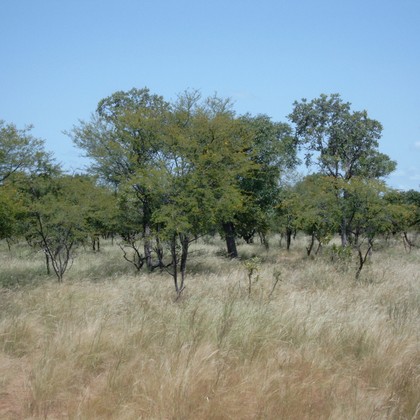
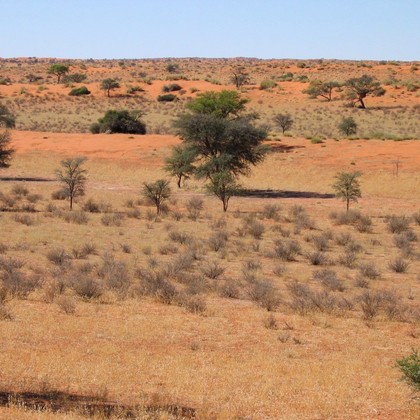
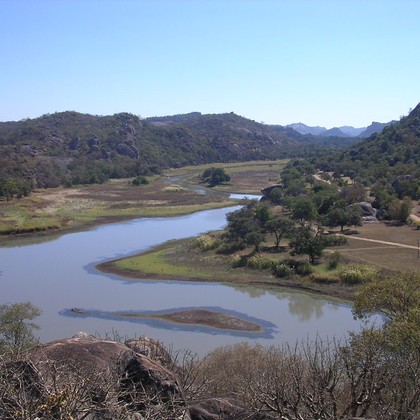
Dry, open savanna with scattered bushes: acacia thornveld, Kalahari thornveld, open mixed woodland, bushed grassland and the edges of fields and pastures. It avoids dense woodland and the wettest areas. It hunts from a low perch for beetles, grasshoppers and other large insects, sometimes small lizards or nestlings. Males and females each hold their own territory in winter.
Where the bird is most at home, classified by the vegetation units of southern Africa.
Range and movements
Widespread in the interior: all of Botswana, Namibia except the Namib, Zimbabwe, northern and eastern South Africa (Limpopo, North West, Mpumalanga, Gauteng, Free State, the north of the Northern Cape and inland KwaZulu-Natal), Eswatini, southern Mozambique, Zambia (especially the south and west) and southern Angola; scarcer in Malawi and along the east coast, and almost absent from the Western Cape. It breeds from western Europe to western Siberia and Central Asia and winters in eastern and southern Africa.
- Summer visitor (c. Oct–Mar)
- Passage (Mar–Apr, Oct–Nov)
- dark = core range, pale = thinly spread
How and when to look
From late October to early April, most numerous in December and January. Drive slowly through thornveld in the Kalahari, Pilanesberg, Kruger or Etosha and scan the tops of low bushes. With brown birds, check the tail colour to rule out Red-Tailed Shrike.
Conservation status
Not threatened. Over much of Europe the species declined sharply in the twentieth century through agricultural intensification and the loss of large insects, but the total population is large and it is recovering locally. No large-scale threats are known on the wintering grounds, although loss of savanna to cultivation may play a part.
Scientific name
Lanius collurio | Linnaeus, 1758
Linnaeus described the species in 1758 and placed it straight away in the genus where it still stands. He introduced the genus Lanius in that same work. Lanius is Latin for 'butcher', from shrikes' habit of impaling prey on thorns and barbed wire. collurio goes back to Ancient Greek kollurion, a bird mentioned by Aristotle. The specimen the first description was based on came from Sweden.