All species › Passerines › Shrikes › Magpie Shrike
Magpie Shrike | Urolestes melanoleucus
Eksterklauwier | Alcaudón Pío
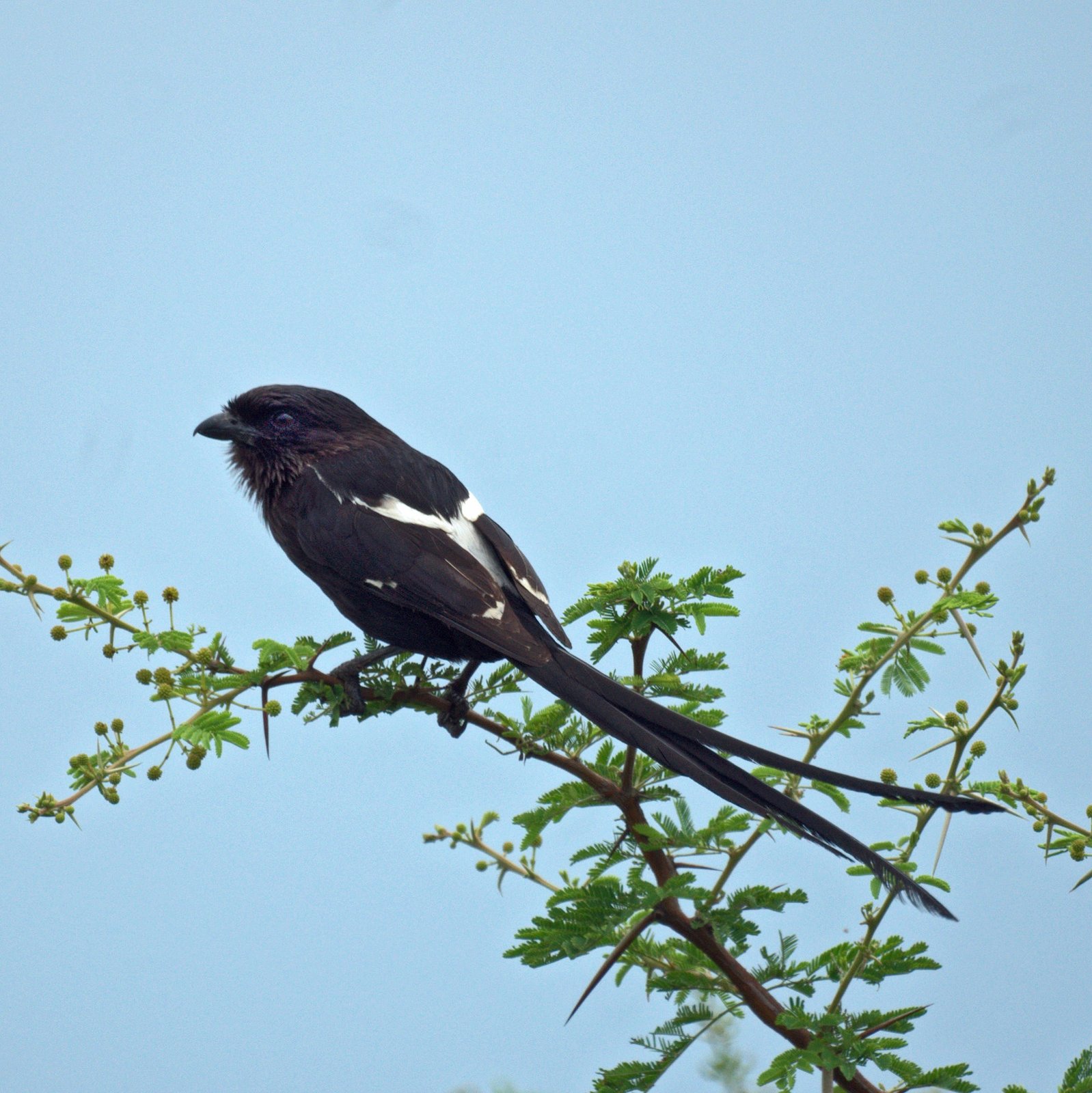
With its very long, graduated tail, the Magpie Shrike is the largest and most conspicuous shrike of the region. It lives in noisy groups of three to ten birds that defend a territory together and raise the young cooperatively. A row of black-and-white silhouettes on the tops of thorn trees is a familiar sight in the savanna.
Voice
Clear, liquid whistles, pee-lee-yoo and tweeloo, often sung by several group members together, accompanied by wing-waving and tail-flicking. When alarmed, a rasping, high chrrr and a series of hard clicks.
Recording: Marna Buys — CC BY-NC-SA 4.0 · converted to mono · xeno-canto
Identification
40–50 cm, more than half of it tail. The plumage is glossy black, with a broad white stripe along the scapulars forming a V on the back, a white patch at the base of the primaries and a grey-white rump. The bill is heavy, black and hooked. The tail is long, narrow and graduated. The female has a shorter tail and a white patch on the flanks, which are black in the male. Juveniles are duller, brownish-black with fine barring and a shorter tail. It flies with fast wingbeats and an undulating tail, low from tree to tree.
Confusion species
Southern Fiscal Lanius collaris is much smaller, with white underparts and a shorter tail. Breeding Long-Tailed Widowbird Euplectes progne also has a long black tail, but shows a red and white shoulder patch and a conical bill, and lives in grassland. Long-Tailed Paradise Whydah Vidua paradisaea has a chestnut and buff breast and broad, flat tail feathers. Fork-Tailed Drongo Dicrurus adsimilis is all black with a forked tail.
Habitat
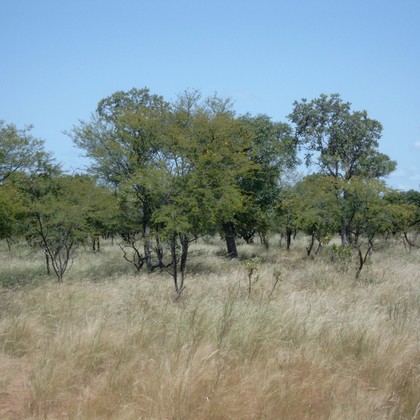
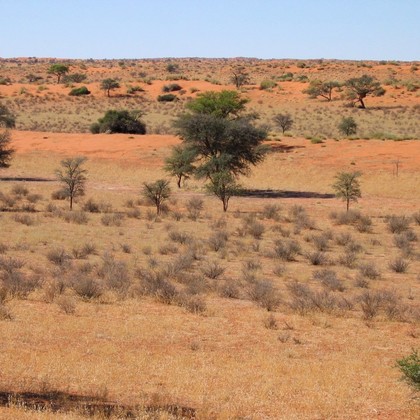
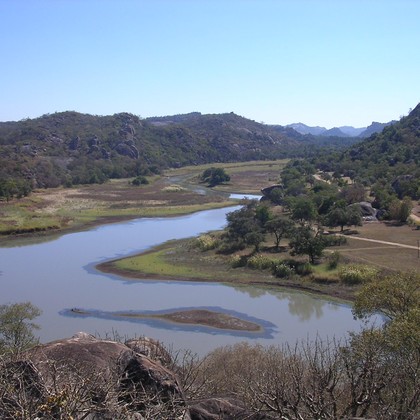
Open acacia savanna, thornveld and mixed woodland with scattered tall trees and a grassy or bare floor, also the edges of mopane woodland and farmland with trees. It hunts from a high lookout for large insects, lizards and small rodents, which it takes on the ground and sometimes impales on thorns.
Where the bird is most at home, classified by the vegetation units of southern Africa.
Range and movements
In the region in Botswana (mainly the north and east), northern and north-eastern Namibia, Zimbabwe (mainly the west and the lowveld), southern Mozambique, south-western Zambia and the extreme south-east of Angola, and in South Africa in Limpopo, Mpumalanga, North West, the northern Northern Cape and Zululand, into eastern Eswatini. Beyond the region there is a separate population in Kenya and Tanzania.
- Resident
- Summer visitor (c. Oct–Mar)
- Winter visitor (c. Apr–Sep)
- Passage (Mar–Apr, Oct–Nov)
- dark = core range, pale = thinly spread
How and when to look
Year-round; best in early morning light, when the group sits sunning and calling on a treetop. Easily seen in the Kruger Park, Pilanesberg and around the fringes of the Okavango. Keep your distance: the group will then allow a relaxed view while the birds take turns dropping to the ground.
Conservation status
Not threatened; common in suitable habitat. Locally declined through clearing and bush encroachment in savannas, but the species also benefits from managed savanna in game reserves.
Scientific name
Urolestes melanoleucus | (Jardine, 1831)
Jardine described the species in 1831 as Lanius melanoleucus; because it was later moved to another genus, the author and year stand in brackets. The genus Urolestes was introduced in 1851 by Cabanis. Urolestes comes from the Greek oura, 'tail', and lēstēs, 'robber' — a shrike, the classic 'robber', with a strikingly long tail. melanoleucus comes from the Greek melas, 'black', and leukos, 'white' — for the black-and-white plumage. The specimen the first description was based on came from Orange River.