All species › Passerines › Weavers › Red-Billed Buffalo Weaver
Red-Billed Buffalo Weaver | Bubalornis niger
Roodsnavelbuffelwever | Bufalero Piquirrojo
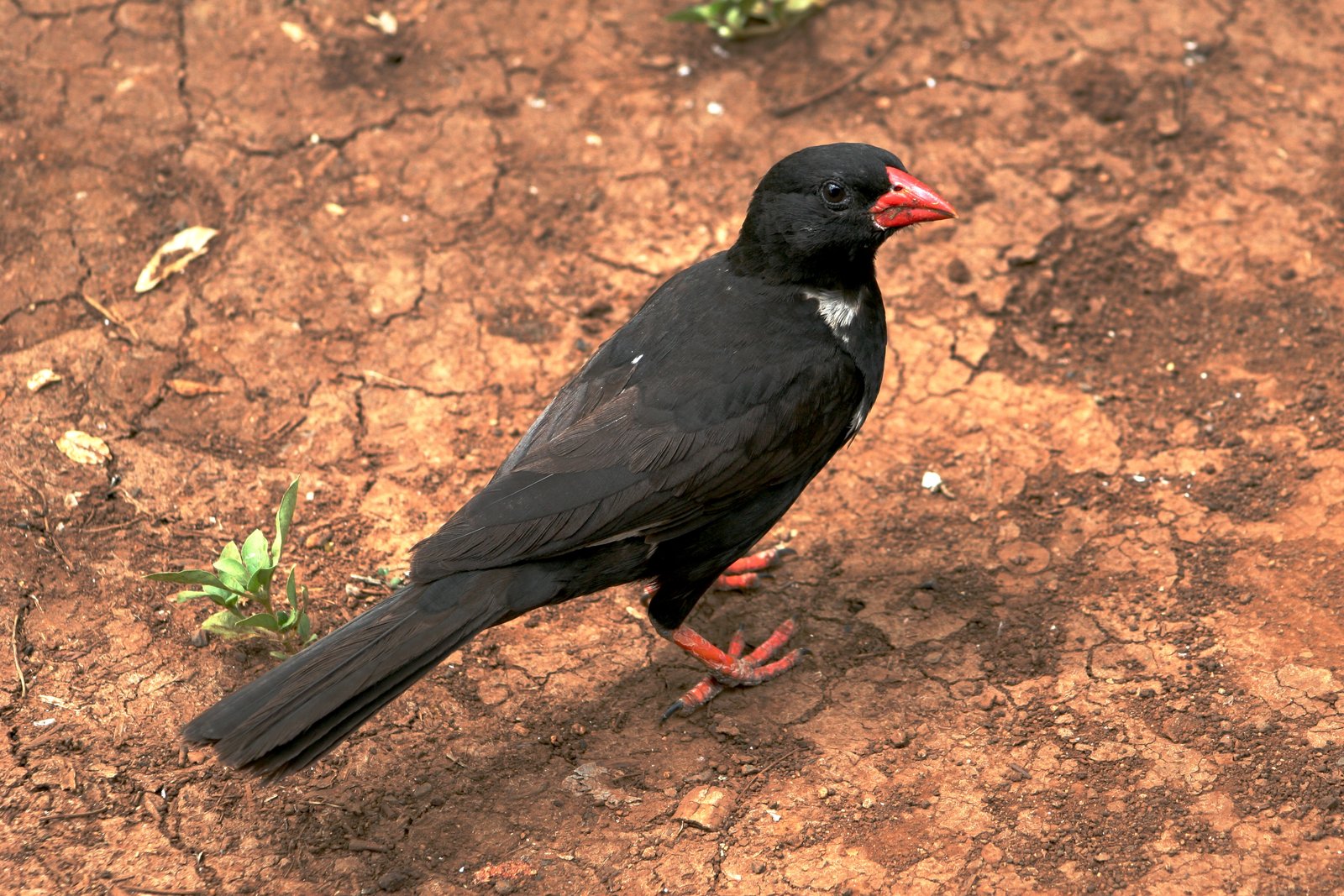
The Red-Billed Buffalo Weaver is a large, black, red-billed weaver that builds huge thorny stick nests in noisy colonies in baobabs, acacias and windmills. The male is one of the few passerines with a penis-like organ.
Voice
Loud and exuberant: a series of rolling, gurgling and clattering notes, chip-chip-doodley-doodley-doo, delivered by the male from the nest with spread wings. There is also loud chatter within the colony and a harsh alarm.
Recording: isaac kilusu — CC BY-NC-SA 4.0 · converted to mono · xeno-canto
Identification
22–24 cm, large and starling-like, with a heavy conical bill. The male is dull black with white patches on the flanks and white bases to the primaries, which show in flight as a clear white wing patch; the bill is bright red, brighter in the breeding season. The female is dark brown with whitish scaling and streaking on throat and underparts and has a duller orange-red to horn bill. Juveniles resemble the female, with a pale pinkish to horn bill.
Confusion species
Thick-Billed Weaver (Amblyospiza albifrons) is smaller, brownish black with a white patch at the base of the wing and a heavy dark bill, and lives in reeds and forest edges. Red-Winged Starling (Onychognathus morio) is slimmer, glossy black, with chestnut primaries and a black bill. Fork-Tailed Drongo (Dicrurus adsimilis) has a forked tail and a fine black bill. The red bill and the white flank patches settle it.
Habitat
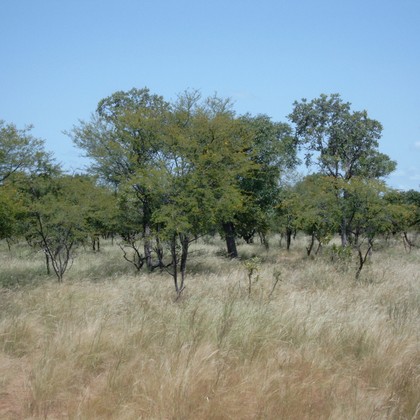
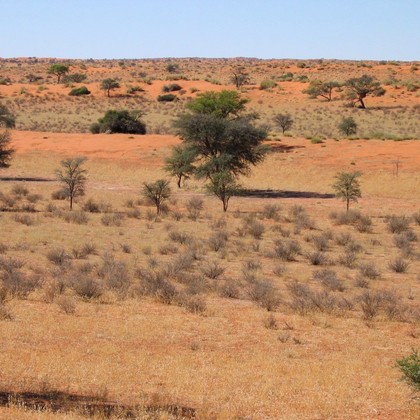
Dry savanna, mopane woodland, acacia veld and Kalahari thornveld, especially with large trees; also at farms, windmills and stock troughs. It forages in groups on the ground for insects, seeds and fruit, often close to grazing livestock or game. Colonies are large, rough masses of thorny sticks with separate nest chambers, often in baobabs or tall acacias.
Where the bird is most at home, classified by the vegetation units of southern Africa.

Range and movements
Within the region in northern and central Namibia, northern and eastern Botswana, Zimbabwe (especially the lower-lying parts), southern Mozambique, northern and north-eastern South Africa (Limpopo, Mpumalanga, North West and the Lowveld), the lowveld of Eswatini, southern Zambia (Zambezi Valley, Luangwa), southern Malawi and south-western Angola. Beyond the region from Tanzania and Kenya to Ethiopia, Somalia and South Sudan.
- Resident
- Summer visitor (c. Oct–Mar)
- Winter visitor (c. Apr–Sep)
- Passage (Mar–Apr, Oct–Nov)
- dark = core range, pale = thinly spread
How and when to look
Regularly seen in Kruger, Etosha, Chobe and the mopane of northern Botswana and Zimbabwe: look for a baobab or tall acacia with large, shaggy stick nests. In the breeding season the male sings on the nest with quivering, spread wings. In females and juveniles look for the brown, scaled underparts and the pale bill.
Conservation status
Not threatened; common and widespread in the dry savannas of the region. It benefits locally from windmills and stock troughs, but the felling of large trees can drive colonies away.
Scientific name
Bubalornis niger | Smith, 1836
Smith described the species in 1836 and placed it straight away in the genus where it still stands. He introduced the genus Bubalornis in that same work. Bubalornis comes from the Greek boubalos, 'buffalo', and ornis, 'bird' — for buffalo weavers' habit of foraging around buffalo and other large game. niger is Latin for 'black' — for the male's largely black plumage. The specimen the first description was based on came from Kurrichane, near Zeerust, North West (South Africa).