All species › Passerines › Chats and flycatchers › Red-Capped Robin-Chat
Red-Capped Robin-Chat | Cossypha natalensis
Roodkaplawaaimaker | Cosifa de Natal
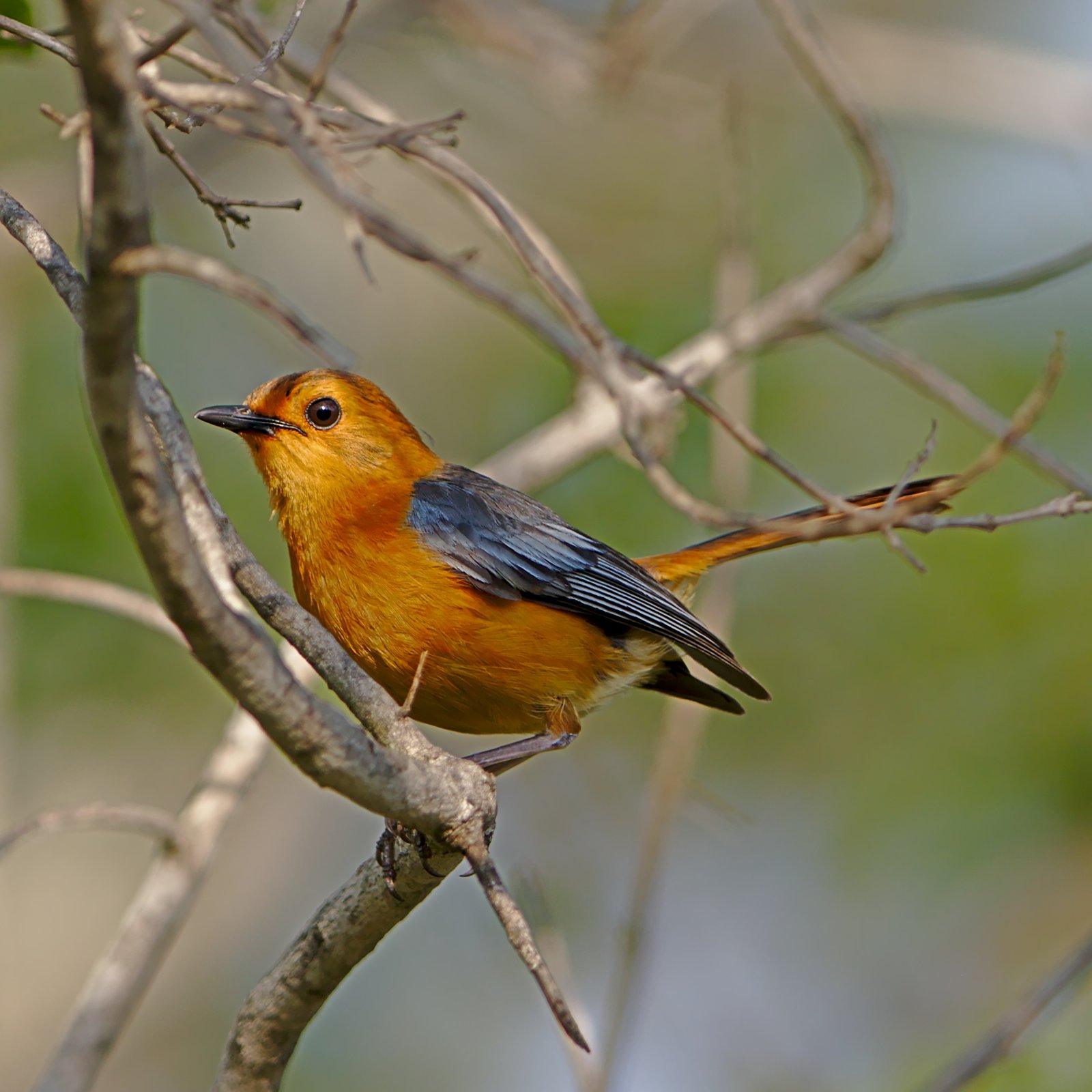
The Red-Capped Robin-Chat is a secretive, brightly coloured robin-chat of dense lowland and coastal forest. It is heard far more often than seen: its song is an endless string of imitations of other birds.
Voice
The song is a long, varied stream of imitations of, among others, African Fish Eagle, cuckoos, bulbuls and shrikes, interspersed with its own soft whistles, see-saw, see-saw. The call is a soft, sad tchee-a-tchee or see-saa, and a rasping trrrr in alarm. Sings mainly at dawn, often before first light.
Recording: Louis A. Hansen — CC BY-NC-SA 4.0 · shortened to the first 60 s, mono · xeno-canto
Identification
A compact robin-chat of 16 to 18 cm. Head, neck and the entire underparts are bright orange-rufous, with no supercilium; crown and hindneck are a little darker rusty brown. Back and wings are slaty blue to blue-grey, rump and outer tail feathers orange, central tail feathers black. Bill black, legs pinkish- to greyish-brown. The sexes are alike. Juveniles are dark with ochre spots. Often sits still and upright in the shade, slowly flicking its tail.
Confusion species
Chorister Robin-Chat (Cossypha dichroa) is larger, with a dark slate-grey head and back and orange underparts, and lives in higher montane forest. White-Browed Robin-Chat (Cossypha heuglini) and Cape Robin-Chat (Dessonornis caffer) have a black head with a white supercilium. The yellow belly of White-Starred Robin (Pogonocichla stellata) and the orange flanks of Olive-Flanked Ground Robin (Dessonornis anomalus) can confuse in the forest gloom; look for the entirely orange head.
Habitat
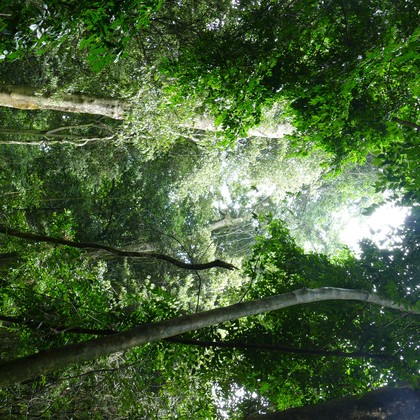
Dense evergreen lowland and coastal forest, riverine forest, thickets in savanna and ravines, and in the Eastern Cape and KwaZulu-Natal also large gardens with indigenous vegetation. Mostly below 1500 m, higher in Angola and Zambia. Forages on the ground for insects and also eats berries.
Where the bird is most at home, classified by the vegetation units of southern Africa.

Range and movements
In South Africa in the eastern coastal belt of the Eastern Cape and KwaZulu-Natal and in the Lowveld and escarpment fringes of Mpumalanga and Limpopo; also Eswatini, Mozambique, eastern and northern Zimbabwe, Malawi, Zambia and northern and western Angola. Outside the region to Kenya, Somalia and Cameroon.
- Resident
- Summer visitor (c. Oct–Mar)
- Winter visitor (c. Apr–Sep)
- Passage (Mar–Apr, Oct–Nov)
- dark = core range, pale = thinly spread
How and when to look
At dawn in coastal forest, such as at St Lucia or around Durban, listen for a bird imitating one species after another: that is often this robin-chat. Then wait quietly at the edge of a clearing in the forest; the bird usually appears low down in the shade.
Conservation status
Not threatened. Widespread and locally common; numbers are stable. Loss of coastal forest to development and of riverine forest to clearing affects it locally, but it also inhabits well-vegetated gardens.
Scientific name
Cossypha natalensis | Smith, 1840
Smith described the species in 1840 and placed it straight away in the genus where it still stands. The genus Cossypha was introduced in 1825 by Vigors. Cossypha comes from the Greek kossyphos, 'blackbird' — for the blackbird-like build and loud, melodious song of the robin-chats. natalensis means 'from Natal', the region around Durban where the first specimen was collected. The specimen the first description was based on came from Durban, South Africa.