All species › Passerines › Chats and flycatchers › Chorister Robin-Chat
Chorister Robin-Chat | Cossypha dichroa
Choristerlawaaimaker | Cosifa Bicolor
The Chorister Robin-Chat is the large, dark robin-chat of the Afromontane and mistbelt forests of eastern South Africa. It is endemic to South Africa and Eswatini and known for its rich song full of mimicry, which carries far through the forest canopy.

Voice
The song is a powerful, varied series of its own whistles and imitations of, among others, forest cuckoos, greenbuls, Knysna Turaco and even raptors, often sustained for long periods from the canopy. The call is a sad, descending tchoo-tchoo-wee or tyoo-er, and a harsh grating in alarm.
Recording: Ian-Malcolm Rijsdijk — CC BY-NC-SA 4.0 · converted to mono · xeno-canto
Identification
The largest robin-chat of the region, 19 to 20 cm. Head, cheeks, back and wings are dark slate-grey to blackish-grey, without a supercilium. The entire underparts from throat to undertail coverts are warm orange-yellow to orange-rufous, and the rump and outer tail feathers are orange with dark central feathers. Bill black, legs grey-brown. The sexes are alike. Juveniles are dark with ochre spotting. Keeps higher in the forest than other robin-chats, up into the mid-canopy.
Confusion species
Red-Capped Robin-Chat (Cossypha natalensis) is smaller, has an orange head and blue-grey wings, and lives in warmer lowland and coastal forest; in winter both may share the same forest. Cape Robin-Chat (Dessonornis caffer) and White-Browed Robin-Chat (Cossypha heuglini) have a white supercilium. White-Starred Robin (Pogonocichla stellata) is much smaller, with yellow underparts and white spots in the tail.
Habitat
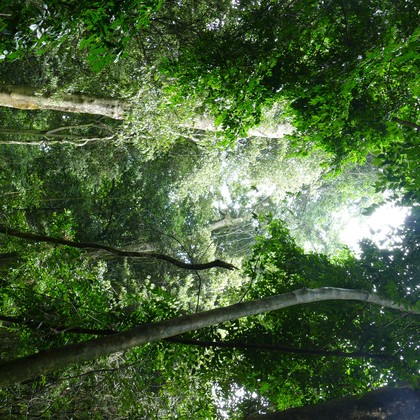
Afromontane and mistbelt forest with a dense canopy, from sea level in the south to about 1800 m; in winter part of the population moves to lower-lying forest, ravine forest and dense coastal thickets. Forages for insects in the mid-canopy and on the forest floor, and eats much fruit and many berries.
Where the bird is most at home, classified by the vegetation units of southern Africa.

Range and movements
Endemic to South Africa and Eswatini. From the Amatola Mountains and the forests of the Eastern Cape north through KwaZulu-Natal, along the Drakensberg escarpment and the Mpumalanga escarpment to the mistbelt forests of Limpopo (Magoebaskloof, Soutpansberg), with a few populations in western Eswatini. The species occurs nowhere outside this region.
- Resident
- Summer visitor (c. Oct–Mar)
- dark = core range, pale = thinly spread
How and when to look
In spring and early summer visit a montane forest such as Magoebaskloof, Hogsback or Karkloof and listen at dawn for a loud songster full of imitations high in the trees. Then look for a dark bird with an orange belly in the mid-canopy; it often sits still on a horizontal branch.
Conservation status
Not threatened. The species is locally common in protected forests, but depends on Afromontane forest, which is being fragmented by logging, exotic plantations and fire. Where the forest remains intact, numbers are stable.
Scientific name
Cossypha dichroa | (Gmelin, 1789)
Gmelin described the species in 1789 as Muscicapa dichroa; because it was later moved to another genus, the author and year stand in brackets. The genus Cossypha was introduced in 1825 by Vigors. Cossypha comes from the Greek kossyphos, 'blackbird' — for the blackbird-like build and loud, melodious song of the robin-chats. dichroa comes from the Greek dikhroos, 'two-coloured' — for the sharp contrast between the dark upperparts and orange underparts. The specimen the first description was based on came from South Africa (not specified).