All species › Passerines › Chats and flycatchers › White-Headed Robin-Chat
White-Headed Robin-Chat | Cossypha heinrichi
Rands lawaaimaker | Cosifa Cabeciblanca
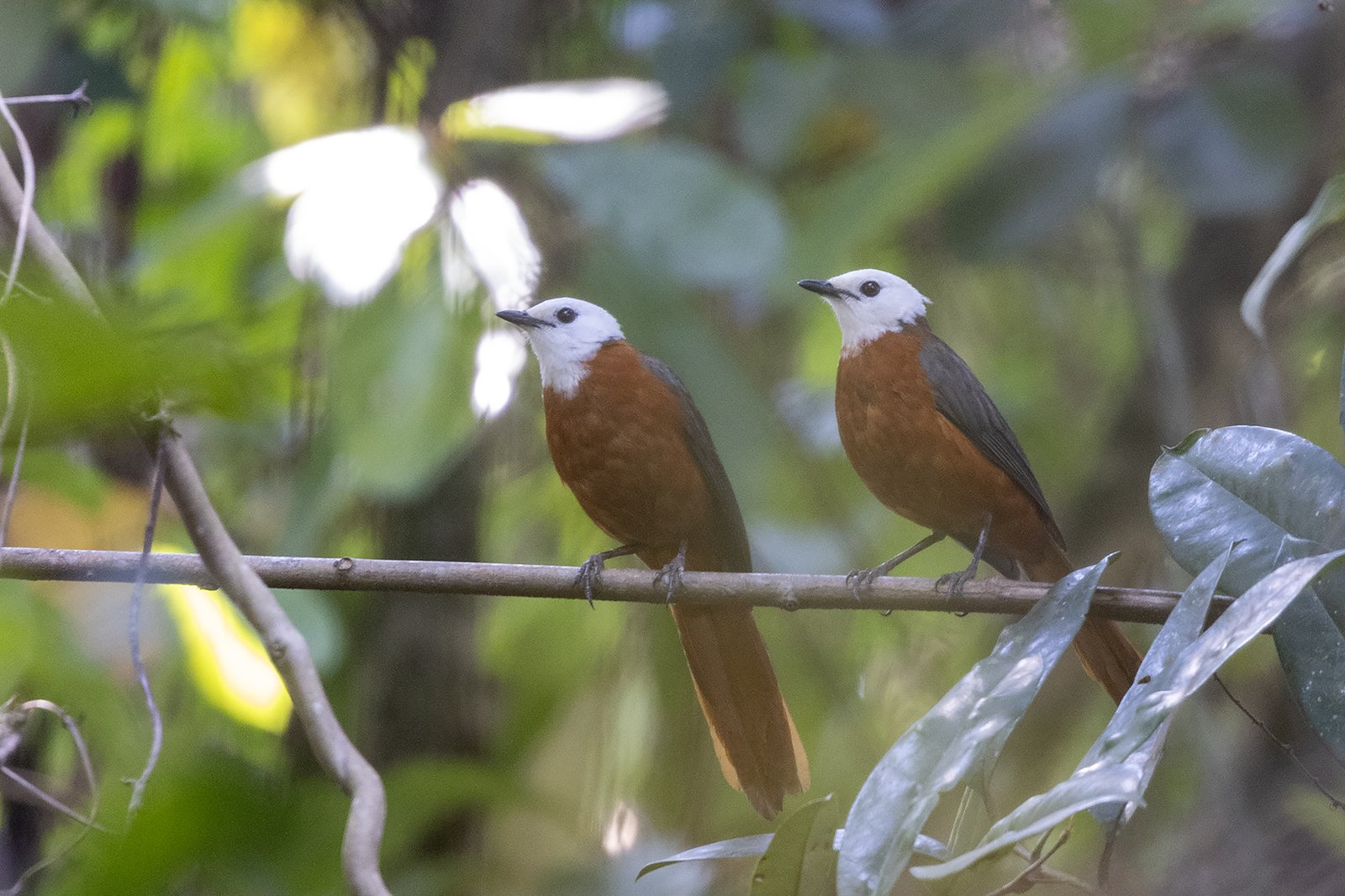
The White-Headed Robin-Chat is the largest and one of the least known robin-chats of Africa, with a striking all-white head. Within the region it is known only from a few gallery forests in northern Angola; elsewhere it lives only in a handful of isolated forest patches in south-western DR Congo.
Voice
The song consists of repeated whistles that start softly and then become much louder, in the manner of White-Browed Robin-Chat but fuller, and high, clear whistles. The bird responds very strongly to its own song. Calls and alarm are harsh, rattling notes.
Recording: Arnon Dattner — CC BY-NC-SA 4.0 · converted to mono · xeno-canto
Identification
A large, long-tailed robin-chat of 22 to 23 cm. The entire head and neck are pure white, sharply demarcated from an olive-brown mantle and a greyer back. The rump is orange-rufous, the central tail feathers black and the outer ones orange-rufous. Flight feathers blackish-brown with olive-brown edges. The underparts are warm rufous to chestnut-orange. Bill black, legs grey-brown. The sexes are alike. Lives hidden in the undergrowth, but when singing sometimes perches in the open on a low branch.
Confusion species
Within the region the all-white head is unmistakable. White-Browed Robin-Chat (Cossypha heuglini), which occurs in the same area, has a black head with only a white supercilium and is smaller. Grey-Winged Robin-Chat (Sheppardia polioptera) is much smaller, with a grey crown and an orange throat. With a glimpse in the forest, look above all for the white head and the long tail with orange sides.
Habitat
Dense undergrowth of gallery forest along streams in a savanna landscape, at around 1200–1300 m, sometimes also forest edges and the adjacent miombo. In DR Congo in isolated patches of dense forest within savanna. Forages on the ground and low in the vegetation, probably also at driver-ant swarms.
Where the bird is most at home, classified by the vegetation units of southern Africa.


Range and movements
Within the region only in northern Angola, known from a small number of sites, including the type locality near Calandula in Malanje province and the gallery forest at Kinjila. Outside the region only in south-western DR Congo, in and around the Bombo-Lumene Reserve near Kinshasa. One of the smallest ranges of any robin-chat.
- Resident
- dark = core range, pale = thinly spread
How and when to look
This species can only be found on dedicated expeditions to northern Angola. At dawn, search gallery forest and adjacent miombo at Kinjila and listen for swelling series of whistles from the undergrowth. Family parties often move about together; wait at the forest edge: in the gloom the white head is conspicuous once the bird shows itself.
Conservation status
Not threatened, despite the small range; the world population is estimated at a few thousand to fifteen thousand mature birds. The gallery forest on which it depends is under pressure from clearing, cultivation and savanna fires, so the species is being monitored.
Scientific name
Cossypha heinrichi | Rand, 1955
Rand described the species in 1955 and placed it straight away in the genus where it still stands. The genus Cossypha was introduced in 1825 by Vigors. Cossypha comes from the Greek kossyphos, 'blackbird' — for the blackbird-like build and loud, melodious song of the robin-chats. heinrichi honours the German collector Gerd Heinrich (1896–1984), who discovered the species in Angola. The specimen the first description was based on came from c. 30 km northeast of Calandula (Duque de Bragança), Angola.